Botanical species
Romulea rollii
Parl.
Zafferanetto di Rolli
Description
Morphological description
Romulea rollii is a small perennial herbaceous plant belonging to the family Iridaceae, recognizable by its biological form as a bulbous geophyte. The height ranges between 10 and 25 cm. The underground system consists of an asymmetric ellipsoid corm about 10-15 mm long, with brown tunics that tend to peel off at the apex.
The flowering stem is relatively short, generally shorter than the leaves, and in the upper part is epigeal, while the base is hypogeal (underground). The leaves are two, basal, short and sheathing, while the cauline ones are longer, with a length ranging from 15 up to 35-40 cm, thin and subcylindrical, about 0.7 mm in diameter. They are arranged prostrate on the ground and present a characteristic quadruple groove, typical of the genus Romulea.
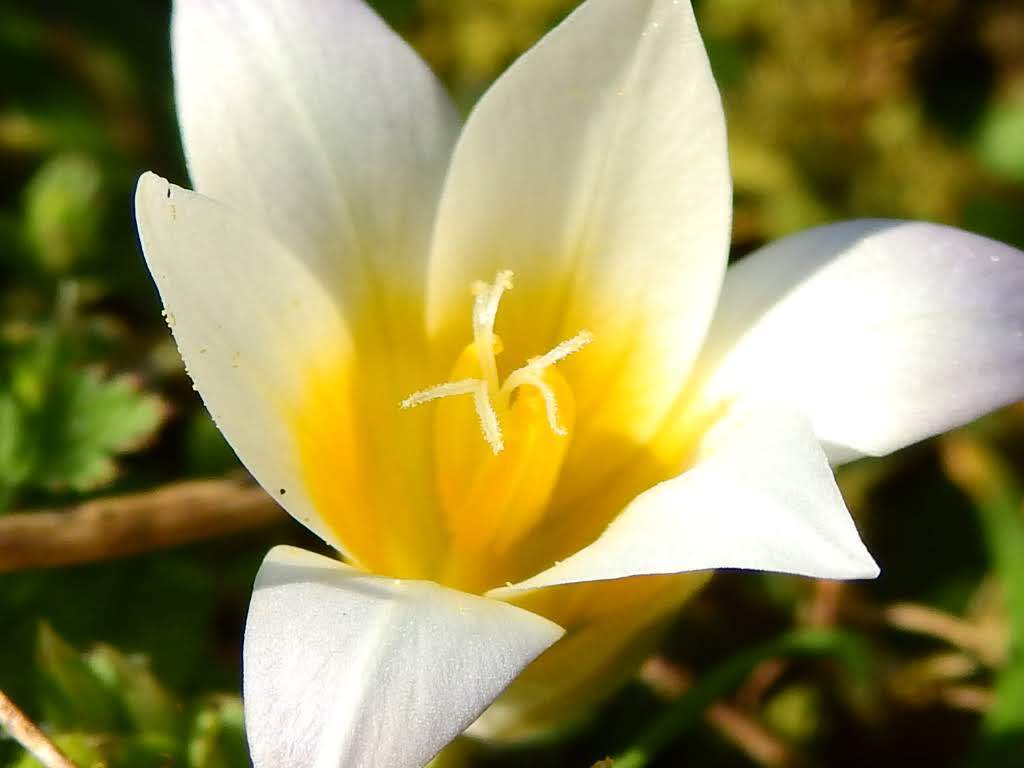
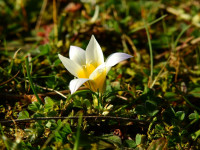
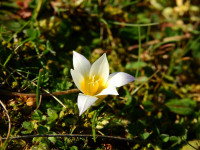
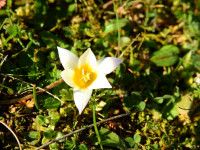
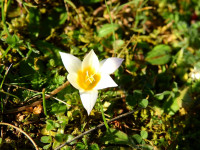
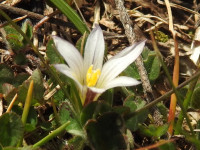
The flowers are solitary, protected by a subacute bract with a hyaline margin and by a membranous bracteole with an herbaceous median nerve. The perigonium, measuring from 15 to 22 mm, is composed of six elongated-lanceolate lobes of white color, sometimes with lilac shades, with darker stripes. The throat of the perigonium is yellowish and slightly hairy, a distinctive characteristic of the species. The stamens are about half the length of the perigonium, with hairy filaments and yellow anthers; the style is generally shorter than the apex of the anthers, a trait that distinguishes Romulea rollii from some related species.
The fruit is an ellipsoid capsule approximately 5 × 7 mm, containing spherical brown seeds.
Habitat and distribution
Romulea rollii is a typical species of the Italian Tyrrhenian coasts, with records mainly in the provinces of Pisa and between Argentario and Maremma, in Tuscany. The species prefers sandy habitats, particularly dune fields and predominantly coastal moist sands, but can occasionally be found also on river sands. It grows at low altitudes, in environments characterized by loose and well-drained soils, generally exposed to full sun or light shade conditions.
In the Mediterranean context, the genus Romulea counts about 90 species with disjunct distribution, with a main center of diversity in the Cape region and a second in the Mediterranean-Atlantic basin, to which Romulea rollii belongs. The central geographic position in the western Mediterranean favors genetic exchanges between different populations, facilitating processes of hybridization and speciation.
Flowering period
The flowering of Romulea rollii mainly occurs between February and March, a period that coincides with that of many other species of the genus. This temporal synchrony of flowering favors the possibility of natural hybridization among related species coexisting in the same habitats.
Ecology and pollination
As many species of the genus Romulea, R. rollii also shows marked phenotypic and genotypic variability that can be linked to adaptive reproductive strategies. The flowers, with their distinctive structure and color, are probably pollinated by pollinating insects attracted by the combination of white with yellowish details in the throat of the perigonium. The hairiness present on the staminal filaments may facilitate pollen transport.
Pollination is presumably entomogamous, with insects moving among species in simultaneous flowering, also favoring natural hybridization processes. Seed dispersal occurs through the capsule that opens at maturity, releasing spherical and brownish seeds, probably destined to remain near the mother plant, adapting to colonize the sandy soils of the coasts.
Curiosities and traditional uses
No ethnobotanical, medicinal, or specific food uses are known for Romulea rollii. However, the genus Romulea in general is little studied from this perspective, and Mediterranean species are often appreciated for their ornamental value, especially for the delicate flowers that resemble those of saffron, from which derives the common name "little saffron".
Etymology
The generic name Romulea probably derives from Romulus, the legendary founder of Rome, perhaps due to the abundance of some species in Italy or for a classical suggestion linked to Mediterranean flora. The specific name rollii is a tribute to the Italian botanist Giuseppe Rolli, to whom the species is dedicated.
The Italian common name "zafferanetto di Rolli" recalls the similarity of the flowers with those of saffron (Crocus sativus), although it is a different species, and recognizes the dedication to Rolli.
Sources
- (not indicated) (database piante-spontanee.it)
Characteristics
Scheda botanica
| Famiglia | Iridaceae |
|---|---|
| Fioritura | febbraio – marzo |
| Forma biologica | Bulbous |
| Habitat | with white flowers, with yellow flowers, Perennial plant |
Domande frequenti
- Quando fiorisce Zafferanetto di Rolli?
- Zafferanetto di Rolli fiorisce febbraio – marzo.
- Che tipo di pianta è Zafferanetto di Rolli?
- Zafferanetto di Rolli è una Geophytes (Bulbous) secondo la classificazione di Raunkiaer.
- A quale famiglia appartiene Zafferanetto di Rolli?
- Zafferanetto di Rolli appartiene alla famiglia botanica Iridaceae.
Where I found it (13 sightings)
Classification
- Kingdom
- Plantae
- Family
- Iridaceae
- Full name
- Romulea rollii Parl.
- Synonyms
- Romulea columnae Sebast. & Mauri subsp. rollii (Parl.) Marais
- Life form
- Geophytes bulbous
Similar species
Search for species with similar characteristicsNoticed an error in the identification? Write to me
Other species of the same family
Iridaceae

Explore
Other species of Iridaceae