Botanical species
Hermodactylus tuberosus
(L.) Mill.
Snake's-head Iris
Description
Morphological description
Perennial herbaceous plant belonging to the family Iridaceae, characterized by an erect habit and a height ranging from 20 to 40 cm. The stem is rigid, smooth, cylindrical in section, and supported by a horizontal rhizome equipped with elongated tubercles arranged in a digitiform manner. This rhizomatous system is both deep and superficial, with root fibers mixed with the tubercles, which give the plant a strong anchorage to the soil.
The leaves are all basal, arranged in a rosette, linear in shape and 30 to 70 cm long, generally longer than the flowering scape. They are quadrangular in section, with a width of 3-4 mm, and are surrounded by long sheaths without leaflets (aphyllous). The lower leaves closest to the rhizome are reduced to pale scales.
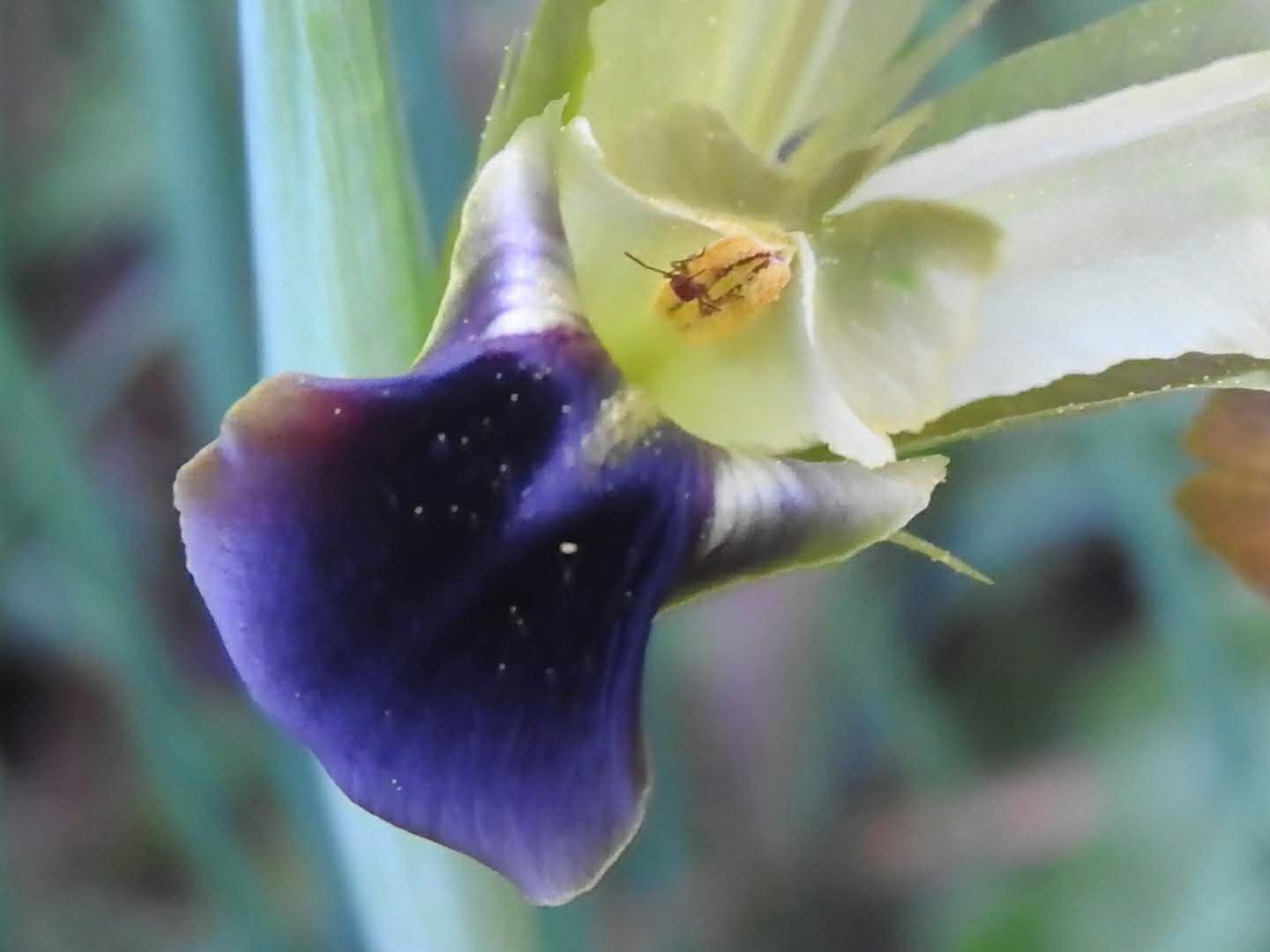
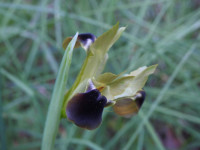
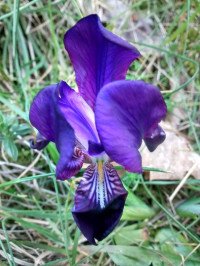
The flowers are solitary and terminal, about 5 cm in diameter, borne singly at the apex of the rigid stem. At the base of the flower there are one or two herbaceous lanceolate spathes that wrap the perigonium. The perigonium tube is shorter than the ovary. The outer tepals are ovate, violet-dull in color with yellowish edges, velvety and glabrous, with a reflexed blade and a crenate margin. The inner tepals, shorter, are erect, linear-lanceolate, green-yellowish in color. The stigmas are erect, bilobed, acuminate and yellow, shorter than the outer lobes and very developed, assuming a tepaloid shape. The ovary is unilocular, fusiform, about 1.5 cm long and extends into a short style.
The fruit is an oblong loculicidal capsule containing numerous spherical brown seeds at maturity.
Habitat and distribution
The species is widespread along the southern coasts of Europe, from Spain to Greece, also present in Italy, especially in Mediterranean and submontane regions. It preferably grows in uncultivated, grassy places, roadside edges, abandoned fields, vineyards, and olive groves. It can grow up to about 1400 meters above sea level.
It prefers sunny exposures and well-drained soils, typical of Mediterranean environments with a temperate-warm climate. It is a steno-Mediterranean species, adapted to poor and moderately dry soil conditions.
Flowering period
Flowering mainly occurs in February and March, corresponding to the end of winter and the beginning of spring. No significant geographical variations in the flowering period have been reported.
Ecology and pollination
The species reproduces through solitary flowers, which attract pollinating insects, although specific data on the main pollinators are not available. The flower structure, with reflexed outer tepals and developed stigmas, suggests an entomogamous pollination strategy, probably favored by insects such as bees and butterflies.
Seed dispersal occurs through the dehiscence of the loculicidal capsule, which releases numerous spherical brown seeds at maturity, promoting colonization of new suitable sites.
Curiosities and traditional uses
The Italian common name "Snake's-head Iris" is inspired by the elegant and dark appearance of the outer tepals, velvety and with light edges, reminiscent of mourning attire, like that of a widow. This aesthetic characteristic has contributed to the plant being appreciated for its beauty, although it is not common in commerce and is mainly known by gardening enthusiasts.
The plant is easy to cultivate but does not have a wide distribution in nurseries, probably due to its slow growth and the peculiarity of the tuberous rhizomatous system. No documented medicinal or food uses are reported, nor particular references in traditional folklore.
Etymology
The genus name derives from Greek: "ἔρμα" (hérma), meaning base or support, and "δακτυλος" (dáktylos), meaning finger, referring to the tuberous root which presents tubercles arranged like fingers. The specific name "tuberosus" refers precisely to the tuberous appearance of the roots.
The Italian common name "Snake's-head Iris" arises from the appearance of the flowers, with dark, velvety, and elegant tepals, reminiscent of a widow's mourning dress, thus emphasizing the beauty and peculiarity of this species.
Sources
- Prof. S. Pignatti, Flora d'Italia, Edagricole, Bologna, 1982
- Acta Plantarum - Flora delle regioni italiane (scheda di Mirna Medri)
Characteristics
Scheda botanica
| Famiglia | Iridaceae |
|---|---|
| Fioritura | febbraio – marzo |
| Forma biologica | Rhizomatous |
| Habitat | with blue flowers |
Domande frequenti
- Quando fiorisce Snake's-head Iris?
- Snake's-head Iris fiorisce febbraio – marzo.
- Che tipo di pianta è Snake's-head Iris?
- Snake's-head Iris è una Geophytes (Rhizomatous) secondo la classificazione di Raunkiaer.
- A quale famiglia appartiene Snake's-head Iris?
- Snake's-head Iris appartiene alla famiglia botanica Iridaceae.
Where I found it (9 sightings)
Classification
- Kingdom
- Plantae
- Family
- Iridaceae
- Full name
- Hermodactylus tuberosus (L.) Mill.
- Synonyms
- Iris tuberosa L.
- Life form
- Geophytes rhizomatous
Similar species
Search for species with similar characteristicsNoticed an error in the identification? Write to me
Other species of the same family
Iridaceae
Explore
Other species of Iridaceae