Botanical species
Romulea columnae
Sebast. & Mauri
Sand Crocus
Description
Morphological description
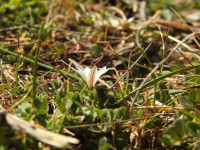
Small perennial herbaceous plant belonging to the family Iridaceae, characterized by a bulbous perennial organ of ovoid shape, called corm, which generally measures between 8 and 15 mm in diameter. The bulb is wrapped in brown tunics, which tend to dissolve in the upper part with maturation. The plant has a short stem (flowering scape), between 2 and 7 cm long, but it can also reach 15 cm during the fruiting phase.
The leaves are basal and reduced to translucent sheaths that wrap the base of the stem, while the upper leaves are narrowly linear, semicylindrical in section, striated and rigid. These leaves are generally erect during flowering, but often become curved and widen at the base of the plant during fruiting. Their length varies from 6 to 22 cm, thus exceeding the height of the flowering scape.
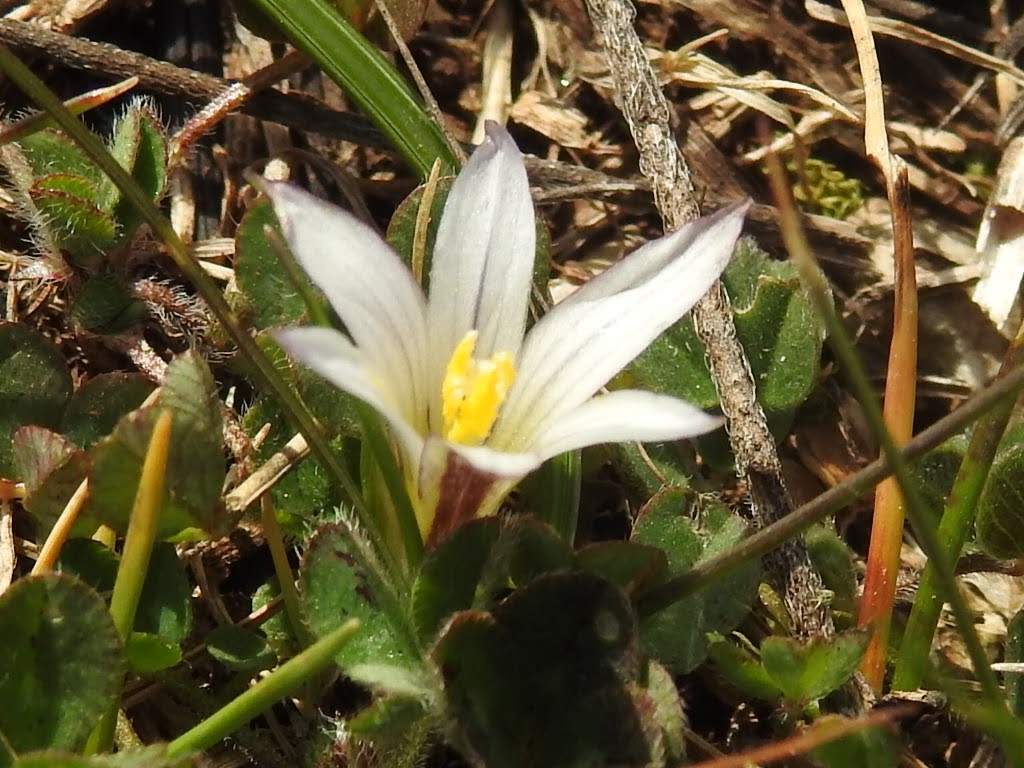
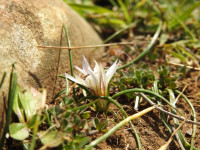
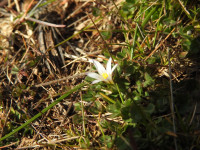
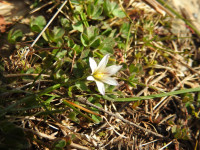
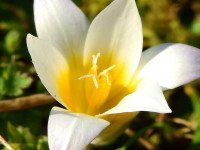
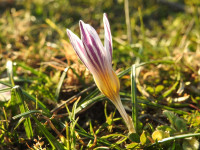
The flowers, hermaphroditic and usually single (rarely up to three on the same scape), are relatively small, with a funnel-shaped perigonium about 8-10 mm long. The tube of the perigonium is white and occupies about half the length of the lobes, which are pale lilac, white or white-yellowish, veined with fine dark violet lines. The throat of the perigonium is glabrous and yellow, while the style is short and does not exceed the length of the anthers, which carry yellow pollen masses.
The floral spathes are cauline and paired: the upper spathe is membranous and translucent with a prominent herbaceous median nerve, while the lower one is herbaceous with a membranous margin. The fruit is a laterally compressed obovoid loculicidal capsule, 5-12 mm long and about 0.8-1 mm in diameter.
Habitat and distribution
The species is a typical narrow Mediterranean entity, with a range distributed along the coasts of the Mediterranean basin, also known as belonging to the "Olive area". In Italy, its habitat includes meadows in Mediterranean maquis, pastures and mown meadows, where it prefers generally sunny soils with open exposure.
The growth altitude ranges from 0 up to about 600 meters, but in southern regions and the major islands it can be found up to 1000 meters above sea level.
Flowering period
Flowering mainly extends from January to April. Possible geographic variations may slightly shift the flowering period, particularly in southern areas where the first flowers may appear earlier due to the milder climate.
Ecology and pollination
The plant exhibits a reproductive strategy typical of Mediterranean bulbous geophytes, with hermaphroditic flowers that open in an early spring period. Pollination is mediated by pollinating insects, mainly attracted by the pale lilac color of the lobes and the yellow of the perigonial throat, which can serve as a visual guide for pollinators.
Seed dispersal occurs through release from loculicidal capsules, whose obovoid and compressed shape may favor rapid fall near the mother plant, typical of herbaceous species of Mediterranean meadows.
Curiosities and traditional uses
No particular ethnobotanical, medicinal or food applications are known for this species. Its interest is mainly botanical and naturalistic, being a typical species of Mediterranean meadow and pasture communities, with a role in the floristic biodiversity of Italian and Mediterranean coastal areas.
Etymology
The genus name "Romulea" derives from Romulus, legendary founder and first king of Rome, thus linking the plant to a symbol of Italian history and culture. The specific name "columnae" is a tribute to Fabio Colonna (1567-1650), an important naturalist and pioneer of pre-Linnaean botany, recognizing his contribution to the history of botany.
The Italian common name "Sand Crocus" refers to the similarity of the flowers to those of saffron (Crocus sativus), although it is a distinct species of smaller size, and directly recalls the naturalist Colonna.
Sources
- Acta Plantarum - Flora delle regioni italiane (actaplantarum.org)
- Acta Plantarum - Flora delle regioni italiane (scheda di Umberto Ferrando)
Characteristics
Scheda botanica
| Famiglia | Iridaceae |
|---|---|
| Fioritura | gennaio – aprile |
| Forma biologica | Bulbous |
| Habitat | with white flowers |
Domande frequenti
- Quando fiorisce Sand Crocus?
- Sand Crocus fiorisce gennaio – aprile.
- Che tipo di pianta è Sand Crocus?
- Sand Crocus è una Geophytes (Bulbous) secondo la classificazione di Raunkiaer.
- A quale famiglia appartiene Sand Crocus?
- Sand Crocus appartiene alla famiglia botanica Iridaceae.
Where I found it (15 sightings)
Classification
- Kingdom
- Plantae
- Family
- Iridaceae
- Full name
- Romulea columnae Sebast. & Mauri
- Life form
- Geophytes bulbous
Similar species
Search for species with similar characteristicsNoticed an error in the identification? Write to me
Other species of the same family
Iridaceae
Explore
Other species of Iridaceae