Botanical species
Iris germanica
L.
Bearded Iris
Description
Morphological description
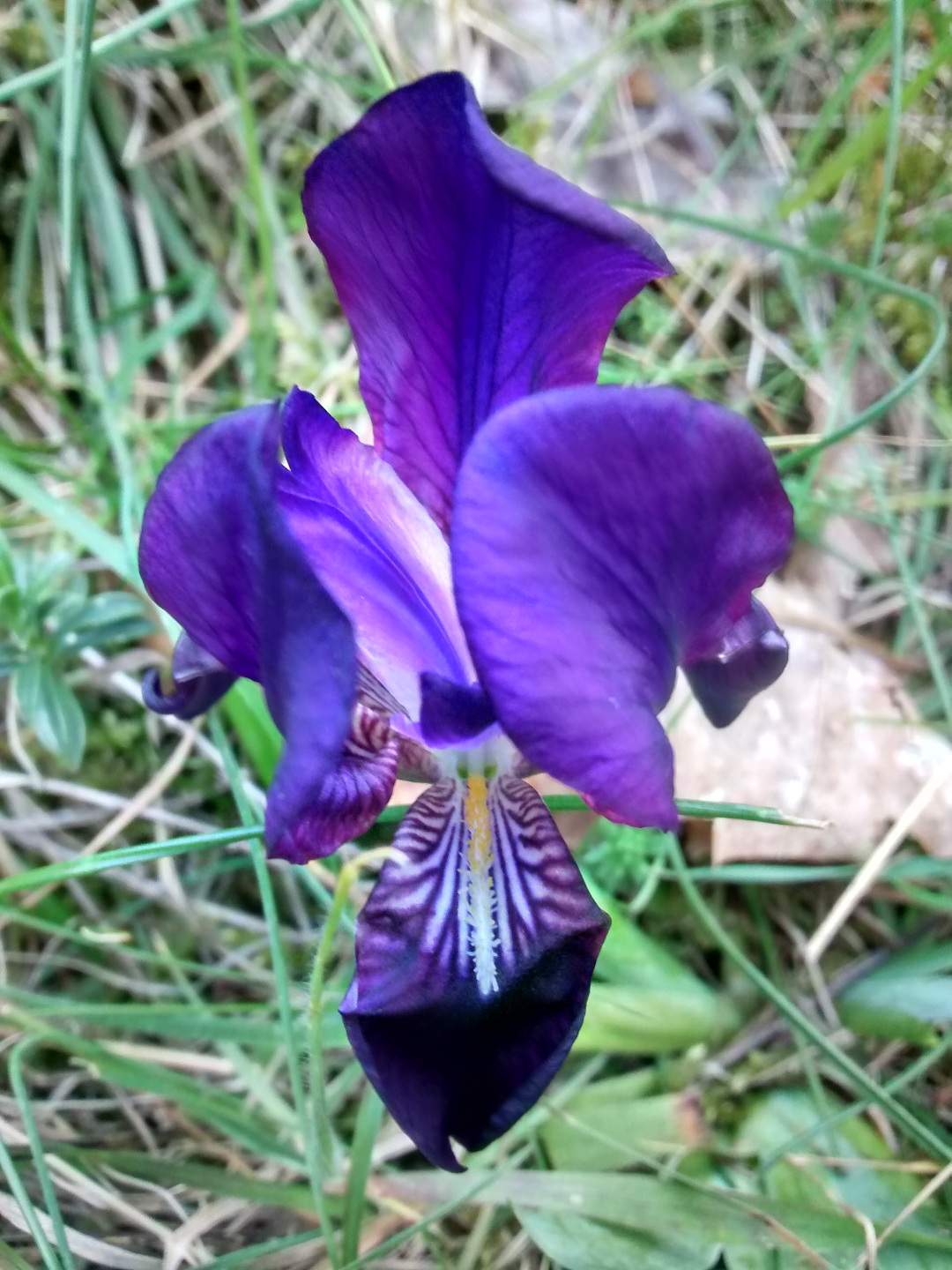
Perennial herbaceous plant between 50 and 120 cm tall, with an erect habit and cylindrical stem, sometimes slightly compressed, robust and branched. The stem can reach about 1 m in height, bearing 2 to 5 large flowers, usually subsessile or with short peduncles, wrapped by broad bracts, white-membranous in the upper half and often colored purple.
The leaves are almost all basal, glaucous green in color, with parallel veins typical of monocotyledons, linear-lanceolate in shape, often defined as "ensiniform" or sword-shaped, up to 4-5 cm wide and 40-70 cm long, with an acute apex. The cauline leaves, shorter and scarious, clasp the stem.
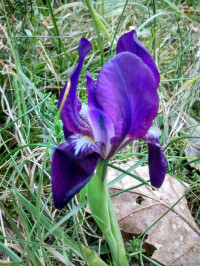
The flowers are large, about 10 cm in diameter, characterized by six tepals: three outer recurved and wavy, bearing in the center a "beard" of yellowish or whitish hairs, and three inner tepals lighter in color, also wavy and crisped at the margins, which act as styles. The predominant color is blue-violet or intense violet, with shades sometimes tending to lavender or white. The scent is generally absent or very faint.
The stamens are white or pale violet in color, with anthers as long as the filament. The style is about 3.5-4.5 cm long, with divergent oval-shaped lobes. The ovary is inferior.
The root system consists of a fleshy, thick, creeping and aromatic rhizome, which emits fasciculate roots. The rhizome plays a fundamental role in vegetative reproduction and plant perennation.
The fruit is an ovoid capsule, slightly triangular, 3-5 cm long, containing black, discoid and shiny seeds, which rarely develop due to frequent capsule abortion.
Habitat and distribution
Species of uncertain origin, probably allochthonous but widely naturalized, the Bearded Iris is widespread throughout the Italian territory, from the plains up to about 1,200 meters altitude. It prefers warm and sunny environments, such as vegetable gardens, gardens, grassy slopes also stony, walls and rocks, particularly on well-drained substrates.
In the Mediterranean area and in central and southern Europe, it is commonly found in rocky habitats, vineyards, dry stone walls and embankments, often as a subspontaneous or naturalized species. In Italy it is present in almost all regions and can be considered a typical plant of anthropized environments with conditions of light exposure and dry or moderately moist soils.
Flowering period
The flowering extends from April to June, with possible variations related to altitude and latitude. Under favorable conditions, the period can start as early as late March and continue until July in warmer areas or with favorable microclimate.
Ecology and pollination
The Bearded Iris is a xerophilous and thermophilous plant, well adapted to poor soil conditions and sunny exposure. Reproduction occurs both vegetatively through the rhizome and by entomogamous pollination, mainly carried out by pollinating insects such as bees and bumblebees attracted by the color and structure of the flower.
The flowers, equipped with a characteristic "beard" of hairs on the surface of the outer tepals, facilitate pollination by guiding insects towards the reproductive organs. Seed dispersal is limited and ineffective, contributing to the prevalence of vegetative propagation.
Curiosities and traditional uses
The rhizome of the Bearded Iris, harvested in summer from adult plants, has been known since ancient times for its medicinal properties. It contains starch, mucilages, essential oils with violet scent (irone), resins and coloring substances. Traditionally it has been used as a diuretic, depurative, expectorant and cholagogue, useful for disorders such as headaches, migraines, inflammations of the respiratory and digestive tracts. At high doses it can have purgative and emetic effects, while fresh parts are toxic.
In cosmetics, the powder obtained from the dried rhizome was used to perfume face powders and toothpastes, while iris essence is a precious ingredient in modern perfumery. Historically the rhizome was also used to scent linen and as a sternutatory.
In the past, small rhizome balls, the "Piselli di Parigi," were prepared and used in pharmacies as cauteries. The oil in which the rhizome was fried was applied to relieve muscle and rheumatic pains. In Florence, the “Giardino dell’Iris” near Piazzale Michelangelo testifies to the cultural and botanical importance of the species.
Etymology
The scientific name “Iris” derives from ancient Greek Ἶρις, meaning “rainbow,” referring to the multiple colors of the flowers of the genus. In Greek myth, Iris was the messenger of the gods and personification of the rainbow, serving as a link between heaven and earth.
The Italian common name “giaggiolo” probably derives from the Latin “giaculum” (javelin), alluding to the elongated sword-shaped leaves.
Sources
- Acta Plantarum - Flora delle regioni italiane (scheda di Stefania Tomassini)
- Tela Botanica / H. Coste, "Flore descriptive et illustrée de la France"
- World Flora Online (WFO)
Characteristics
Scheda botanica
| Famiglia | Iridaceae |
|---|---|
| Fioritura | aprile – giugno |
| Forma biologica | Rhizomatous |
| Habitat | with purple flowers, with blue-purple flowers |
Domande frequenti
- Quando fiorisce Bearded Iris?
- Bearded Iris fiorisce aprile – giugno.
- Che tipo di pianta è Bearded Iris?
- Bearded Iris è una Geophytes (Rhizomatous) secondo la classificazione di Raunkiaer.
- A quale famiglia appartiene Bearded Iris?
- Bearded Iris appartiene alla famiglia botanica Iridaceae.
Where I found it (2 sightings)
Classification
- Kingdom
- Plantae
- Family
- Iridaceae
- Full name
- Iris germanica L.
- Synonyms
- Iris alba Savi; Iris albicans auct., non Lange; Iris florentina auct., non L.; Iris germanica L. subsp. albicans auct., non (Lange) O.Bolòs & Vigo; Iris germanica L. var. florentina auct., non (L.) Dykes; Iris pallida Lam. x Iris variegata L.; Iris sambucina L.; Iris squalens L.
- Life form
- Geophytes rhizomatous
Similar species
Search for species with similar characteristicsFurther reading
Noticed an error in the identification? Write to me
Other species of the same family
Iridaceae
Explore
Other species of Iridaceae