Botanical species
Gladiolus italicus
Mill.
Italian Gladiolus
Description
Morphological description
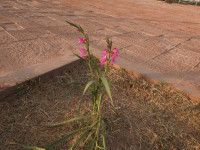
Perennial herbaceous plant belonging to the Iridaceae family, it has an erect habit with a height ranging from 40 to 80 cm. The stem is glabrous, robust, and cylindrical, wrapped for a good part of its length by the leaves. The root system consists of a globular bulb, about 2 cm in diameter, covered by fibrous tunics, parallel and reticulated in the upper part, which ensure its perenniality in the soil.
The leaves are generally 3 to 5, spathiform, lanceolate and narrow, with an acuminate apex and well-defined parallel veins. They can reach a length of about 65 cm, with a width ranging between 8 and 22 mm. The leaf blade is flat and green in color, contributing to characterize the plant as evergreen.
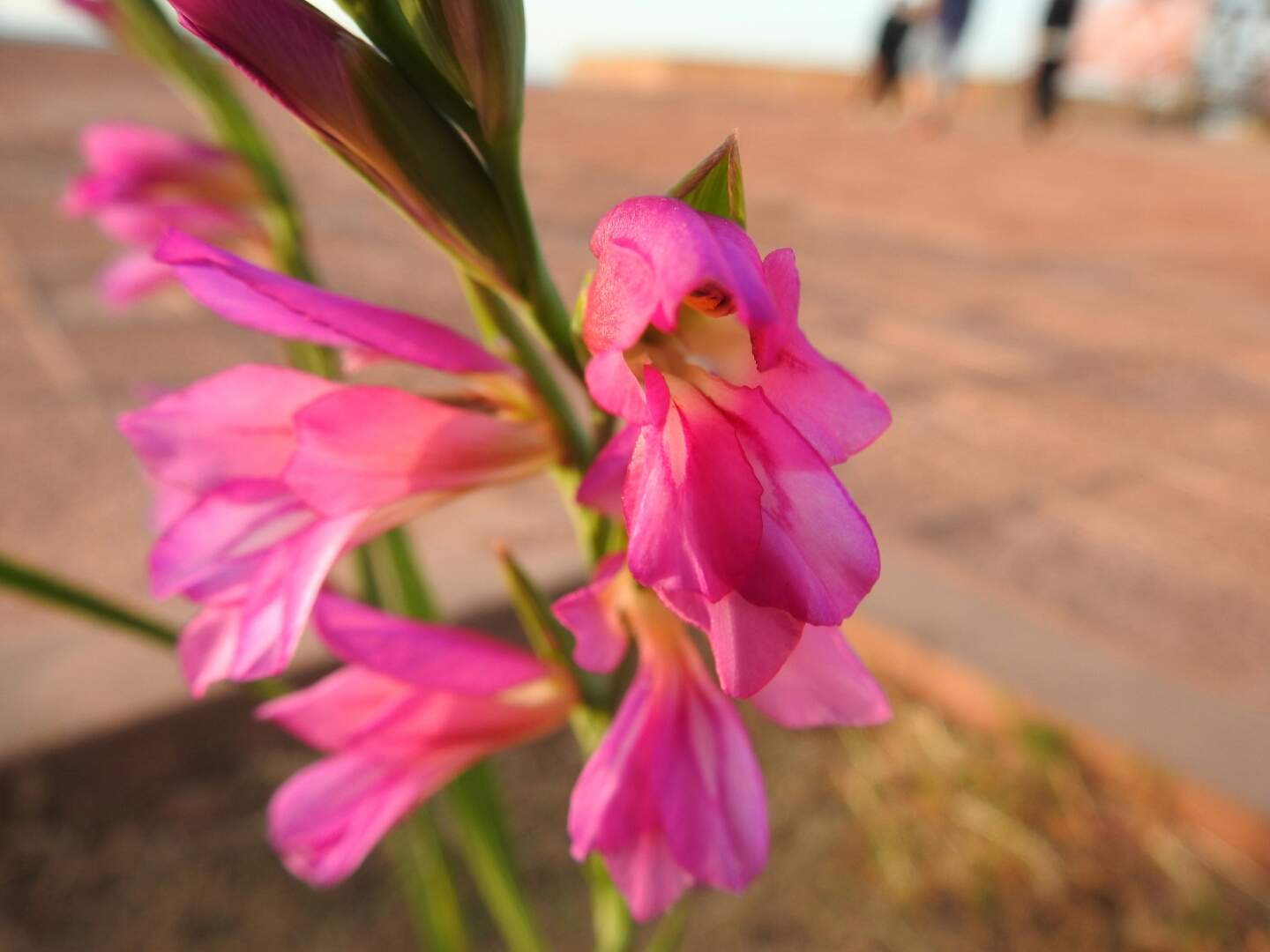
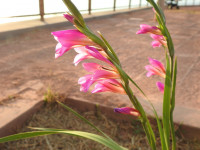
The inflorescence consists of a terminal spike, subunilateral and distichous, bearing 6 to 10 large flowers, with colors ranging from pale pink to intense fuchsia, sometimes with lighter streaks, especially on the middle part of the lower tepals. The flowers are strongly characterized by unequal tepals: the upper tepals are longer and wider, with the median tepal often marked by a whitish central streak, while the lateral tepals are narrower and oblong-cuneiform. The perianth has an obliquely funnel-shaped tube about 10-12 mm long. The anthers are longer than the filaments supporting them, with divergent auricles, and the stigmas are spatulate in shape, progressively narrowed towards the base.
The fruit is a subspherical capsule, triquetrous with rounded angles, containing globose or slightly angular seeds, without wings, red in color and about 2-3 mm in diameter. These seeds lack winged structures, so their dispersal occurs mainly by falling or with the aid of external agents such as animals or water.
Habitat and distribution
The Italian Gladiolus is a typical species of Mediterranean regions, with a distribution extending from the Mediterranean basin to more northern and eastern areas of Europe. In Italy it is present in many regions, from the plains up to about 700 meters altitude, preferring marginal environments to cultivated fields, especially cereals, grassy fallows, and olive groves. Once common, it has now become rarer due to modern agricultural practices such as chemical weeding and deep soil tillage that destroy the bulbs.
The species grows on well-drained soils, often calcareous or clayey, in sunny or semi-shaded exposures, generally in mountainous and hilly environments. It is considered a commensal plant, i.e., living in close association with human cultivations, but in marginal environments not intensively disturbed.
Flowering period
Flowering mainly occurs between April and May, with possible geographical variations: in the southern areas and at lower altitudes it can start as early as late April, while in cooler or mountainous zones it can extend until June. Individual flowers remain open for several days, together forming a visually very showy flowering spike thanks to the bright colors.
Ecology and pollination
The Italian Gladiolus reproduces mainly sexually through seeds produced by mature capsules. Pollination is entomogamous, mediated by pollinating insects attracted by the bright color of the flowers, particularly bees and butterflies, which facilitate cross-fertilization. The shape and arrangement of the tepals favor insect access inside the flower, facilitating contact with the reproductive organs.
Seed dispersal occurs mainly by falling near the mother plant, but can be facilitated by small animals or weather events that promote wider diffusion. The presence of a deep tuberous bulb allows the plant to survive mowing and periods of drought, an important characteristic for species living in environments subject to agricultural and climatic disturbances.
Curiosities and traditional uses
The Italian Gladiolus, although not particularly known for medicinal or food uses, was in the past appreciated for its ornamental beauty and as an ecological indicator of little disturbed cultivated environments. In some areas the plant was called by popular names such as “spadacciuola” or “spadina,” referring to the shape of the leaves.
No significant medicinal or food uses are documented, nor particular legends or folklore associated with this species. Its presence in cultivated fields testifies to an ancient link with traditional Mediterranean agriculture, and its current rarity highlights the impact of modern agricultural practices on biodiversity.
Etymology
The genus name “Gladiolus” derives from the Latin "gladius," meaning “sword,” referring to the shape of the narrow and lanceolate leaves, similar to small swords. The specific epithet “italicus” recalls the geographical area of greatest distribution of the species, namely Italy, with a historical reference to the region of ancient Bruttium (present-day southern Calabria), the first part of the Italian peninsula to be called “Italy” in ancient times.
The Italian common name “gladiolo dei campi” is a direct and descriptive translation of the species, emphasizing its typical presence in agricultural and cultivated environments.
Sources
- Acta Plantarum - Flora delle regioni italiane (scheda di Marinella Zepigi)
- Tela Botanica / H. Coste, "Flore descriptive et illustrée de la France"
- World Flora Online (WFO)
Characteristics
Scheda botanica
| Famiglia | Iridaceae |
|---|---|
| Fioritura | aprile – maggio |
| Forma biologica | Bulbous |
| Habitat | with fuchsia flowers |
Domande frequenti
- Quando fiorisce Italian Gladiolus?
- Italian Gladiolus fiorisce aprile – maggio.
- Che tipo di pianta è Italian Gladiolus?
- Italian Gladiolus è una Geophytes (Bulbous) secondo la classificazione di Raunkiaer.
- A quale famiglia appartiene Italian Gladiolus?
- Italian Gladiolus appartiene alla famiglia botanica Iridaceae.
Where I found it (5 sightings)
Classification
- Kingdom
- Plantae
- Family
- Iridaceae
- Full name
- Gladiolus italicus Mill.
- Synonyms
- Gladiolus segetum Ker Gawl.; Gladiolus spathaceus Parl.
- Life form
- Geophytes bulbous
Similar species
Search for species with similar characteristicsFurther reading
Noticed an error in the identification? Write to me
Other species of the same family
Iridaceae
Explore
Other species of Iridaceae