Botanical species
Crocus biflorus
Mill.
Silvery Crocus
Description
Morphological description
Small-sized bulbous geophyte, generally 10 to 15 cm tall, rarely up to 20 cm. The bulb (corm) is oval, with a maximum diameter between 1 and 2 cm, sometimes slightly compressed at the poles, wrapped in papery tunics of brown-rust or brown-yellowish color, which tend to detach at the base forming rings. The tunics can be whole or shredded into fibers, depending on the populations.
The leaves are filiform, linear and thin, with a width of 1-2 mm and a length that reaches or slightly exceeds that of the flowers (up to 20-22 cm). They are dark green with a characteristic white longitudinal line running along the entire leaf blade. The lower leaves are reduced to basal sheaths (spathes), while the upper ones are well developed and erect.
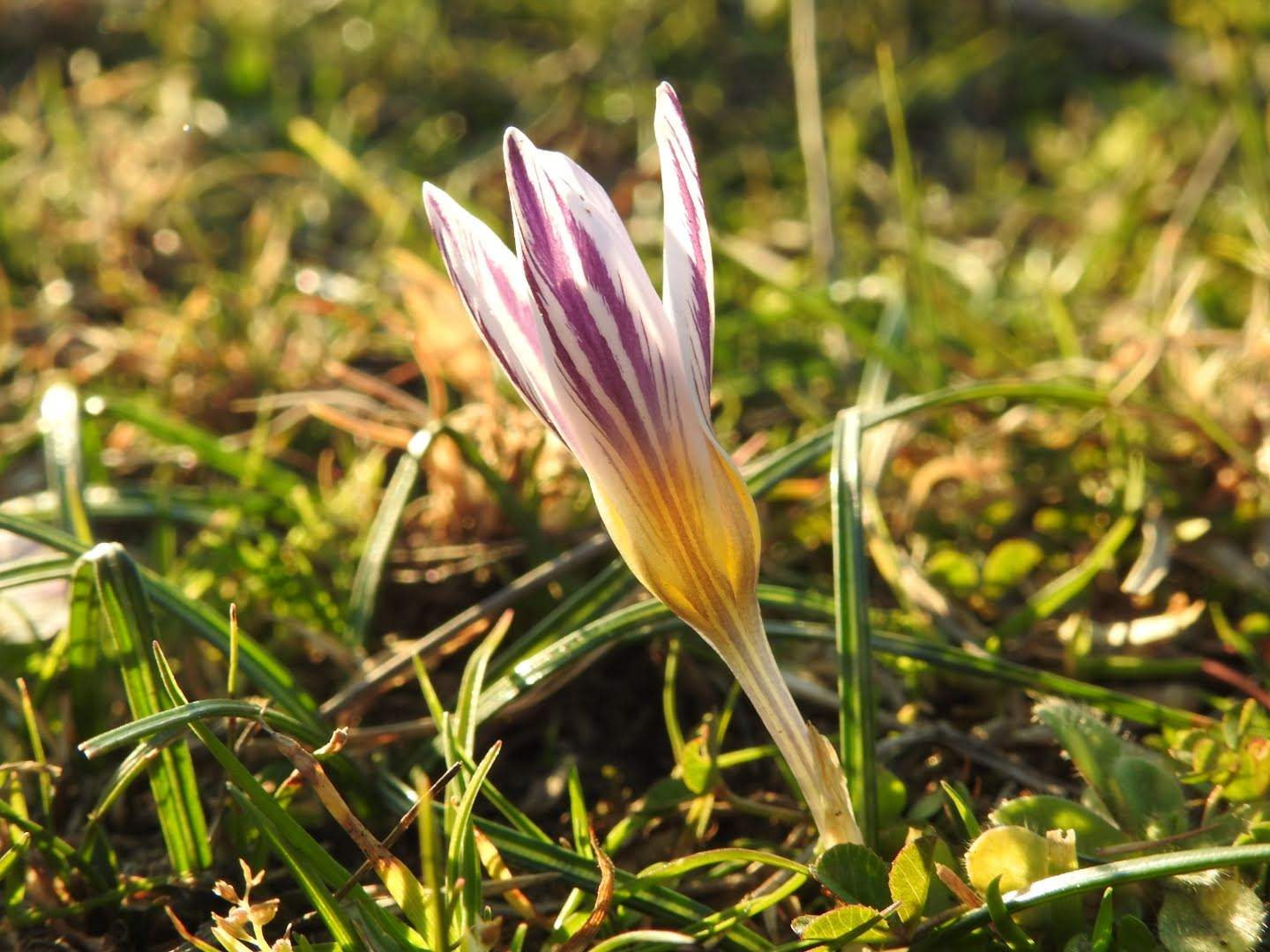
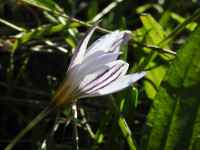
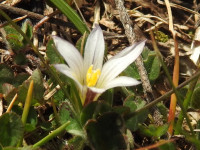
The flowers are generally 1-4 per plant, often 2, of variable size with a perigon diameter that can reach up to 5 cm. The perigon is formed by elliptical lobes, 20 to 35 mm long and 10-14 mm wide, violet or light violet on the outside and darker inside, often with 3-5 darker longitudinal stripes. In some specimens the lobes can be lighter or even white-yellowish. The base of the perigon (the throat) is yellow and clearly visible.
The stamens have white and hairy filaments, about half the length of the anthers, which measure between 8 and 10 mm and are about twice as long as the filaments. The stigmas have a reddish-orange coloration and are generally lobed, a feature that recalls the genus name. The spathes (leaf sheaths that wrap the base of the flowers) are usually 2-3, 6-9 mm wide and loosely wrap the base of the flowers.
The fruit is a capsule containing seeds, but precise details on its morphology or dispersal mode are not available. The root system consists of the bulb or corm, a perennial organ from which leaves and flowers develop every year.
The species shows considerable morphological variability, especially regarding the size, coloration and shape of the perigon lobes, as well as the structure of the bulb tunics. This variability is particularly evident in southern Italian populations.
Habitat and distribution
Silvery Crocus is an Italian endemic species, naturally present in almost all regions of the Peninsula, with a rather discontinuous distribution. It is mainly widespread along the western slopes, from Sicily to Tuscany, while north of the Arno line it becomes very rare. It is also frequent along the Ionian and lower Adriatic coasts, up to Gargano, while it is rare or sporadic in the inland areas and in the middle-upper Adriatic side, as well as in Emilia, Veneto and Lombardy (more common in the Brescia and Bergamo areas). It sporadically reaches Liguria and Piedmont, where the northwestern limits of its range are found. It is absent in the Ligurian and Piedmontese Alps, and absent in Friuli and eastern Veneto, with local exceptions requiring further confirmation.
The typical habitat includes open woods and forest edges, pastures and anthropized environments such as vineyards and olive groves. The species prefers well-drained soils, preferably calcareous or neutral, and develops from near sea level up to about 1200 meters altitude.
Flowering period
Flowering extends from January to April, with variations linked to altitude and latitude. In southern regions and milder environments flowering begins early, already in January or February, while in more northern or mountainous areas flowers appear later, up to April.
Ecology and pollination
The flowers are generally odorless, although in some southern populations they may have a slight scent. Pollination mainly occurs through pollinating insects, especially bees and other hymenopterans attracted by the bright colors of the perigon and the presence of nectar in the yellow throat.
The species has a predominantly sexual reproductive strategy, producing seeds enclosed in capsules. Seed dispersal presumably occurs by gravity and through small animals, but no specific data on dispersal modes are available.
Curiosities and traditional uses
Silvery Crocus, although similar in appearance to cultivated saffron (Crocus sativus), is not used in agriculture for spice production. However, it contains alkaloids such as crocin and picrocrocin, which confer emmenagogue, hypnotic-sedative, stimulating and tonic properties, mainly attributed to the stigmas. The latter are slightly toxic and discourage uncontrolled domestic or food use.
In the past, the corms were used as a food source due to their starch richness and pleasant taste. However, food use is now rare and discouraged due to toxicity. The species is considered medicinal but with caution, and any medicinal use must be carried out under specialist supervision.
Etymology
The generic name Crocus derives from the Greek "krokos", meaning "filament" or "stigma", referring to the characteristic fringed stigmas of many species of the genus. The specific epithet biflorus refers to the frequent presence of two flowers per bulb, a distinctive feature of this species.
The Italian common name "zafferano selvatico" recalls the similarity with cultivated saffron, although it is a different and spontaneous species, with different properties and uses.
Sources
- Acta Plantarum - Flora delle regioni italiane (actaplantarum.org)
- Acta Plantarum - Scheda di Umberto Ferrando
Characteristics
Scheda botanica
| Famiglia | Iridaceae |
|---|---|
| Fioritura | gennaio – aprile |
| Forma biologica | Bulbous |
| Habitat | with purple flowers, with fragrant flowers |
Domande frequenti
- Quando fiorisce Silvery Crocus?
- Silvery Crocus fiorisce gennaio – aprile.
- Che tipo di pianta è Silvery Crocus?
- Silvery Crocus è una Geophytes (Bulbous) secondo la classificazione di Raunkiaer.
- A quale famiglia appartiene Silvery Crocus?
- Silvery Crocus appartiene alla famiglia botanica Iridaceae.
Where I found it (7 sightings)
Classification
- Kingdom
- Plantae
- Family
- Iridaceae
- Full name
- Crocus biflorus Mill.
- Life form
- Geophytes bulbous
Similar species
Search for species with similar characteristicsFurther reading
Noticed an error in the identification? Write to me
Other species of the same family
Iridaceae
Explore
Other species of Iridaceae