Botanical species
Geranium rotundifolium
L.
Round-Leaved Crane's-Bill
Description
Morphological description
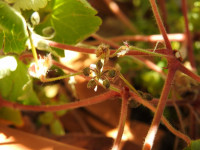
Annual herbaceous plant, Geranium rotundifolium presents a prostrate or ascending habit, reaching a height ranging from 10 to 40 cm. The stem is branched, zigzagging, and reddish in color, densely covered by a thick pubescence composed of glandular and simple hairs, giving the whole a rough and hairy appearance. The roots are taproots, a typical feature that allows the plant to anchor firmly to the ground.
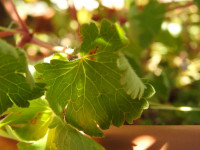
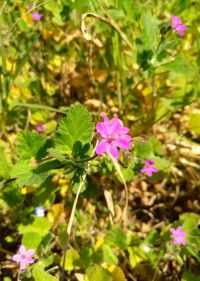
The leaves are opposite, with a petiole 2 to 3 cm long, and have a semicircular or orbicular blade measuring between 2 and 6 cm in width and length. The blade is palmately lobed, divided into 5 lobes deeply incised up to about two-thirds of the length, each ending in tridentate shapes or with crenate-dentate margins. The leaf surface is dull, villous and hairy, often with red spots at the base of the incisions, which can help in recognizing the species.
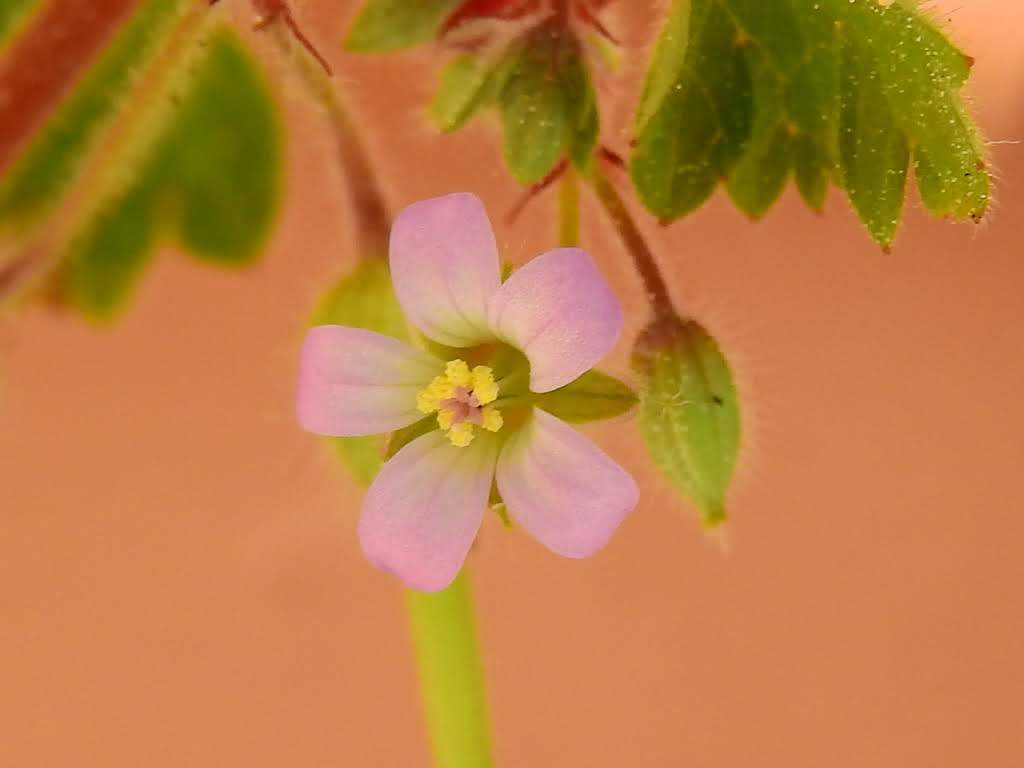
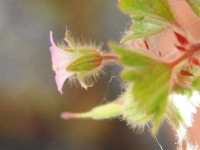
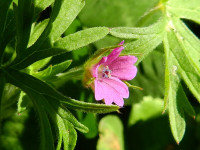
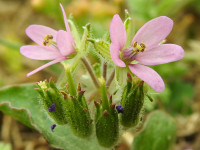
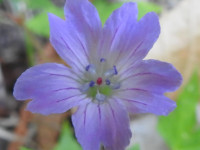
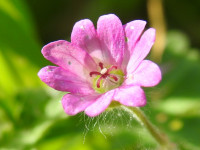
The inflorescence consists of two-flowered cymes on pubescent peduncles, with pedicels 0.7 to 2 cm long, also provided with glandular hairs. The flowers are hermaphroditic, actinomorphic, pentamerous and dialypetalous. They have five entire petals, pink-violet with whitish shades at the base, 4 to 7 mm long, with a rounded or slightly truncate apex. The sepals are five, 3.5 to 6 mm long, hairy and with a short mucronate apex. The stamens are ten, with filaments ciliate at the base and violet or yellowish anthers.
The ovary is superior, composed of five carpels. The fruit is an erect schizocarp, 1.6 to 1.8 cm long, with five smooth, brown mericarps equipped with spreading hairs. The fruit beak, typical of the genus, measures about 1.2-1.3 cm and is covered with spreading hairs. The seeds are reticulated, brown, about 1.8-2 mm long. Flowering is followed by the maturation of these characteristic fruits, which facilitate dispersal.
Habitat and distribution
Geranium rotundifolium is a species widespread in Italy and much of the Mediterranean area, extending from Europe to North Africa. In Italy it is common in hilly and lower mountainous areas, preferring ruderal environments, meadows, cultivated fields, walls, gardens, vegetable gardens and especially vineyards, where it often grows as a spontaneous species. It grows up to moderate mountain altitudes, generally below the high mountain belt.
It prefers well-drained soils, often calcareous or poor, with sunny or partially shaded exposure. It adapts well to dry or disturbed soils, typical of anthropized areas or roadside embankments.
Flowering period
Flowering mainly occurs between May and June, with a possible extension until July in some areas. Depending on altitude and local climatic conditions, flowering may show slight temporal variations, occurring earlier or later by a few weeks. Fruit maturation generally occurs between June and July.
Ecology and pollination
Geranium rotundifolium reproduces through entomogamous pollination, favored by pollinating insects attracted by the pink-violet color of the flowers and their whitish shades at the base of the petals. The pentamerous structure and numerous stamens facilitate cross-pollination, ensuring good genetic variability.
Seed dispersal occurs through the schizocarp fruit equipped with a long beak, whose shape resembles the bill of a crane, which favors detachment and distribution in the surrounding soil. The hairs present on the fruit and beak can facilitate adhesion to substrates or animals, increasing the possibility of dispersal over greater distances.
Curiosities and traditional uses
No significant traditional food or medicinal uses are reported for this specific species. However, the common name “malvaccino” could derive from a popular distortion due to the similarity of the leaves with those of other plants of little value or “malvagious.” The genus Geranium, in general, is known for its symbolism related to protection and health in European folk traditions, but there are no certain sources directly linking this species to such uses.
Etymology
The genus name “Geranium” derives from the Greek “géranos,” meaning “crane,” referring to the characteristic shape of the fruit that resembles the elongated beak of this bird. The specific epithet “rotundifolium” refers to the rounded shape of the leaves, which represents a distinctive characteristic of the species.
The Italian name “geranio malvaccino” is probably linked to the appearance of the leaves, which may resemble those of plants belonging to different groups, or to an ancient dialect term indicating a plant considered of little use or “malvagious.”
Sources
- Prof. S. Pignatti, "Flora d'Italia"
- Acta Plantarum - Flora delle regioni italiane (sheet by Roberta Alberti)
- World Flora Online (WFO)
Characteristics
Where I found it (9 sightings)
Classification
- Kingdom
- Plantae
- Family
- Geraniaceae
- Full name
- Geranium rotundifolium L.
- Life form
- Terofite scapose
Similar species
Search for species with similar characteristicsNoticed an error in the identification? Write to me
Other species of the same family
Geraniaceae

Explore
Other species of Geraniaceae