Botanical species
Anemone coronaria
L.
Poppy Anemone
Description
Morphological description
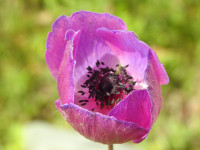
Perennial bulbous herbaceous plant, Anemone coronaria has a single, erect but slightly sinuous stem, reaching a height between 20 and 40 cm. The stem is swollen at the base and may be flexible; in the upper part it can be slightly pubescent. The root system consists of a brownish tuber, from which stems and leaves develop every year.
The basal leaves are ternate-pinnatisect or bipinnate, divided into narrow and linear divergent lobes, with a generally hairy lower surface. The cauline leaves, on the other hand, form a characteristic bracteal involucre arranged in a crown just below the flower; these bracts have a widened base with a thickly fringed edge and are also deeply divided into narrow and elongated lobes.
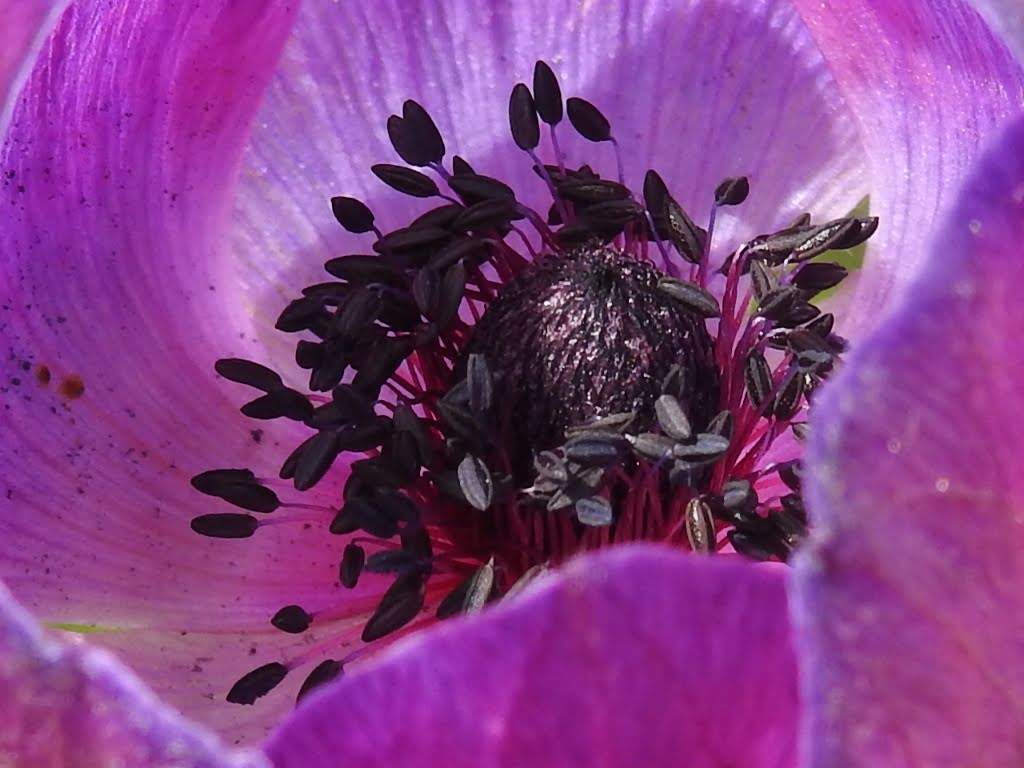
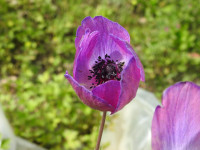
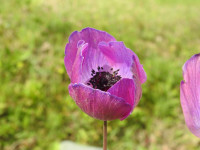
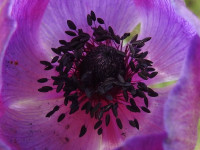
The flowers are solitary and large, with a diameter ranging from 3.5 to 6.5 cm. They are composed of 5-8 petaloid sepals of elliptic-rounded, ovate or subround shape, with margins sometimes dentate or lobed. The color of the sepals varies widely: from white to violet, from fuchsia to red, up to bluish-violet shades, depending on the varieties and populations. The anthers are bluish-violet or bluish in color, another distinctive trait of the species.
The fruits are woolly carpels, with a short glabrous beak. The plant has a geophyte bulbous biological cycle, meaning it survives winter through the underground tuber.
Habitat and distribution
Anemone coronaria is a typically Mediterranean species, with a distribution that includes the Mediterranean coasts of Europe and Western Asia. In Italy it is mainly found along coastal regions and in low-altitude mountainous environments, often near olive groves, open fields, and edges of cultivated areas. It is more widespread along the Adriatic side and in Sicily, where violet or red-violet flower forms prevail, while on the western coasts individuals with red or purple flowers are more frequently found.
In central Italy, the species was introduced in very ancient times (archaeophyte), as evidenced by some populations around Etruscan ruins. Colonies in northern Italy are more recent and probably derived from strains cultivated for ornamental purposes.
It prefers well-drained soils, often calcareous or stony, with sunny or partially shaded exposure. The species adapts to Mediterranean-type climates with mild winters and cool springs.
Flowering period
Flowering generally occurs between February and April, with some variations depending on the geographical area and local climatic conditions. In milder areas, flower emergence can begin as early as late winter. The flowers bloom singly at the stem apex, offering a spectacular color variety.
Ecology and pollination
Anemone coronaria is mainly pollinated by pollinating insects, attracted by the bright colors and bluish anthers, which indicate the presence of pollen. The most common insects involved in pollination are bees and other hymenopterans. The solitary and prominent arrangement of the flowers facilitates pollen dispersal.
Seed dispersal occurs through the woolly carpels, which, thanks to their hairy structure, can be carried by wind or animals. The plant also exploits the ability to regenerate from the underground tuber, allowing good persistence over time even in variable environmental conditions.
Curiosities and traditional uses
The genus name Anemone derives from the Greek ἀνεμώνη (anemóne), meaning “daughter of the wind,” recalling the ease with which the petals are dispersed by the wind. The specific epithet “coronaria” may refer to the crown-like arrangement of the bract leaves under the flower, or to the ancient use of the flowers to make celebratory crowns.
The species has a long history of cultivation as an ornamental plant and cut flower, thanks to its beauty and the color variety of the flowers. However, it is also a toxic plant, like many Ranunculaceae, and should be handled with care.
In ethnobotanical contexts, Anemone coronaria is linked to myths and legends, including that of the nymph Anemone, transformed into a flower by the flower goddess Chloris as punishment for her beauty. The plant has traditionally been appreciated for its early flowering and strong visual impact in Mediterranean landscapes.
Excessive wild collection has caused its rarity in some areas; therefore, indiscriminate harvesting is advisable to avoid.
Etymology
The genus name Anemone derives from the Greek ἀνεμώνη (anemóne), “daughter of the wind,” referring to the lightness and ease with which the petals are dispersed by the wind. The specific epithet coronaria may refer to the crown shape of the bract leaves placed under the flower or to the ancient use of the flowers to make celebratory crowns.
The common Italian name “Poppy Anemone” recalls the tradition of ornamental cultivation and the sale of these flowers, much appreciated for floral arrangements and gardens.
Sources
- Prof. S. Pignatti, "Flora d'Italia"
- Acta Plantarum – Flora delle regioni italiane (sheet by Giovanni Gestri)
- Tela Botanica / H. Coste, "Flore descriptive et illustrée de la France"
Characteristics
Where I found it (9 sightings)
Classification
- Kingdom
- Plantae
- Family
- Ranunculaceae
- Full name
- Anemone coronaria L.
- Life form
- Geofite bulbose
Similar species
Search for species with similar characteristicsFurther reading
Noticed an error in the identification? Write to me
Other species of the same family
Ranunculaceae
Explore
Other species of Ranunculaceae