Botanical species
Poterium sanguisorba
L.
Salad Burnet
Description
Morphological description
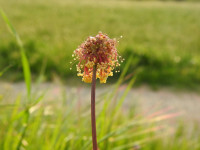
Perennial, evergreen herbaceous plant with an erect habit, the Salad Burnet reaches a height between 20 and 60 cm. It develops from a woody and thickened rhizome, which allows it to survive and regenerate over time. The stem is straight, often striated and reddish in color, simple or branched in the upper part; sometimes it has slight hairiness in the basal portion.
The basal leaves are arranged in a rosette, measuring between 10 and 20 cm long, pinnatisect, consisting of 5 to 17 petiolated leaflets. These leaf segments are elliptical, about 1 cm long, with a toothed margin, typically with 4-6 sharp teeth per side. The leaflets may have slight scattered hairiness on both sides, with the upper surface dark green and the lower one glaucous. The cauline leaves are progressively smaller and with fewer leaflets.
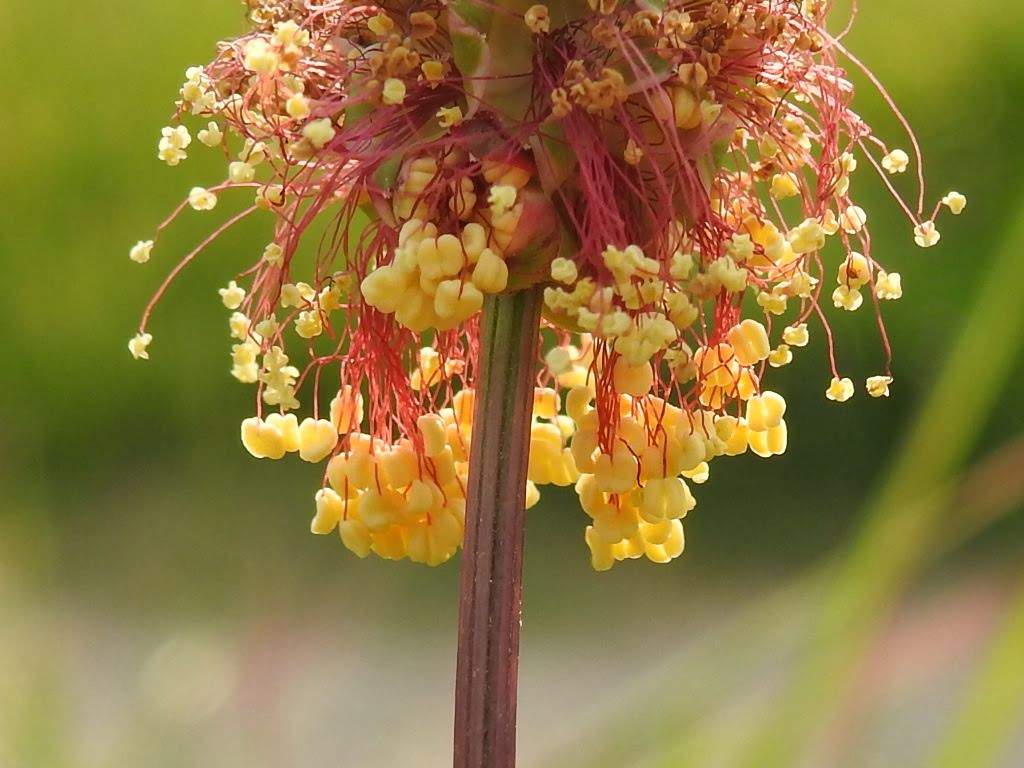
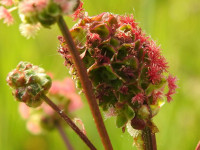
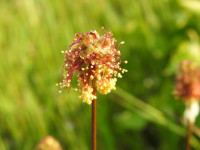
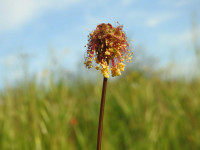
The inflorescence is a spherical-oval spike about 2 cm in diameter, located at the apex of the branches. The flowers are small, apetalous, characterized by 4 ovate sepal-like lobes green or reddish with a white margin. Inside the capitulum, the upper flowers are female with a pink or red feathery stigma, while the lower ones are male, equipped with numerous long and protruding yellow stamens. In the center there are also hermaphroditic flowers with less protruding stamens. The peculiar floral structure reflects a mixed reproductive strategy.
The fruits are obovoid pomes, 2.8 to 6 mm long and 2-3.8 mm wide, consisting of an urn-shaped, dry and accrescent receptacle (hypanthium), with four ribs and reticulated or more or less sharp crested surfaces. Each fruit contains one to three achenes.
The root system consists of a woody rhizome that allows the plant to be perennial and to regenerate every year.
Habitat and distribution
The Salad Burnet is a species widely distributed in the Mediterranean basin and in many other temperate areas of the planet, with some gaps in distribution. In Italy it commonly grows from the plains up to about 1,300 meters of altitude, but can occasionally be found up to 2,000 meters.
It prefers dry and sunny environments, such as uncultivated lands, meadows, road margins and ruderal areas, often in areas with poor and well-drained soils. It is frequent in fields intended for fodder and in Mediterranean grasslands, showing good adaptability to different exposures, provided they are well lit.
Flowering period
Flowering mainly occurs in July and August, with possible variations depending on latitude and altitude. In warmer climates and lower positions it can start slightly earlier, while in the mountains it can be prolonged or slightly anticipated depending on climatic conditions.
Ecology and pollination
The Salad Burnet employs a reproductive strategy combining male, female and hermaphroditic flowers within the same inflorescence, thus favoring some flexibility in pollination. The flowers, lacking petals and with protruding stamens, are visited by pollinating insects that facilitate pollen transfer. Among the main pollinating insects are bees and bumblebees, attracted by the reddish-pink color of the stigmas and the presence of numerous yellow stamens.
Seed dispersal occurs through the small achenes contained in the pomes, which can fall near the mother plant or be transported by external agents such as wind or animals, although the main mode of expansion remains propagation through the rhizome.
Curiosities and traditional uses
The Salad Burnet has a long tradition of use both in cooking and in folk medicine. The young leaves emit a delicate cucumber scent and are edible raw in salads, or used to flavor cheeses, soups, cooked vegetables and fruit salads, contributing a fresh and slightly bitter aroma.
From a medicinal point of view, the plant is known for its astringent, digestive, refreshing and antihemorrhagic properties, mainly attributed to tannins, triterpenic saponins and essential oil contained in the leaves. Traditionally, decoctions or infusions were used to treat diarrhea, dysentery, ulcerative colitis, hemorrhoids and dermatitis. External use includes the application of poultices obtained from crushed leaves macerated in oil, used as antirheumatic, analgesic and healing for wounds, sores and burns. Furthermore, the introduction of plant powder into the nostrils was used to stop epistaxis.
In the past, the species was known as “Pimpinella”, a name still used colloquially, although botanical classification later distinguished it from the homonymous genus of Apiaceae. An old proverb emphasized the importance of the plant in cooking: "Salad is neither good nor beautiful without Pimpinella".
Etymology
The genus name derives from the Greek "πότηρ" (pòter), meaning cup, goblet or chalice, referring to the characteristic shape of the floral calyx. The specific epithet "sanguisorba" is composed of the Latin words "sanguis" (blood) and "sórbeo" (I absorb), probably alluding to the traditional belief, consolidated in the doctrine of signatures, that attributed hemostatic and healing properties to the plant, highlighted by the reddish color of the inflorescence.
The Italian common name "salvastrella minore" recalls its botanical affinity with other similar species (such as the larger Salad Burnet), while the term “salvastrella” probably derives from popular tradition linked to its therapeutic properties.
Sources
- Acta Plantarum - Flora delle regioni italiane (scheda di Marinella Zepigi)
Characteristics
Scheda botanica
| Famiglia | Rosaceae |
|---|---|
| Fioritura | luglio – agosto |
| Forma biologica | Scapose |
| Habitat | edible plant, with red flowers, Perennial plant |
| Uso alimentare | Commestibile |
| Uso officinale | Pianta officinale |
Domande frequenti
- Quando fiorisce Salad Burnet?
- Salad Burnet fiorisce luglio – agosto.
- È commestibile Salad Burnet?
- Salad Burnet è considerata commestibile. Verifica sempre le parti eduli e la preparazione corretta prima del consumo.
- Che tipo di pianta è Salad Burnet?
- Salad Burnet è una Hemicryptophytes (Scapose) secondo la classificazione di Raunkiaer.
- A quale famiglia appartiene Salad Burnet?
- Salad Burnet appartiene alla famiglia botanica Rosaceae.
Where I found it (6 sightings)
Classification
- Kingdom
- Plantae
- Family
- Rosaceae
- Full name
- Poterium sanguisorba L.
- Synonyms
- Sanguisorba minor Scop.
- Life form
- Hemicryptophytes scapose
Similar species
Search for species with similar characteristicsNoticed an error in the identification? Write to me
Other species of the same family
Rosaceae
Explore
Other species of Rosaceae