Botanical species
Potentilla reptans
L.
Creeping Cinquefoil
Description
Morphological description
Perennial herbaceous plant belonging to the Rosaceae family, characterized by a creeping and stoloniferous habit. The stems are up to 1 meter long, thin, flexible, and rooting at the nodes, allowing the plant to spread horizontally and form new leaf rosettes. The stolons, reddish in color, generally have sparse hairiness.
The leaves are palmate, typically composed of five obovate leaflets with a cuneate base, varying in size between 8-20 mm in width and 16-60 mm in length. The leaflets are green on both sides, glabrous or slightly pubescent, with a coarsely toothed or crenate-toothed margin, with 5-10 blunt teeth per side, and with a rounded or obtuse tip. The basal leaves are long-petiolate, while the cauline leaves are smaller and subsessile. At the base of the leaves there are foliar stipules, generally entire or bidentate.
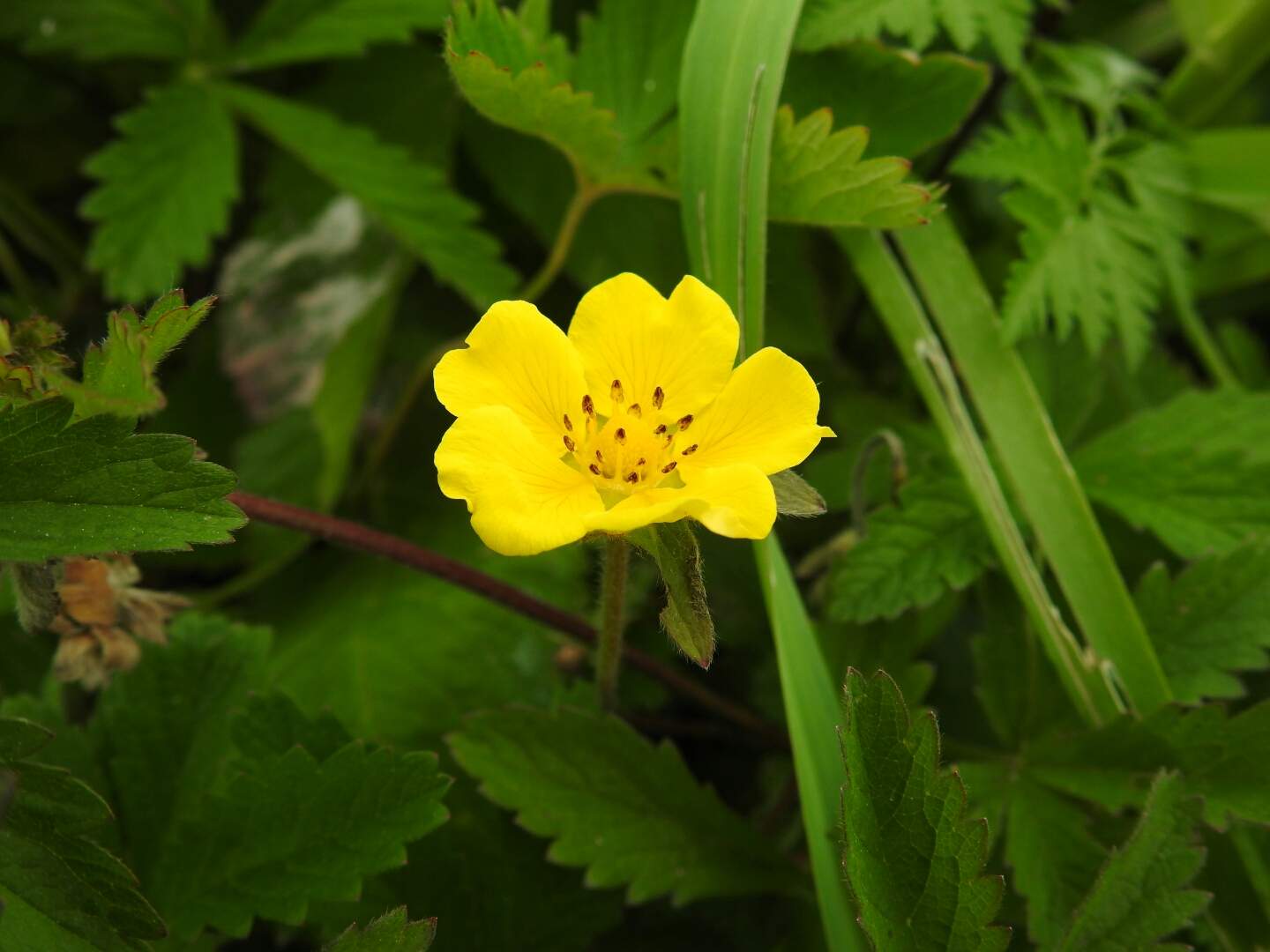
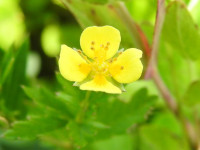
The flowers are solitary, hermaphroditic, intense golden yellow in color, with a diameter ranging from 1 to 2 cm, sometimes up to 3 cm. They are axillary, on erect peduncles 4 to 8 cm long, which protrude above the leaves. The corolla consists of five obcordate petals, longer than the sepals, with a notched apex. The calyx is formed by five triangular and hairy sepals, with an epicalyx presenting five lobes larger than those of the calyx itself. The stamens are numerous (about 20), arranged in three series, with filaments villous in the lower half and yellow anthers that turn brown upon maturation. The ovary is superior, formed by numerous free carpels with delicate and deciduous styles.
The fruits are aggregated achenes, hairy and wrinkled, about 1.3-1.6 mm, dispersed through mechanisms of falling and passive transport.
The root system is taproot, which allows good anchorage to the soil and efficient absorption of water and nutrients.
Habitat and distribution
Species widely distributed throughout the Italian territory and also present in much of the Mediterranean area, as well as in Europe, Western and Northern Asia, and North Africa. It grows from the lowlands up to mountainous elevations of about 1,600 meters above sea level.
It prefers open and semi-shaded environments such as uncultivated lands, poor and humid meadows, edges of paths and roads, ruins, rubble, and wet areas like margins of ponds, ditches, and canals. It favors fresh and well-drained soils, with exposure ranging from full sun to partial shade.
Flowering period
Flowering extends from May to September, with peaks that may vary slightly depending on latitude and altitude. In some Mediterranean areas, flowering can extend until October.
Ecology and pollination
The species is mainly pollinated by pollinating insects, such as bees, hymenopterans, and dipterans, attracted by the yellow flowers and the presence of abundant nectar and pollen. The flower structure, with well-visible petals and long peduncles, facilitates access for pollinators.
Reproduction occurs both sexually through seeds produced by the aggregated achenes, and vegetatively through stolons that root at the nodes, allowing the plant to rapidly colonize new surfaces.
Curiosities and traditional uses
The scientific name derives from the Latin potens, meaning "strong, powerful," indicating the tonic and astringent properties attributed to many species of the genus. The specific name reptans refers to the creeping habit of the stems. The Italian common name "cinquefoglia comune" indicates the characteristic leaf composed of five segments.
Traditionally, the plant has been used in folk medicine for its astringent, febrifuge, and mildly antispasmodic properties, especially in cases of diarrhea, nosebleeds, gum inflammations, and as a remedy for wounds difficult to heal. In the past, it was considered an antidote against bites from venomous animals and used to treat pulmonary diseases.
The young, tender, and fresh leaflets are edible and were used in salads. Additionally, the plant is valued by the cosmetic industry for its anti-wrinkle properties, used in the production of skin creams.
Etymology
The genus name Potentilla derives from the Latin potens, "powerful," referring to the astringent and tonic properties of some species. The specific epithet reptans means "creeping," describing the typical habit of the plant with stems that extend horizontally and root at the nodes.
The common name "cinquefoglia" refers to the characteristic leaf composed of five leaflets, very distinctive and easily recognizable.
Sources
- Prof. S. Pignatti, Flora d'Italia
- Acta Plantarum - Flora delle regioni italiane (scheda di Marinella Zepigi)
- Tela Botanica / H. Coste, Flore descriptive et illustrée de la France
- World Flora Online (WFO)
Characteristics
Scheda botanica
| Famiglia | Rosaceae |
|---|---|
| Fioritura | maggio – settembre |
| Forma biologica | Rosulate |
| Habitat | with yellow flowers, creeping plant, Perennial plant |
Domande frequenti
- Quando fiorisce Creeping Cinquefoil?
- Creeping Cinquefoil fiorisce maggio – settembre.
- Che tipo di pianta è Creeping Cinquefoil?
- Creeping Cinquefoil è una Hemicryptophytes (Rosulate) secondo la classificazione di Raunkiaer.
- A quale famiglia appartiene Creeping Cinquefoil?
- Creeping Cinquefoil appartiene alla famiglia botanica Rosaceae.
Where I found it (3 sightings)
Classification
- Kingdom
- Plantae
- Family
- Rosaceae
- Full name
- Potentilla reptans L.
- Life form
- Hemicryptophytes rosulate
Similar species
Search for species with similar characteristicsFurther reading
Noticed an error in the identification? Write to me
Other species of the same family
Rosaceae
Explore
Other species of Rosaceae