Botanical family
Rosaceae
Description
Botanical characteristics
Plants belonging to the family Rosaceae present a great variety of forms: they can be trees, shrubs, or herbaceous plants, mostly perennial but with some annual forms. The herbaceous species also include stoloniferous, rhizomatous, or creeping plants, while among the shrubs there are often spiny specimens and sometimes climbing ones.
The leaves are simple or compound, with margins that can be entire or serrated, and are always provided with stipules that usually fall off. The leaf arrangement is mostly spiral, while opposite arrangement is rare.
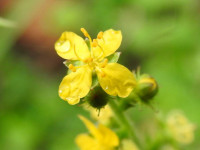
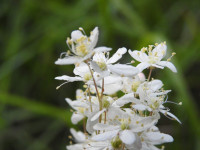
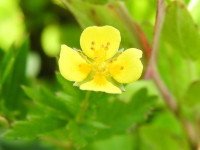
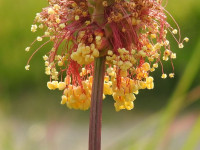
The flowers are generally hermaphroditic, actinomorphic, and pentamerous, although they can vary from 4 to 7 petals, or be petal-less as in Alchemilla. The perianth is double, consisting of calyx and corolla, both generally pentamerous; the sepals (5 or sometimes 4) can be free or doubled, deciduous or persistent depending on the genus. The stamens are numerous, often arranged spirally, a secondary adaptation. The ovary is semi-inferior in most cases, but can also be inferior or superior, with a variable number of carpels.
The fruit is highly variable: it can be a drupe (as in Prunus), a pome (as in Malus and Pyrus), a follicle, an achene, or even a hip (for example in Rosa). This variety of fruits has historically been used to divide the family into different taxonomic groups.
A distinctive character of the family is the presence of stipules on the leaves and the typical flower shape with a variable receptacle: flat, convex, or cup-shaped, depending on the genus. Pollination is mostly entomogamous, i.e., mediated by insects, with frequent presence of apomixis and complex hybrids.
Distribution and diversity
Rosaceae is a cosmopolitan family, distributed almost worldwide except Antarctica. The greatest diversity is found in the northern hemisphere, especially in temperate regions.
The family includes about 110 genera and about 5,000 species, making it one of the richest among angiosperms, both in terms of number of species and morphological variability and habitats occupied.
Main genera and representative species
Among the best-known and most important genera of Rosaceae are:
- Rosa: the genus of roses, an ornamental and cultural symbol, with numerous wild and cultivated species in Italy and the Mediterranean.
- Rubus: includes bramble species, such as raspberry and blackberry.
- Fragaria: the genus of strawberries.
- Prunus: includes many fruit tree species such as cherry, peach, plum, almond, apricot.
- Malus and Pyrus: respectively apple and pear, fruit trees of great economic importance.
- Crataegus: hawthorn, a shrub or small tree widely distributed in Europe.
- Potentilla, Alchemilla, Geum: herbs and shrubs common in temperate environments.
In Italy, many wild species belonging to these and other genera of the family are present, both as herbaceous plants and as shrubs and trees.
Etymology
The name of the family derives from the type genus Rosa, which in Latin indicates the rose, the symbolic flower of the family. The term “Rosaceae” is therefore a systematic formation indicating the group of plants recognized for their affinity with the genus Rosa.
Curiosities and uses
Rosaceae have a significant ecological role in many ecosystems, providing food and shelter to numerous pollinating insects and other animal species.
From an economic point of view, the family is of great importance to humans. It includes many fruit trees of worldwide relevance, such as apple, pear, cherry, peach, plum, almond, and apricot, fundamental sources of fresh and processed foods.
Besides food use, many species are ornamental (for example roses and hawthorn) and some have traditional medicinal uses. Moreover, some species provide materials for industrial use or forage for livestock.
Sources
- Wikipedia (https://it.wikipedia.org/wiki/Rosaceae)
- Provided botanical database (text)

Explore
Other botanical families