Botanical species
Potentilla erecta
(L.) Raeusch.
Tormentil
Description
Morphological description
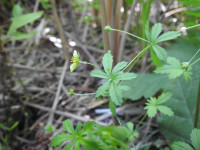
Perennial herbaceous plant belonging to the Rosaceae family, characterized by an erect or ascending habit, with branched stems generally reaching a height between 10 and 30 cm, but under certain conditions can reach up to 60 cm. The stems are slightly hairy, green in color, with open branching and not stoloniferous.
The root system consists of a woody, cylindrical and often developed rhizome, reddish inside, which allows the plant to perennialize and regenerate. The rhizome is superficial and irregularly thickened, about 1 to 8 cm long.
The basal leaves are arranged in a rosette and palmately compound, generally formed by three to five obovate or cuneate segments (leaflets), with deeply toothed margins and longer teeth towards the apex. These basal leaves often fall early and are therefore absent during flowering. The cauline leaves, sessile or subsessile, are usually ternate but can appear five-leaved due to the presence of stipules similar to leaflets; they are smaller than the basal leaves, with lanceolate or oblanceolate segments, toothed margins and herbaceous texture.
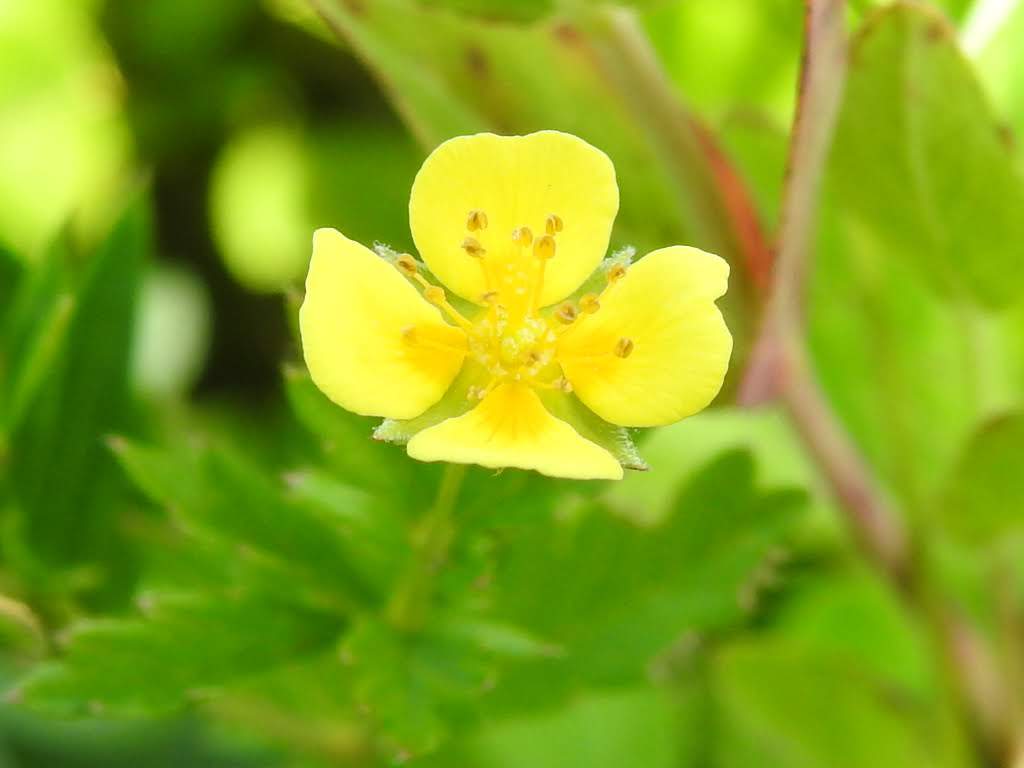
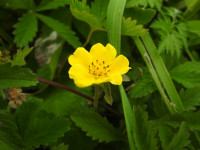
The flowers, bright yellow in color, are typically 4-merous, but can show variations from 3 to 6 petals. They have a diameter ranging from 7 to 11 mm, with obovate petals and a retuse or cordate apex. The calyx is formed by 4-5 oval or lanceolate sepals, often accompanied by an epicalyx (calyculus) with smaller elements. The flowers are hermaphroditic, solitary or grouped in leafy and sparse cymes, borne on thin and long peduncles (from 2 to 6 cm), originating from the axils of the upper leaves. The stamens are numerous (about 15-20) and the carpels, from 4 up to 20, are free and form an apocarpous gynoecium.
The fruit is a polyachene consisting of numerous wrinkled and glabrous achenes, about 1.2-2 mm long.
Habitat and distribution
The species is widespread throughout temperate Europe and much of the Eurasian area, extending from the Mediterranean basin to Japan. In Italy it commonly grows from the plains up to about 2400 meters of altitude, frequenting light woodland environments, wet meadows, heaths and pastures on predominantly acidic and moist soils. It prefers sunny or partially shaded exposures and well-drained soils rich in organic matter.
Its presence is reported in various habitat types, from forest edges to subalpine grasslands, demonstrating good ecological adaptability.
Flowering period
Flowering mainly occurs between May and August, with possible variations linked to altitude and latitude: in more mountainous or northern areas it can extend until September while in milder climate zones it can start as early as late April.
Ecology and pollination
The plant reproduces mainly sexually through seeds, but thanks to the woody rhizome it can also regenerate vegetatively. The flowers, yellow and highly visible, are visited by numerous pollinating insects, including bees, bumblebees and other hymenopterans, which promote entomophilous pollination.
The production of numerous wrinkled achenes facilitates seed dispersal, which mainly occurs through wind and animals. The species does not have adventitious roots capable of rooting from the nodes, so vegetative spread is limited to the rhizome.
Curiosities and traditional uses
This plant has been known since ancient times for its medicinal properties. The rhizome contains bioactive compounds such as tomentol (a triterpenic alcohol) and special tannins that confer tonic, stimulating, astringent, antimicrobial, antidiarrheal and antidyssenteric properties.
In folk medicine it has been used to relieve inflammations of the mouth and throat, as well as to promote the healing of difficult wounds, burns, frostbites and hemorrhoids. The tincture obtained from the root is also used as a natural dye for red inks.
Today extracts of this species are used in the cosmetic industry for the production of soaps, lotions, creams and deodorants. Its astringent and antimicrobial properties make it a valued ingredient in skin care products.
The genus name refers to the potency of its therapeutic properties, while the specific name "erecta" refers to the typical erect habit of the plant. The Italian common name "Tormentil" derives from the characteristic palmately compound leaf with five segments, although the cauline leaves often appear ternate with stipules similar to leaflets, giving the impression of five leaflets.
Etymology
The genus name Potentilla derives from the Latin potens, meaning "powerful", referring to the medicinal virtues attributed to these plants. The specific name erecta indicates the erect habit of the stems, which are distinguished by their vertical or ascending position. The Italian common name "Tormentil" refers to the presence of leaves composed of five lobes or segments, arranged palmately, and to the erect habit of the plant.
The historical synonym Tormentilla derives from the Latin tormentum, meaning pain or torment, referring to the traditional use of the plant to relieve pains such as dental pain, cramps or colics.
Sources
- Prof. S. Pignatti, Flora d'Italia
- Acta Plantarum - Flora delle regioni italiane (scheda di Giuliano Salvai)
- Tela Botanica / H. Coste, Flore descriptive et illustrée de la France
- World Flora Online (WFO)
Characteristics
Scheda botanica
| Famiglia | Rosaceae |
|---|---|
| Fioritura | maggio – agosto |
| Forma biologica | Scapose |
| Habitat | with yellow flowers |
| Uso officinale | Pianta officinale |
Domande frequenti
- Quando fiorisce Tormentil?
- Tormentil fiorisce maggio – agosto.
- Che tipo di pianta è Tormentil?
- Tormentil è una Hemicryptophytes (Scapose) secondo la classificazione di Raunkiaer.
- A quale famiglia appartiene Tormentil?
- Tormentil appartiene alla famiglia botanica Rosaceae.
Where I found it (9 sightings)
Classification
- Kingdom
- Plantae
- Family
- Rosaceae
- Full name
- Potentilla erecta (L.) Raeusch.
- Life form
- Hemicryptophytes scapose
Similar species
Search for species with similar characteristicsFurther reading
Noticed an error in the identification? Write to me
Other species of the same family
Rosaceae
Explore
Other species of Rosaceae