Botanical species
Helianthemum nummularium
(L.) Mill.
Common Rock-Rose
Description
Morphological description
Evergreen perennial plant belonging to the family Cistaceae, characterized by a suffrutescent habit with woody stems only at the base and prostrate or ascending branches reaching a variable height between 10 and 40 cm. The upper part of the stems is often rough or velvety, with a wrinkled and sometimes cobwebby surface.
The leaves are arranged oppositely along the branches, petiolate, leathery in texture and semi-persistent. The leaf shape varies from lanceolate to elliptical, with sizes that can reach 20-35 mm in length. The leaf surface can be glabrous or tomentose, with simple hairs, while the margin is generally revolute and ciliate. At the base of the upper leaves there are lanceolate stipules, about 1-2 mm by 6-10 mm.
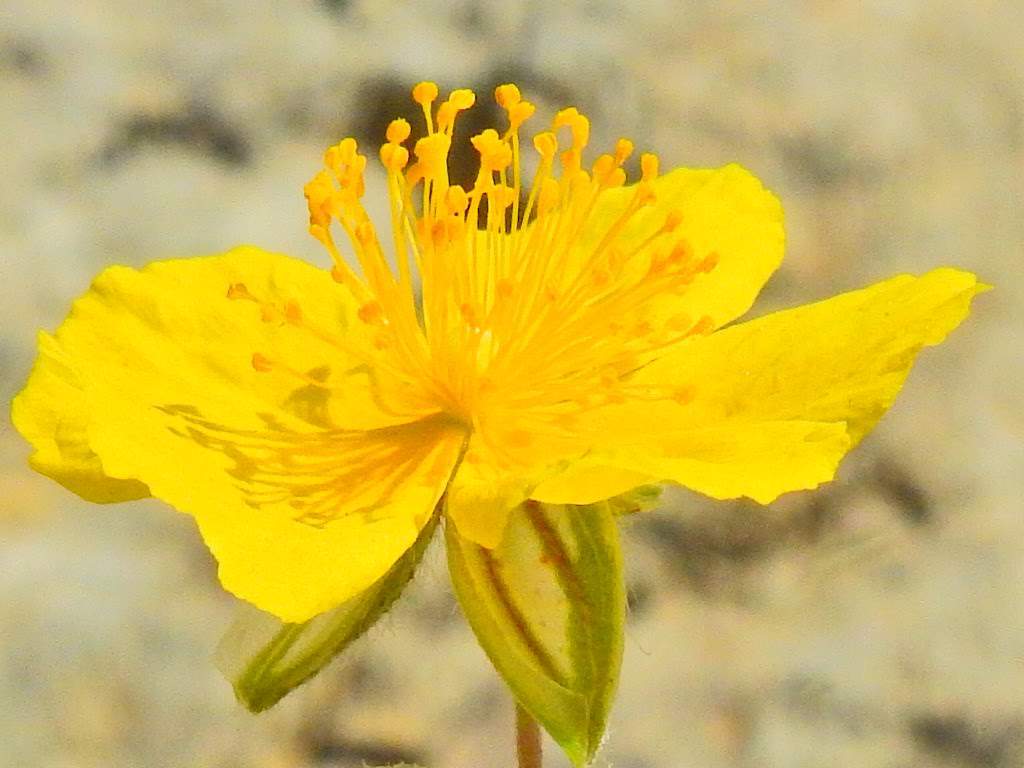
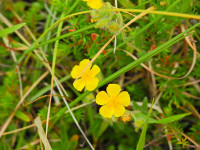
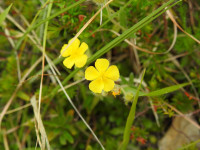
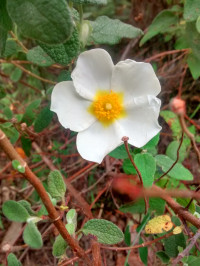
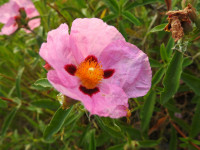
The flowers appear in cymes formed by 4-7 units, often arranged unilaterally, but they can also be grouped in pairs. The corolla is composed of five spatulate petals ranging from heart-shaped to obcordate, of intense golden yellow color, sometimes with variations including pink, white or pink-orange petals, especially in some subspecies. The petals are slightly wrinkled and generally measure between 8 and 15 mm in length, with a width of 9-14 mm depending on the subspecies. The calyx is persistent, formed by five sepals, of which two outer are smaller and narrower, and three inner are larger and ovate-acuminate.
The fruits are curved capsules, measuring between 6 and 9 mm, which open to release the seeds.
The root system is typical of Mediterranean suffrutescent plants, with well-developed roots to anchor to rocky and sandy substrates, allowing survival in arid and nutrient-poor environments.
Habitat and distribution
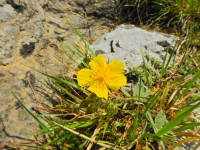
This species has a European and Caucasian distribution, widely present throughout the Italian territory, except for the Po Plain and other large alluvial plains. It mainly grows in arid environments, such as dry grasslands, rocky places, stony and sandy slopes, preferring predominantly calcareous substrates. It also adapts to shallow and poor soils, with sunny exposure that favors flowering and vegetative development.
The growth altitude ranges from the hilly zone up to alpine elevations of about 2,500 meters above sea level, with different subspecies that differ ecologically and morphologically in relation to altitude and substrate type. For example, some subspecies are found on coastal calcareous sands, others in dry mountain meadows on dolomite or on lava with limited calcium content.
Flowering period
Flowering mainly extends from May to August, with possible variations related to latitude and altitude. In warmer and sunnier areas flowering can start early in May, while in mountainous environments it can extend until late summer.
Ecology and pollination
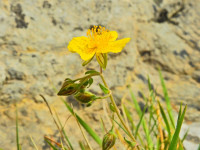
The plant is a suffrutex that adapts well to Mediterranean and continental climates, living in association with plant communities of dry grasslands and garrigues. The intense yellow color of the corolla and the open flower structure are typical of species pollinated by pollinating insects, especially bees and butterflies, attracted by the color and nectar.
Seed dispersal occurs through capsules that open at maturity, releasing relatively small seeds that can be carried by the wind or fall near the parent plant, favoring colonization of open and rocky spaces.
Curiosities and traditional uses
The genus name recalls the connection with the sun, not only for the bright color of the flowers, but also for the plant’s ecology, which prefers very sunny environments. Although there are no detailed indications on specific food or medicinal uses in Italian popular tradition, the plant is sometimes cultivated for ornamental purposes due to its decorative appearance and showy flowering.
Historically, the name Helianthemum was introduced by the French botanist Joseph Pitton de Tournefort and derives from the Greek “hēlios” (sun) and “ánthos” (flower). The specific epithet “nummularium” refers to the shape and color of the corollas, similar to gold coins (“nummus” in Latin means “coin”).
Etymology
The scientific name is formed by “Helianthemum”, from the Greek “hēlios” (sun) and “ánthos” (flower), meaning “sun flower” referring to the sunny habitat and the bright golden yellow petals. The specific epithet “nummularium” derives from the Latin “nummus”, coin, recalling the shape and golden brilliance of the flowers, which resemble small coins.
The Italian common name “Common Rock-Rose” highlights the relatively large size of the flowers compared to other species of the genus and emphasizes the characteristic yellow brightness of the flower, which indeed resembles the sun.
Sources
- Prof. S. Pignatti, Flora d'Italia
- Acta Plantarum – Flora delle regioni italiane (scheda di Marinella Zepigi)
- World Flora Online (WFO)
Characteristics
Classification
- Kingdom
- Plantae
- Family
- Cistaceae
- Full name
- Helianthemum nummularium (L.) Mill.
- Synonyms
- Cistus nummularius L.; Helianthemum chamaecistus Mill.; Helianthemum vulgare Gaertn.
- Life form
- Camefite suffruticose
Similar species
Search for species with similar characteristicsNoticed an error in the identification? Write to me
Other species of the same family
Cistaceae
Explore
Other species of Cistaceae