Botanical species
Cistus x purpureus
Lam.
Purple cistus
Description
Morphological description
Cistus purpureus is a perennial plant belonging to the family Cistaceae, known for its showy and brightly colored flowering. It has a bushy habit, generally compact, with a height that can vary from 50 to 100 centimeters. The stem is woody at the base, with young herbaceous and flexible branches, often covered by a fine hairiness that gives a slightly velvety appearance.
The leaves are arranged oppositely along the branches, lanceolate in shape, narrow and elongated, with entire margins and a relatively thin but resistant texture. The leaf surface is matte or slightly tomentose, adapted to reduce water loss in arid and sunny environments.
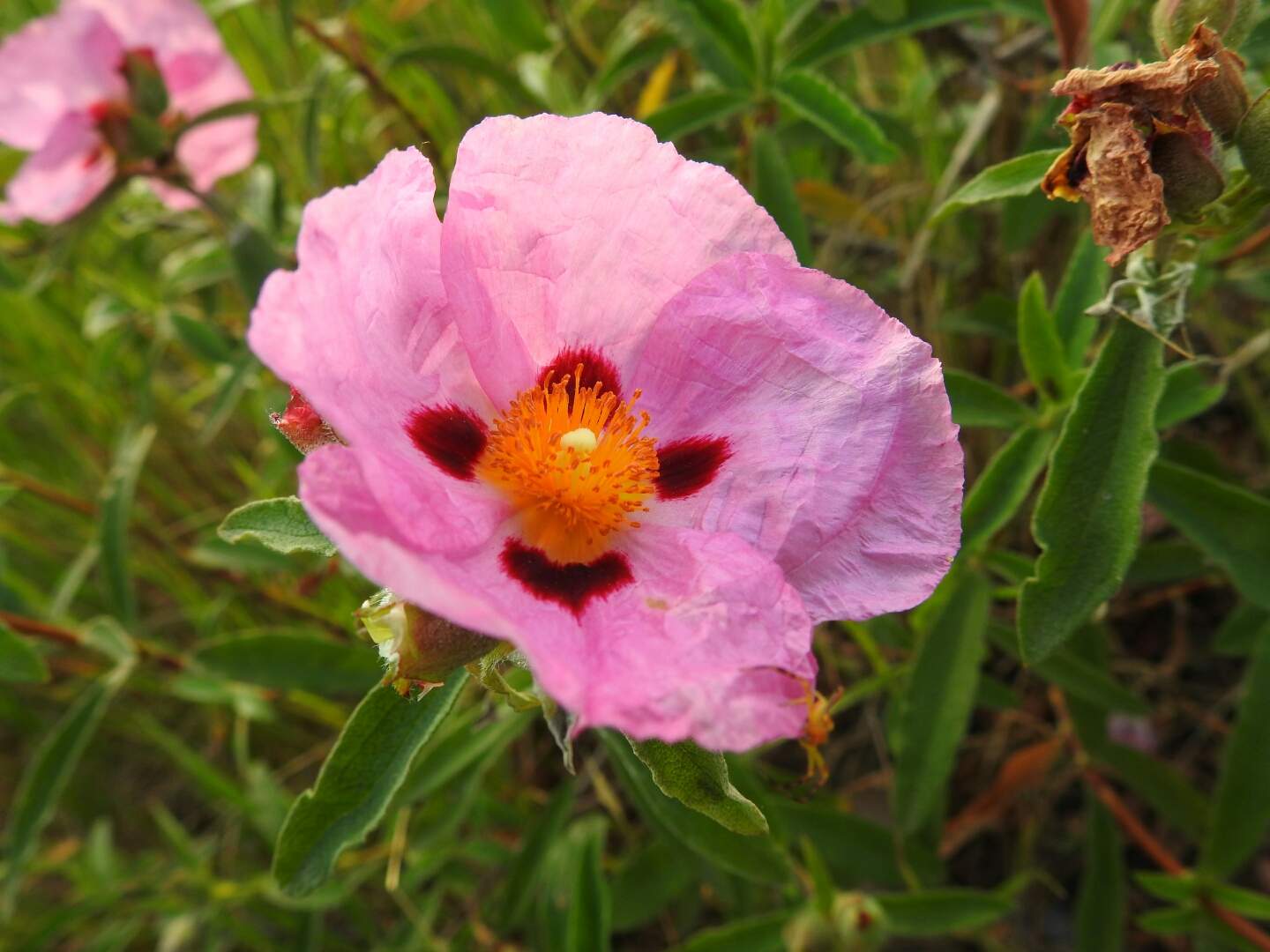
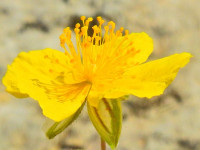
The flowers are particularly characteristic and represent the most decorative element of the plant. They consist of five petals of intense fuchsia color, sometimes with shades tending to blue-violet, which open widely forming a corolla about 4-5 centimeters in diameter. The petals are delicate, slightly curled at the edges, and often fragrant, contributing to the attractiveness for pollinating insects. The calyx is formed by persistent and hairy sepals, which protect the bud and, subsequently, the fruit.
The fruit is a woody capsule, containing numerous small seeds, which disperse at maturity. The root system is quite developed, with roots extending into the soil to firmly anchor the plant and favor water absorption in environments often poor in water resources.
Habitat and distribution
Cistus purpureus is typical of the Mediterranean scrub and open woods, preferring sunny and well-drained areas. In Italy it is widely distributed in coastal and subcoastal regions, especially in the Center and South, where the Mediterranean climate guarantees mild winters and hot, dry summers. It is frequently found on poor, calcareous or sandy soils, capable of ensuring the necessary drainage to avoid water stagnation.
The species usually grows from sea level up to about 600-700 meters altitude, adapting to rather varied environmental conditions within the Mediterranean basin. It grows in open woodland environments, often in association with other typical Mediterranean scrub species, such as evergreen oaks and other aromatic plants.
Flowering period
The flowering of Cistus purpureus is mainly concentrated in late spring and early summer, from May to July, with temporal variations linked to altitude and latitude. In warmer climates and at lower altitudes, flowering may occur earlier, while in mountainous or cooler environments it tends to last slightly longer.
Ecology and pollination
The flowers of Cistus purpureus, thanks to their bright color and delicate fragrance, attract numerous pollinating insects, particularly bees and butterflies, which play a fundamental role in pollination. The plant, being perennial and with a concentrated flowering, synchronizes nectar and pollen production to optimize insect visits during the seasonal peak.
Seed dispersal occurs mainly by falling from the woody capsule, with possible secondary transport by wind or small animals. The species is adapted to rapidly colonize open or disturbed spaces, thanks to its ability to germinate in poor and well-exposed soils.
Curiosities and traditional uses
Cistus purpureus, like other cistus, has traditionally been appreciated for its aromatic and medicinal properties. The resins produced by some Cistus species were used in antiquity for the preparation of incense and ointments, as well as for their antiseptic and anti-inflammatory properties. Although no detailed specific data are available for this hybrid, the genus Cistus in general is known in Mediterranean phytotherapy.
Besides medicinal use, some Cistus species have been employed for tannin production and as ornamental plants for their beauty and ease of cultivation in Mediterranean gardens and terraces.
Etymology
The scientific name "Cistus" derives from the Greek "kístis," meaning "bag" or "pouch," probably referring to the shape of the calyx or the characteristic fruit of the genus. The specific epithet "purpureus" indicates the purple-purplish color of the flowers, which represents the most evident and distinctive characteristic of this hybrid species.
The Italian common name "Purple cistus" also recalls the purple coloration of the petals, emphasizing its aesthetic and recognizable aspect among the different Cistus species present in the Mediterranean flora.
Sources
- Tela Botanica / H. Coste, Flore descriptive et illustrée de la France
Characteristics
Where I found it (3 sightings)
Classification
- Kingdom
- Plantae
- Family
- Cistaceae
- Full name
- Cistus x purpureus Lam.
- Life form
- Fanerofite nano-fanerofite
Flowering period
Data not available
Similar species
Search for species with similar characteristicsFurther reading
Noticed an error in the identification? Write to me
Other species of the same family
Cistaceae
Explore
Other species of Cistaceae