Botanical species
Helianthemum hirtum
(L.) Mill.
Eliantemo irto
Description
Morphological description
Perennial plant, generally 10 to 40 cm tall, with an erect or ascending habit. The stem is lignified at the base, dark gray in color, covered by a dark bark and has a woody texture. The branches are densely covered with spreading hairs and stiff bristles, giving the plant a velvety and rough appearance.
The leaves are narrowly lanceolate or linear in shape, with entire margins often slightly rolled downward. The dimensions range from 1-1.5 mm wide by 7-9 mm long in the upper leaves, while the lower ones can reach 4 mm wide and 13 mm long. The upper surface of the leaves is almost glabrous, while the lower surface is covered by a dense whitish tomentum, giving a gray-silvery appearance. Thin linear stipules 2-4 mm long are present.
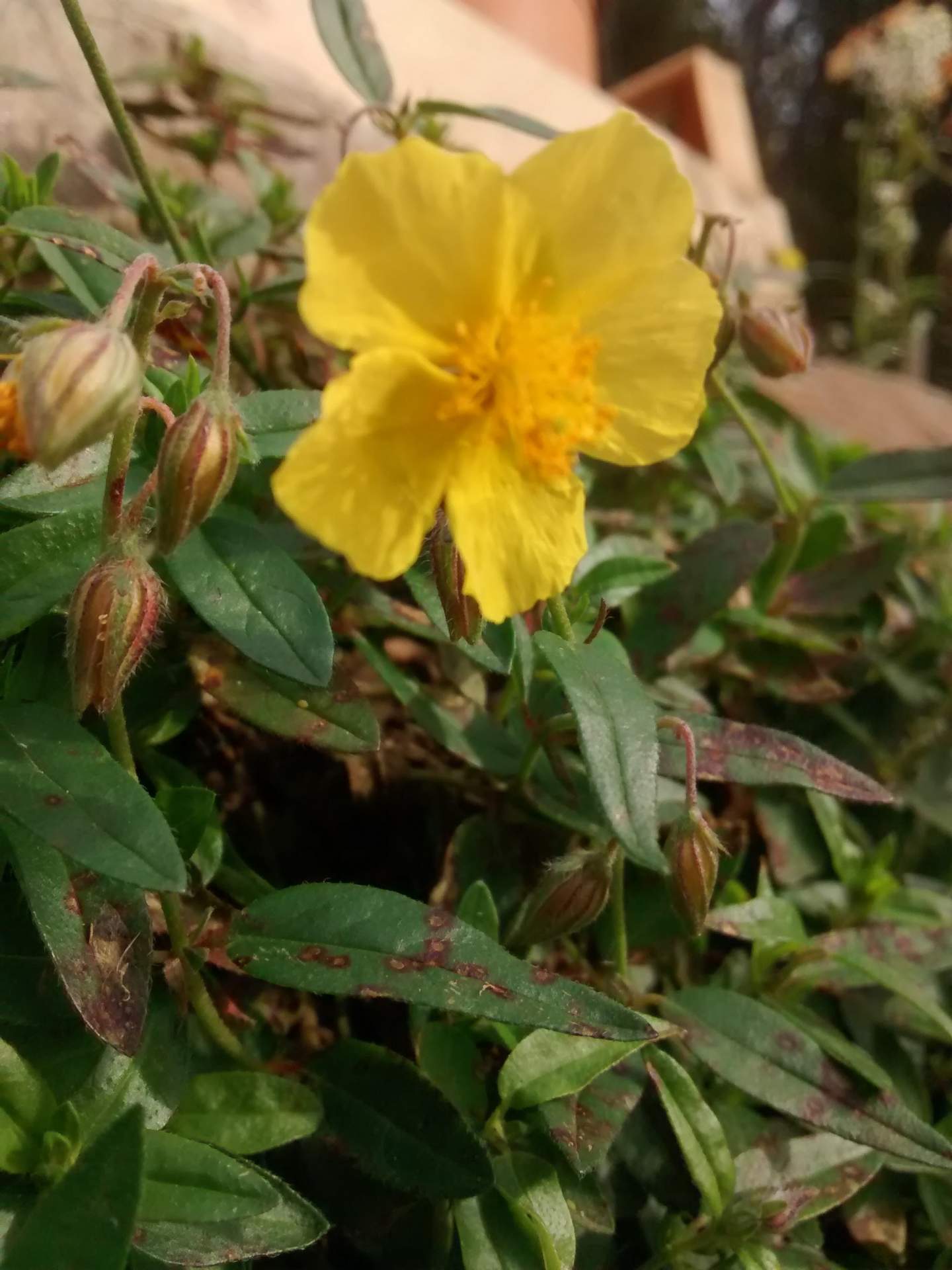
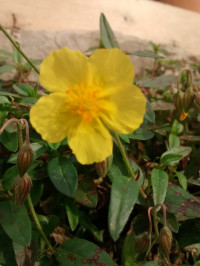
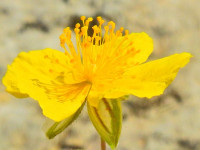
The flowers are gathered in slightly elongated terminal clusters and are bright yellow in color. The petals measure between 7 and 9 mm, with evident oval sepals covered by stiff hairs (hispi). The floral structure is characterized by a geniculate style (i.e., with a knee-like bend) that exceeds in length the fruit capsule. The latter is small, oval-triangular, tomentose, and 1-2 times shorter than the sepals. Inside the capsule there are generally three relatively large seeds with a granular surface.
The root system is not described in the available sources; however, as in many Mediterranean rupicolous species, it is presumably adapted to penetrate limestone crevices, promoting stability and absorption in poor and well-drained soils.
Habitat and distribution
This species is typical of Mediterranean environments, particularly garrigue and limestone coasts, and is mainly found in regions characterized by calcareous and well-drained soils. In Italy it is present in the southern and central belt, with a distribution extending from Provence and Languedoc in France to the Var and the regions of the Maritime Alps, including Drôme, Basse-Alpes, and Hautes-Alpes. In the broader Mediterranean area, it has also been reported in Spain and Portugal.
It prefers sunny exposures and dry soils, typical of rocky areas and south or southwest-facing slopes, where competition with other species is reduced. The growth altitude generally varies from sea level up to moderate mountain elevations, compatible with dry Mediterranean climate conditions.
Flowering period
Flowering occurs mainly in the summer period, from June to July, with possible variations related to latitude and altitude. In warmer and lower areas flowering can start slightly earlier, while at higher elevations it may be slightly delayed.
Ecology and pollination
The species is part of the typical ecosystem of Mediterranean garrigues and limestone coasts, where it contributes to floristic biodiversity and provides food resources for pollinating insects. The yellow flowers mainly attract hymenopterans (wild bees and other pollinating insects) which, thanks to the open and easily accessible flower structure, facilitate fertilization.
The presence of the geniculate style, longer than the capsule, suggests an adaptation for pollen dispersion and prevention of self-pollination, favoring cross-pollination. Seed dispersal probably occurs by gravity and by the action of small animals, but precise data on the mode of dissemination are not available.
Curiosities and traditional uses
No specific medicinal or food uses are documented for this species within the Italian or Mediterranean tradition. However, belonging to the family Cistaceae, some related species have historically been used for their resins or herbal applications. There are no particular folkloric or cultural references linked to elianthemum hirtum.
Etymology
The generic name Helianthemum derives from the Greek “hēlios” (sun) and “ánthēmon” (flower), referring to the preference of these plants for sunny and open environments. The specific name hirtum indicates the presence of a stiff and rough pubescence, a characteristic evident on stem and leaves.
The Italian common name "eliantemo irto" reflects the same idea: “eliantemo” as a translation of the genus, and “irto” to emphasize the presence of stiff hairs and bristles that give the plant a spiny or rough-to-the-touch appearance.
Sources
- Prof. S. Pignatti, "Flora d'Italia"
- Tela Botanica / H. Coste, "Flore descriptive et illustrée de la France"
Characteristics
Where I found it (2 sightings)
Classification
- Kingdom
- Plantae
- Family
- Cistaceae
- Full name
- Helianthemum hirtum (L.) Mill.
- Life form
- Camefite suffruticose
Similar species
Search for species with similar characteristicsFurther reading
Noticed an error in the identification? Write to me
Other species of the same family
Cistaceae
Explore
Other species of Cistaceae