Botanical family
Cistaceae
Description
Botanical characteristics
The Cistaceae are a family of dicotyledonous angiosperm plants, predominantly shrubby, occasionally herbaceous. The typical habits consist of small shrubs or perennial plants of limited size, with young stems cylindrical or sometimes tetragonal. The leaves are generally entire, with a simple blade, opposite or sometimes spiral or whorled, with or without stipules, petiolate or sessile; they often have hairs of various types, such as stellate, branched or glandular.
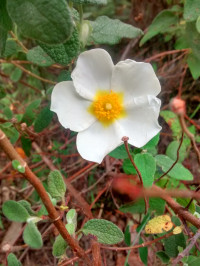
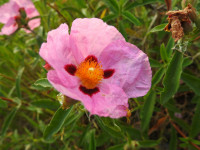
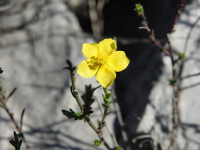
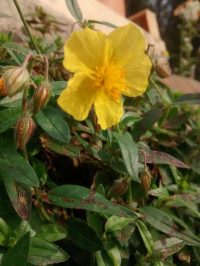
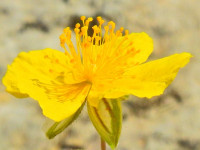
The flowers are hermaphroditic, actinomorphic and typically pentamerous, although they may occasionally have only three sepals or petals. They are solitary or gathered in inflorescences in cymes or racemes. The calyx is formed by five sepals (but sometimes only three) unequal: the two outermost differ from the three inner ones. The corolla is composed of five simple petals, easily deciduous, with colors varying between white, yellow and red. The stamens are many and free, with the outermost sometimes sterile. The ovary is superior, unilocular, formed by the fusion of 3-5 carpels with parietal placentation; the style is simple, cylindrical and often bent at the base.
The fruit is a dehiscent capsule, which opens by means of four valves (loculicidal capsule). The seeds are small with a curved embryo. The species of the family are well adapted to arid environments and often have a characteristic aroma. Pollination is entomophilous: the flowers, lacking nectar, compensate with a large production of pollen to attract pollinating insects.
Distribution and diversity
The family is mainly distributed in the temperate regions of Eurasia, North Africa and North America, with the highest biodiversity concentrated in the Mediterranean basin. Some species are also found in the tropical and subtropical zones of the New World. Worldwide they include about 180 species distributed in about 8 recognized genera. In Italy there are about 40 species mainly belonging to the genera Cistus, Fumana, Helianthemum and Tuberaria, many of which are typical of the Mediterranean maquis and arid or semi-arid environments.
Main genera and representative species
Among the most important genera of the family are:
- Cistus: includes aromatic shrubs widely distributed in the Mediterranean, with large and showy flowers. Notable species in Italy include Cistus albidus, Cistus monspeliensis and Cistus salviifolius.
- Fumana: small shrubs or subshrubs, also typical of the Mediterranean maquis.
- Helianthemum: including herbaceous species and subshrubs, with flowers similar to those of Cistus but generally smaller; frequent are Helianthemum nummularium and Helianthemum apenninum.
- Tuberaria: small shrubs with yellow flowers, also typical of Mediterranean environments.
The other genera include Crocanthemum, Hudsonia, Lechea and Pakaraimaea, with wider or more localized distributions mainly outside the Mediterranean area.
Etymology
The family name derives from the type genus Cistus, a name which in turn comes from the Greek “kistos” or “kistē”, an ancient term used to indicate aromatic plants or shrubs. This refers to the aromatic characteristics and the shape of the flowers of some species of the genus.
Curiosities and uses
The Cistaceae are important ecological components of Mediterranean ecosystems, particularly the maquis, where they contribute to stabilizing arid soils and providing habitat for numerous pollinating insects. They are often aromatic plants, a characteristic that sometimes makes them used in Mediterranean gardens for ornamental purposes, also thanks to their showy and fragrant flowers. Some species are studied for their resinous and aromatic properties, but no widely documented food or medicinal uses are known in the consulted sources.
Sources
- Wikipedia
Explore
Other botanical families