Botanical species
Fumana ericifolia
Wallr.
Heath-Leaved Sun Rose
Description
Morphological description
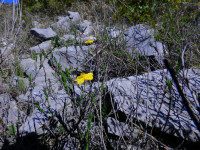
Heath-Leaved Sun Rose is a perennial plant belonging to the family Cistaceae, characterized by a generally erect habit and a lignified and robust stem that gives it a certain rigidity. The plant can be recognized by its relatively greater stature compared to related species such as Fumana procumbens, with branches that develop vertically more frequently.
The leaves are narrow and elongated, measuring between 1 and 6-13 mm, flattened on the upper surface and equipped with a characteristic trinerved venation less evident on the underside. The surface of the leaves and branches presents a predominantly glandular pubescence, which can be observed as a fine hairiness with glands, typical of the genus.
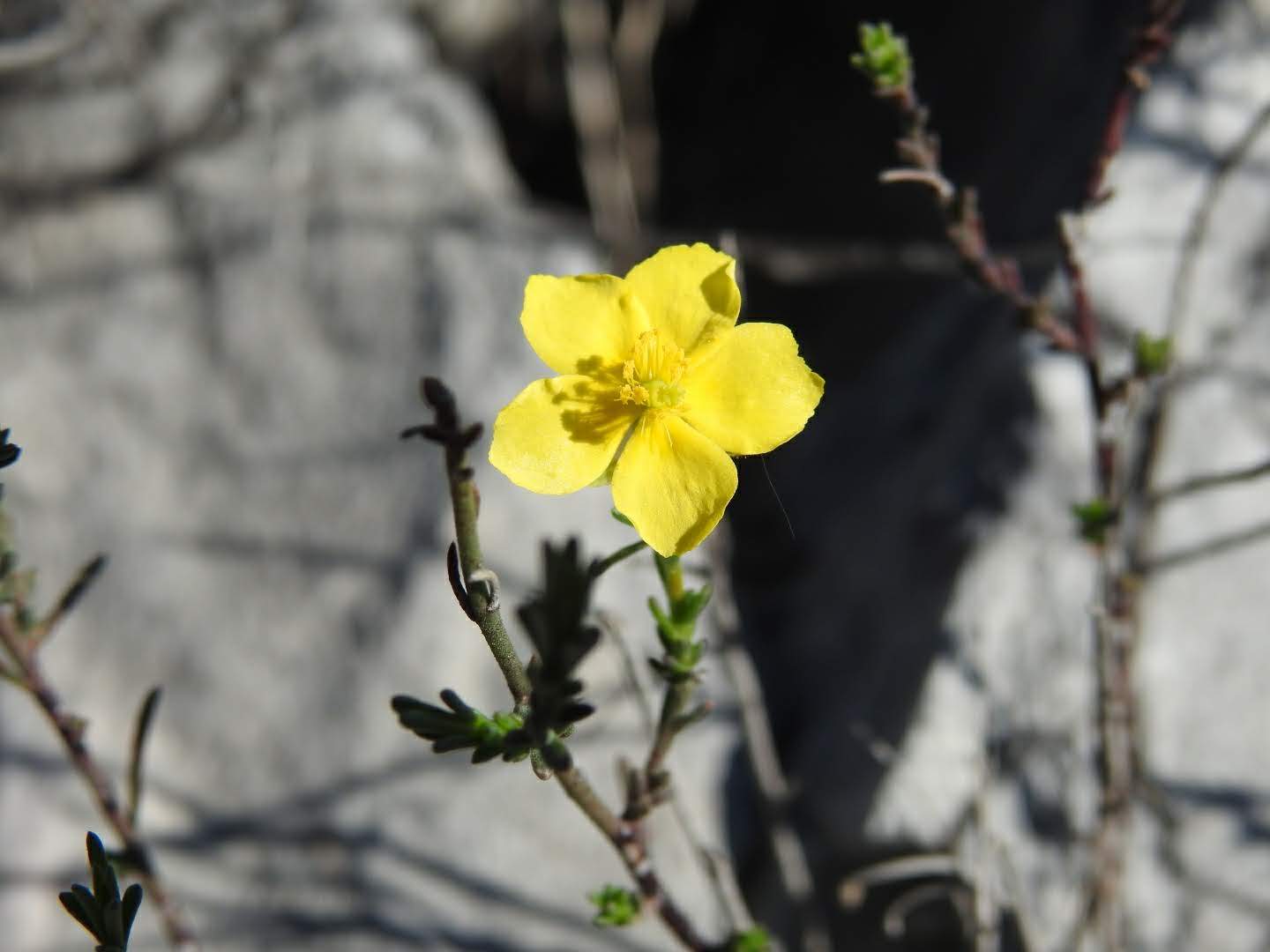
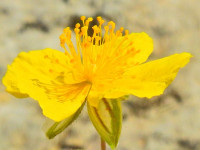
The flowers, which appear from spring until early summer, are an intense yellow and have five petals of generally regular shape, with an approximate size of 7x7 mm. The peduncles supporting the flowers are longer and straighter than those of similar species, giving the flower greater visibility. The fruit, typical of Cistaceae, is a capsule that opens at maturity to release the seeds, although the available texts do not specify further details on the fruit and root system.
Habitat and distribution
Heath-Leaved Sun Rose is a typical species of the mountainous and submontane environments of the Mediterranean belt, preferring calcareous substrates. In Italy it is mainly present in regions with Mediterranean-mountain characteristics, such as Tuscany and Sardinia, where it grows in association with other species typical of calcareous environments.
This plant is found in habitats with sunny exposure, often in open or semi-open places, where the soil is well-drained and poor in nutrients, conditions that limit competition with more vigorous species. In particular, Heath-Leaved Sun Rose is part of the vegetation groups of the Mediterranean belt on limestone, often associated with species of the Rosmarinetalia community.
Its presence is distinct from that of similar species such as Fumana procumbens, which instead prefers continental steppe-type environments, often with Bromus erectus, and extends in Central Asian or South Siberian distributions, up to the southern limit in sub-Mediterranean communities.
Flowering period
The flowering of Heath-Leaved Sun Rose mainly occurs between April and June, with some possible variation related to location and altitude. This period coincides with late spring and early summer, when climatic conditions are more favorable for pollination and subsequent fruit development.
Ecology and pollination
The yellow flowers of Heath-Leaved Sun Rose are adapted to attract specific insect pollinators, although precise data on the pollinating insects of this species are not available. Generally, Cistaceae are pollinated by bees, bumblebees, and other pollinating insects attracted by the bright color and nectar produced by the flowers.
The reproductive strategy is based on entomogamous pollination, with seed dispersal occurring through the opening of the capsule that releases the seeds onto the soil. Particular long-distance dispersal mechanisms or specialization strategies are not known.
Curiosities and traditional uses
No specific traditional, medicinal, or food uses are documented for this species. However, like other Cistaceae, Heath-Leaved Sun Rose may have an important ecological role in Mediterranean plant communities, contributing to the biodiversity of calcareous and mountainous habitats. No significant folkloric or ethnobotanical references are recorded.
Etymology
The generic name Fumana probably derives from vernacular terms linked to the characteristic growth in dry and “smoky” or dusty environments, referring to the calcareous and sunny habitats in which it grows. The specific epithet ericifolia indicates the similarity of the leaves to those of the genus Erica, that is, narrow and linear leaves, similar to those of heathers. The Italian common name “Heath-Leaved Sun Rose” recalls the geographical distribution of the species, linked to Mediterranean environments.
Sources
- Prof. P.V. Arrigoni, "Flora analitica della Toscana", "Flora dell'Isola di Sardegna"
Characteristics
Where I found it (5 sightings)
Classification
- Kingdom
- Plantae
- Family
- Cistaceae
- Full name
- Fumana ericifolia Wallr.
- Synonyms
- Fumana ericoides (Cav.) Gand. subsp. montana ( Pomel ) Güemes & Muñoz Garm.; Fumana ericoides auct. Fl. Ital.
- Life form
- Camefite suffruticose
Similar species
Search for species with similar characteristicsNoticed an error in the identification? Write to me
Other species of the same family
Cistaceae
Explore
Other species of Cistaceae