Botanical species
Tuberaria guttata
(L.) Fourr.
Spotted Rock-Rose
Description
Morphological description
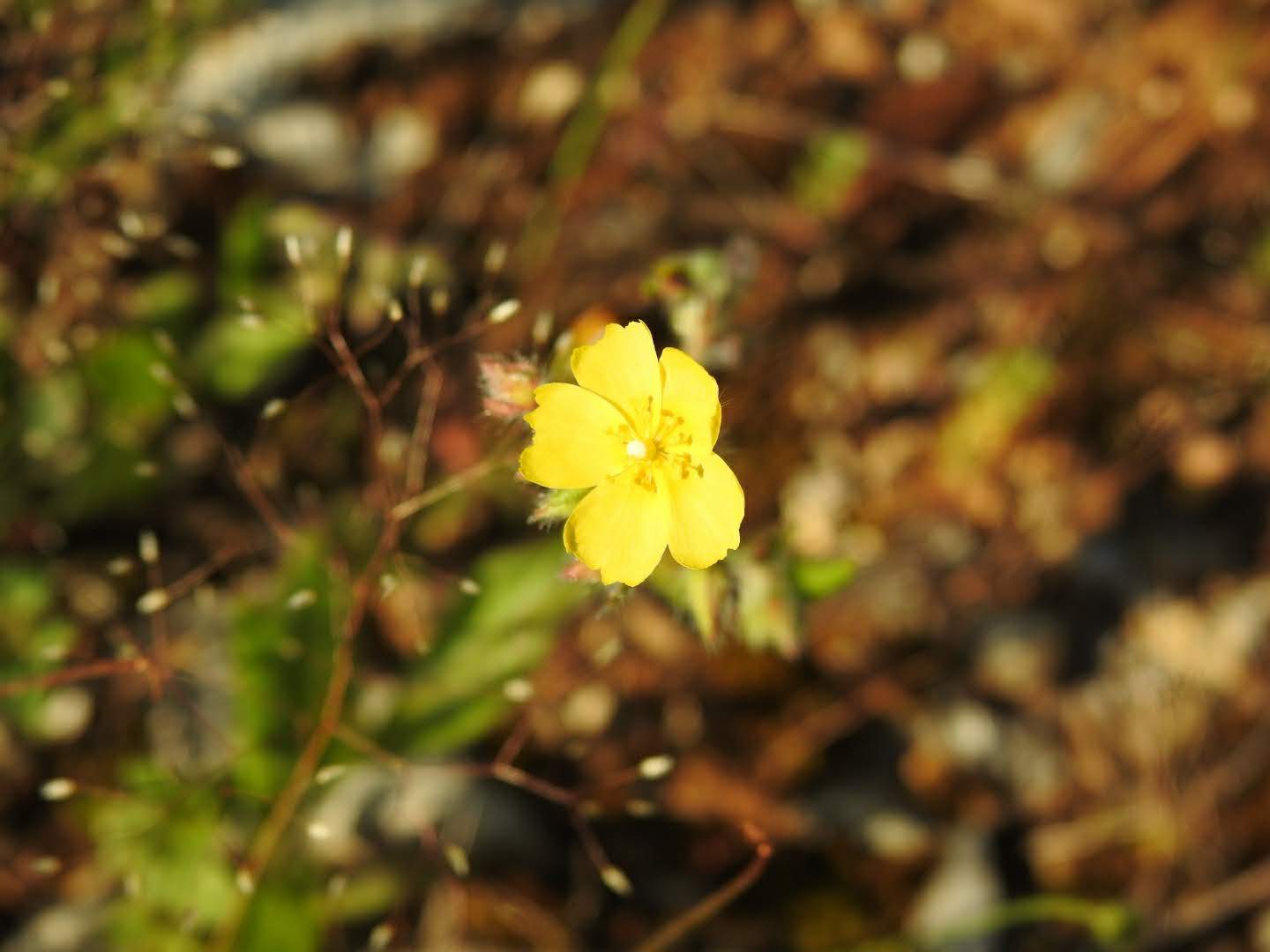
Annual herbaceous plant, generally 5 to 40 cm tall, with an erect habit and scapose stems, often leafless along the floral axis. The stems are villous, covered with patent hairs, which can be simple, stellate, or glandular, giving the plant a velvety surface. The lateral branches are ascending, contributing to a compact but branched habitus.
The leaves are arranged in a basal rosette and along the stem. The basal leaves are elliptic-spatulate, of variable size, and can form a rosette that sometimes persists until flowering. The lower cauline leaves are similar to the basal ones, while the upper ones are lanceolate, about 10-13 mm long and about 3 mm wide, arranged oppositely. The leaves are villous on both sides and have a well-marked triple vein; the margins of the more distal leaves are sometimes revolute. The stipules, linear in shape and up to 8 mm long, are present on the basal and lower leaves.
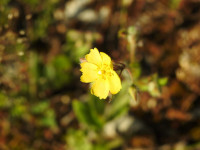
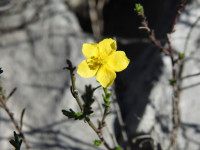
The flowers are hermaphroditic, actinomorphic, and pentamerous, bright yellow or pale yellow tending to whitish, with a characteristic dark spot – brown or violet – at the base of the petals, which is an important diagnostic feature. The petals, spatulate, measure up to 5 mm in length and are easily deciduous. The calyx consists of five sepals, of which the three inner ones are larger (about 4 × 8 mm), ovate or oblong, keeled and acute, with a triple vein; the two outer sepals are smaller, elliptic and obtuse, not enlarging during fruiting. The flowers are borne on peduncles 5 to 9 mm long, inserted in a short and scorpioid cyme that precedes anthesis.
The fruit is a coriaceous, glabrous loculicidal capsule, divided into three ovate valves, obtuse or truncated at the apex, measuring between 4 and 6 mm. Inside, there are numerous shiny brown seeds, dotted with whitish tubercles.
The root system, typical of annual herbaceous species, is generally shallow, suitable for dry and poor soils.
Habitat and distribution
The species is typical of Mediterranean and subatlantic environments, with a range extending along the Mediterranean coasts, but with extensions to the north and east. In Italy it is mainly widespread in the Ligurian regions, along the Peninsula up to the north, in Sardinia, Sicily, Corsica, and minor islands. Populations are also present in Abruzzo, Marche, and Emilia, and it is found in some dry valleys of Piedmont and areas such as Lumezzane (Brescia) and the Euganean Hills.
It prefers dry and sunny habitats, such as uncultivated lands, pastures, and acidic sandy soils, often siliceous, from sea level up to about 800 meters altitude. It is adapted to poor and well-drained substrates, with predominantly full sun exposure.
Flowering period
Flowering mainly extends from March to May. In some locations and particular environmental conditions, especially in low light, the plant can also produce very small terminal flowers or cleistogamous flowers, which self-pollinate without opening.
Ecology and pollination
The flowers, thanks to the dark spot at the base of the petals, attract numerous pollinating insects, including bees and other hymenopterans, which promote cross-pollination. The hermaphroditic structure and the presence of numerous stamens facilitate pollen production. The presence of cleistogamous flowers in low light conditions represents an adaptive reproductive strategy to ensure fertilization even in less favorable environments.
Seed dispersal occurs through the loculicidal capsule that opens at maturity, releasing numerous seeds equipped with tubercles, which probably facilitate mechanical dispersal in the soil.
Curiosities and traditional uses
The species is sometimes used as an ornamental plant for rock gardens, appreciated for its early flowering and the bright color of the flowers. No significant traditional medicinal or food uses are documented, nor particular references in local folklore. However, its common name, "Spotted Rock-Rose," probably refers to the dark spot on the petals, which can resemble the eye or spotted plumage of a rock-rose.
Etymology
The genus name derives from the Latin "túber," meaning "tuber" or "swelling," probably referring to the tuberculate surface of the seeds. The specific name "guttata" derives from the Latin "gútta," meaning "drop," referring to the characteristic dark drop-shaped spot present at the base of the petals.
The Italian common name "fior gallinaccio" seems to refer to the dark spot on the petals that can recall the characteristic spotting of some gallinaceous species.
Sources
- Prof. S. Pignatti, "Flora d'Italia"
- Acta Plantarum - Flora delle regioni italiane (scheda di Daniela Longo)
- World Flora Online (WFO)
Characteristics
Scheda botanica
| Famiglia | Cistaceae |
|---|---|
| Fioritura | marzo – maggio |
| Forma biologica | Scapose |
| Habitat | with yellow flowers, plant with a scapose habit |
Domande frequenti
- Quando fiorisce Spotted Rock-Rose?
- Spotted Rock-Rose fiorisce marzo – maggio.
- Che tipo di pianta è Spotted Rock-Rose?
- Spotted Rock-Rose è una Therophytes (Scapose) secondo la classificazione di Raunkiaer.
- A quale famiglia appartiene Spotted Rock-Rose?
- Spotted Rock-Rose appartiene alla famiglia botanica Cistaceae.
Where I found it (9 sightings)
Classification
- Kingdom
- Plantae
- Family
- Cistaceae
- Full name
- Tuberaria guttata (L.) Fourr.
- Synonyms
- Cistus guttatus
- Life form
- Therophytes scapose
Similar species
Search for species with similar characteristicsNoticed an error in the identification? Write to me
Other species of the same family
Cistaceae
Explore
Other species of Cistaceae