Botanical species
Convolvulus cantabrica
L.
Cantabrian Bindweed
Description
Morphological description
Perennial herbaceous plant, rhizomatous, belonging to the family Convolvulaceae, it generally has a prostrate-ascending and very branched habit. The height ranges between 20 and 50 cm. The stem is circular in cross-section, covered with dense pubescence, with spreading hairs and a velvety appearance, especially on the lower part, while on the upper area the hairs are more appressed. It is not a twining plant, therefore it does not coil around other plant elements.
The leaves are alternately arranged along the stem and vary in shape between the base and the apex of the plant. The basal leaves are spatulate, 1 to 4-5 cm wide, often with a broad and short petiole and wavy margins, of a broader and obtuse shape. The upper leaves are narrower, linear, 25 to 40 mm long and 3-5 mm wide, canaliculate and also obtuse at the tip. Both leaf surfaces are covered with dense pubescence that gives them a slightly whitish appearance.
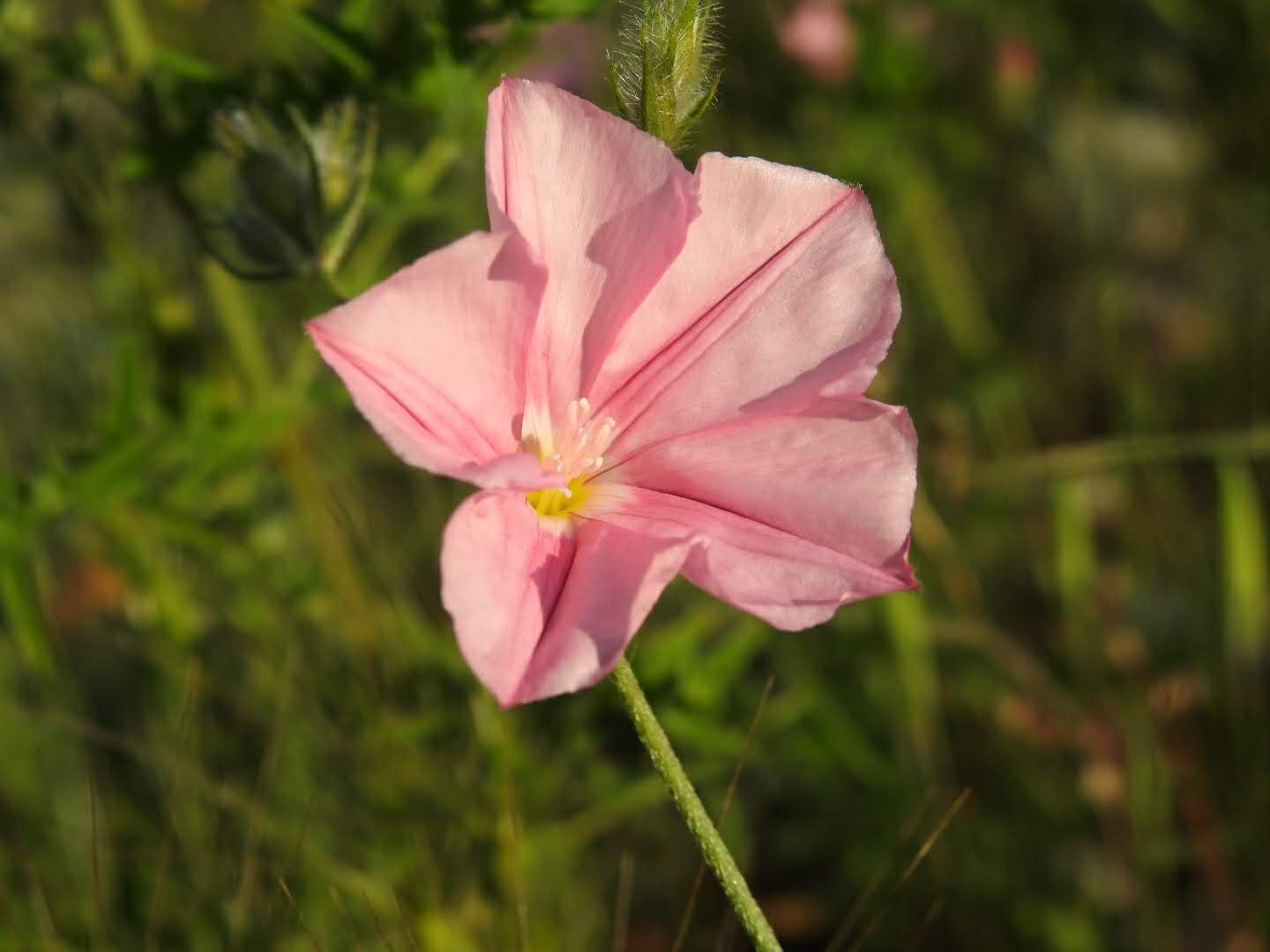
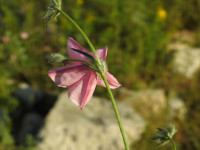
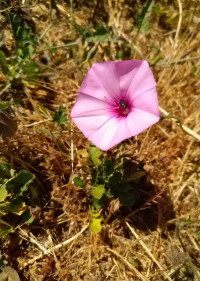
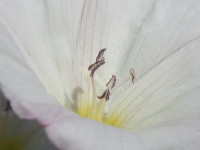
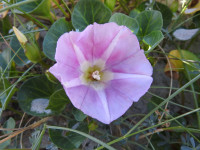
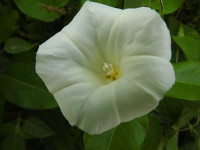
The flowers are solitary or grouped in small clusters of 2-4 units, arranged in loose spikes at the tips of the branches or on long axillary peduncles that exceed in length the leaf to which they are associated. The corolla, widely open and funnel-shaped, has a diameter of 3-4 cm and is pink, with more intense shades on the folds, which in some varieties can fade to almost white. The calyx is hirsute, with five subequal, pointed sepals about 5 mm long, and covered with pubescence. The flower has five stamens with white anthers and a villous ovary, while the style and stigma are white. During the night, the flower closes.
The fruit is a globose capsule, pubescent in the early stages, becoming glabrous at maturity, shorter than the calyx, containing 2 to 4 blackish seeds.
The root system is rhizomatous with a woody rhizome from which the prostrate and spreading branches arise.
Habitat and distribution
The species is typical of Mediterranean climate regions and extends throughout the eurymediterranean area. In Italy it is mainly present along the coasts and in the hilly and mountainous areas of the North, Center and South, up to about 1200 m altitude. It is found in Liguria, the Peninsula, Sicily, Sardinia, Corsica and other minor islands; it is also reported on the Trieste and Gorizia Karst, in the Euganean Hills and on the Eastern Prealps from Lake Garda to Lake Como.
It prefers habitats characterized by calcareous, rocky and dry soils, such as rocky riverbeds, sunny pastures, road margins and open environments in general. It favors sunny exposures and well-drained soils.
Flowering period
Flowering occurs mainly from May to October, with possible variations related to altitude and latitude. In general, the species blooms during the warm season, taking advantage of the summer period and part of autumn.
Ecology and pollination
The species reproduces through entomogamous pollination, with pollinating insects visiting the flowers to collect nectar and pollen. The flower structure, widely open and pink in color, is suitable to attract pollinating insects.
Seed dispersal occurs through the capsule which, once mature, releases the blackish seeds. The wide distribution of the species is facilitated by the ability to root via rhizomes and by resistance to arid and rocky environmental conditions.
Curiosities and traditional uses
Cantabrian Bindweed is a toxic species, but it has recognized medicinal properties especially in the field of traditional phytotherapy. It is known for its purgative properties, historically used for the treatment of constipation.
It is important to emphasize that medicinal and food uses are to be considered for informational and traditional purposes only, and do not replace professional medical advice, given the toxicity of the plant.
Etymology
The genus name, Convolvulus, derives from the Latin convolvere, meaning “to wrap,” referring to the twining stems typical of many species of the genus, although in this species the stem does not coil. The specific epithet cantabrica refers to the historical region of Cantabria, in northern Spain, or to the Cantabrian mountains, from which the species takes its name.
The Italian common name "vilucchio cantabrico" also derives from this geographic association and from the characteristic shape of the flowers, recalling the delicacy and pink coloration of the petals.
Sources
- Prof. S. Pignatti, Flora d'Italia
- Acta Plantarum - Flora delle regioni italiane (sheet by Giuliano Salvai)
Characteristics
Where I found it (5 sightings)
Classification
- Kingdom
- Plantae
- Family
- Convolvulaceae
- Full name
- Convolvulus cantabrica L.
- Life form
- Emicriptofite scapose
Similar species
Search for species with similar characteristicsNoticed an error in the identification? Write to me
Other species of the same family
Convolvulaceae
Explore
Other species of Convolvulaceae