Botanical family
Convolvulaceae
Description
Botanical characteristics
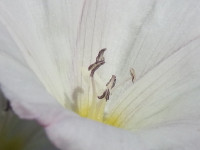
The plants belonging to this family are predominantly herbaceous, often climbing or creeping. The leaves are simple, alternate, and without stipules; in some particular cases, such as in the parasitic genus Cuscuta, the leaves are reduced to small scales. The flowers are hermaphroditic and actinomorphic (radially symmetrical), generally pentamerous (composed of five parts). The calyx and corolla are well distinct, with the stamens inserted at the base of the corolla. The ovary is superior, meaning it is located above the point of attachment of the other floral organs. The fruit can take various forms: capsule, berry, or nut, but in any case it presents two seeds per locule (internal chamber of the fruit). Pollination is mainly entomophilous, carried out especially by butterflies.
Distribution and diversity
This family is widely distributed worldwide, with a prevalence in tropical and subtropical regions, but some species are also found in temperate zones. Worldwide it includes about 60 genera and about 1300 species, with good diversity especially in warm climate areas. In Italy, 6 representative genera are present: Cuscuta, Cressa, Dichondra, Calystegia, Convolvulus, and Ipomoea, often characterized by herbaceous climbing or creeping plants.
Main genera and representative species
Among the best-known genera are:
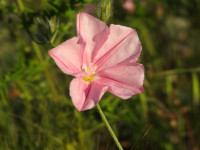
- Convolvulus: includes climbing or creeping species, often with funnel-shaped flowers, also widespread in Italy.
- Ipomoea: includes species of great interest both ornamental and alimentary, such as the sweet potato (Ipomoea batatas), known for its edible tuberous roots.
- Cuscuta: particularly interesting for its parasitic habit and leaves reduced to scales.
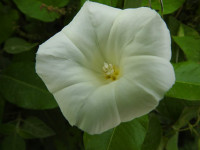
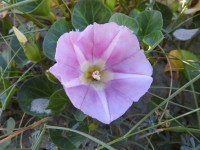
- Calystegia: similar to Convolvulus, with funnel-shaped flowers and climbing growth.
- Cressa and Dichondra: minor genera present in Italy, with more discreet characteristics and often of ecological interest.
Etymology
The name of the family derives from the genus Convolvulus, which in turn takes its name from the Latin convolvere, meaning "to roll" or "to twist," referring to the climbing habit and the leaves or stems that wrap around other plants or supports.
Curiosities and uses
Some species of this family have great food value: for example, the tuberous roots of Ipomoea batatas (sweet potato) are consumed in many cultures as a source of carbohydrates. The leaves of other species, such as water spinach, are also used as vegetables. From a medicinal point of view, some seeds are used for their purgative properties. Some species contain ergot alkaloids, substances probably at the origin of traditional psychedelic uses, due to fungal infections related to the genus Claviceps. Many species are also appreciated for ornamental purposes and are marketed under the generic name "Morning glory." Some exotic species, such as Humbertia madagascariensis, are woody and used for timber production.
Sources
- Wikipedia

Explore
Other botanical families