Botanical species
Convolvulus sepium
L.
Vilucchio bianco
Description
Morphological description
Perennial herbaceous plant belonging to the family Convolvulaceae, vilucchio bianco is characterized by twining, glabrous stems, up to 3 meters long, which skillfully wrap around plant supports or nearby structures. The plant is rhizomatous, with a root system that allows rapid expansion and the maintenance of the plant over time.
The leaves are alternate, petiolate, with an ovate or ovate-lanceolate shape, often sagittate, presenting a cordate base and an acute apex. The leaf margin is undulate and the length can reach 10 cm. This leaf morphology, together with the climbing habit, allows the plant to exploit vertical space in hedges or forest clearings.
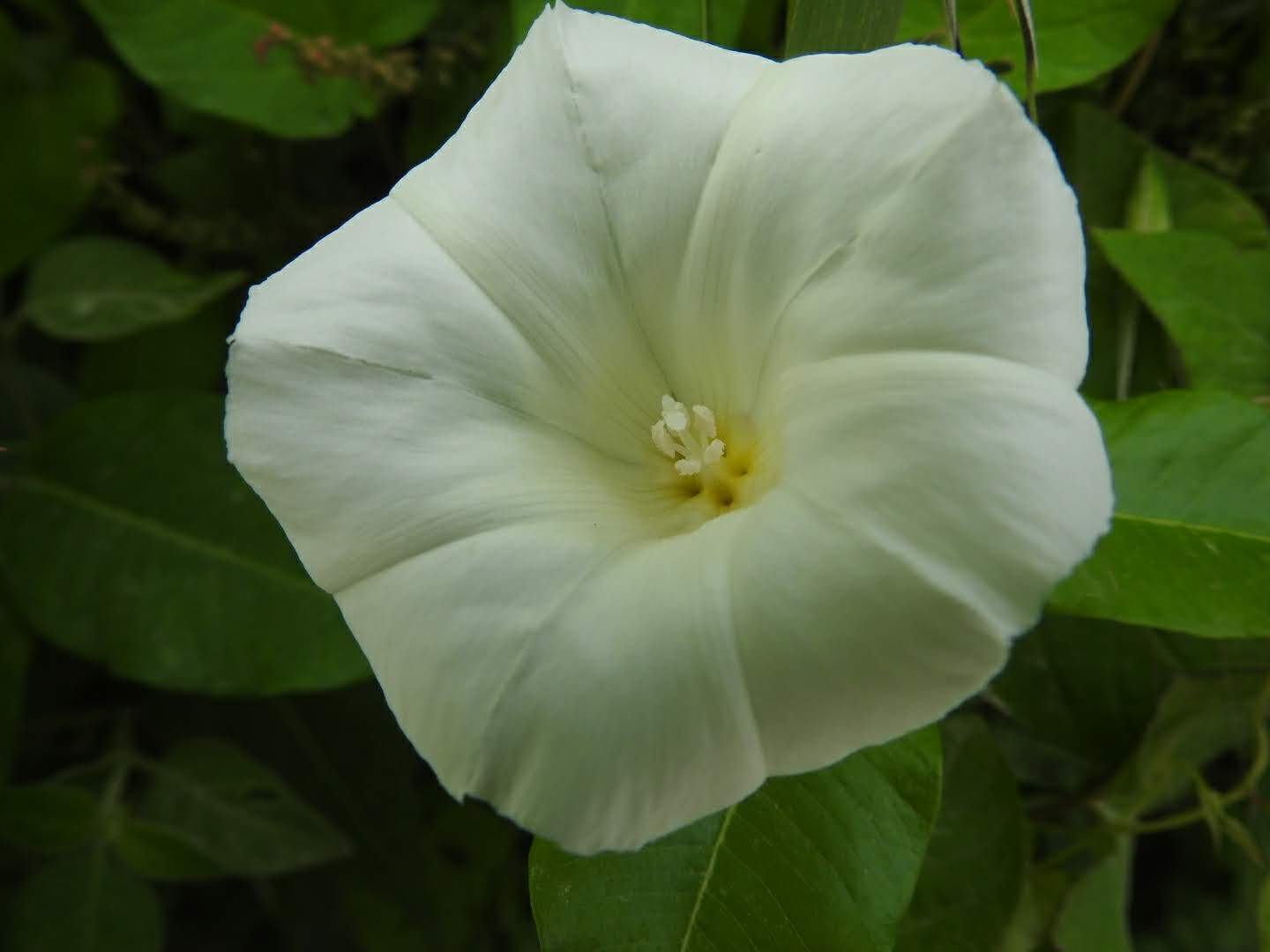
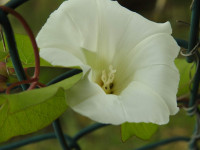
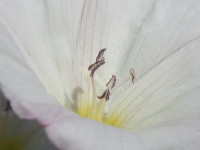
The flowers are solitary, placed in the leaf axils on long thin peduncles. The calyx is divided into five lobes, often streaked with red, and protected by two large oval, leaf-like, flat bracts that partially wrap the calyx without completely closing it. The corolla is bell-shaped, with a diameter of 4-6 cm, and is white, sometimes with slight pinkish shades. The flowers are slightly lobed and stand out for their delicacy and brightness. The fruit is a globose capsule containing 2 to 4 round black seeds.
Habitat and distribution
Vilucchio bianco is a very common and widespread species throughout the Italian territory, present from sea level up to about 1,400 meters in altitude. It prefers humid environments rich in nutrients, typically clayey or moderately heavy soils. It is commonly found in wooded environments, hedges, clearings, and along the edges of cultivated fields, vineyards, and uncultivated areas.
As a weed, it can easily colonize herbaceous and cereal crops, exploiting its rapid growth and rhizomatous capacity. It is typical of Eurasian regions, with a distribution extending from Europe to Japan and, more broadly, also in North Africa.
Flowering period
Flowering mainly occurs between May and September, with the possibility of extending until October in some areas or under favorable conditions. The plant can also establish late in soils subject to seasonal flooding, exploiting the end of summer and the beginning of autumn to flower and complete its reproductive cycle.
Ecology and pollination
Vilucchio bianco presents a pollination strategy adapted to both nocturnal and diurnal insects. The flowers close in case of rain or overcast skies, but often remain open even during the night, exploiting the presence of moths and other nocturnal insects for pollination. Among these, a particularly relevant species is the Convolvulus Hawk-moth (Herse convolvuli), a butterfly with a long proboscis capable of reaching the nectar secreted at the base of the flower, thus favoring effective pollen transfer.
Seed dispersal occurs through the capsules which, once mature, release the black, round, and small-sized seeds, favoring the colonization of new spaces especially in disturbed environments or those subject to seasonal runoff.
Curiosities and traditional uses
Vilucchio bianco has a long history of use in herbal and medicinal fields, although it is recognized as a toxic officinal plant. Its properties include cholagogue, purgative, soothing, febrifuge, and diuretic actions. Traditionally, leaf infusions have been used to stimulate liver function and as a remedy for constipation.
From an ecological point of view, the plant shows remarkable adaptability and rapid growth, allowing it to colonize difficult environments, such as soils subject to seasonal flooding, where it can establish late and flower in autumn.
From folklore and naturalistic observation emerges the interesting behavior of the flowers, which close in bad weather conditions but remain open at night, exploiting the presence of nocturnal pollinators for reproduction.
Etymology
The genus name, Convolvulus, derives from the Latin convolvo, meaning "to wrap," referring to the climbing and twining habit of the stems that coil around supports. The specific epithet sepium recalls the preference of this species for hedges and shrubby environments, typical habitats in which it easily develops.
The common Italian name "vilucchio bianco" probably refers to the light color of the flowers and its affinity for hedge environments and cultivated or spontaneous borders.
Sources
- Acta Plantarum - Flora delle regioni italiane (actaplantarum.org)
- Acta Plantarum - Flora delle regioni italiane (scheda di Marinella Zepigi)
- Tela Botanica / H. Coste, "Flore descriptive et illustrée de la France"
Characteristics
Scheda botanica
| Famiglia | Convolvulaceae |
|---|---|
| Fioritura | maggio – settembre |
| Forma biologica | Scandent |
| Habitat | with white flowers |
| Uso officinale | Pianta officinale |
Domande frequenti
- Quando fiorisce Vilucchio bianco?
- Vilucchio bianco fiorisce maggio – settembre.
- Che tipo di pianta è Vilucchio bianco?
- Vilucchio bianco è una Hemicryptophytes (Scandent) secondo la classificazione di Raunkiaer.
- A quale famiglia appartiene Vilucchio bianco?
- Vilucchio bianco appartiene alla famiglia botanica Convolvulaceae.
Where I found it (7 sightings)
Classification
- Kingdom
- Plantae
- Family
- Convolvulaceae
- Full name
- Convolvulus sepium L.
- Synonyms
- Calystegia sepium (L.) R.Br.
- Life form
- Hemicryptophytes scandent
Similar species
Search for species with similar characteristicsFurther reading
Noticed an error in the identification? Write to me
Other species of the same family
Convolvulaceae
Explore
Other species of Convolvulaceae