Botanical species
Convolvulus soldanella
L.
Bindweed Family
Description
Morphological description
Small perennial herbaceous plant, with a creeping habit and prostrate stems, reaching a length of up to 50-60 cm. The stem is generally covered with sand, especially in the basal part, and tends to be erect only towards the apex. The root system consists of a long stoloniferous rhizome, which extends deeply into the sand to capture moisture present in coastal substrates. This rhizome allows the plant to survive and regenerate even in the presence of sand displacement caused by wind.
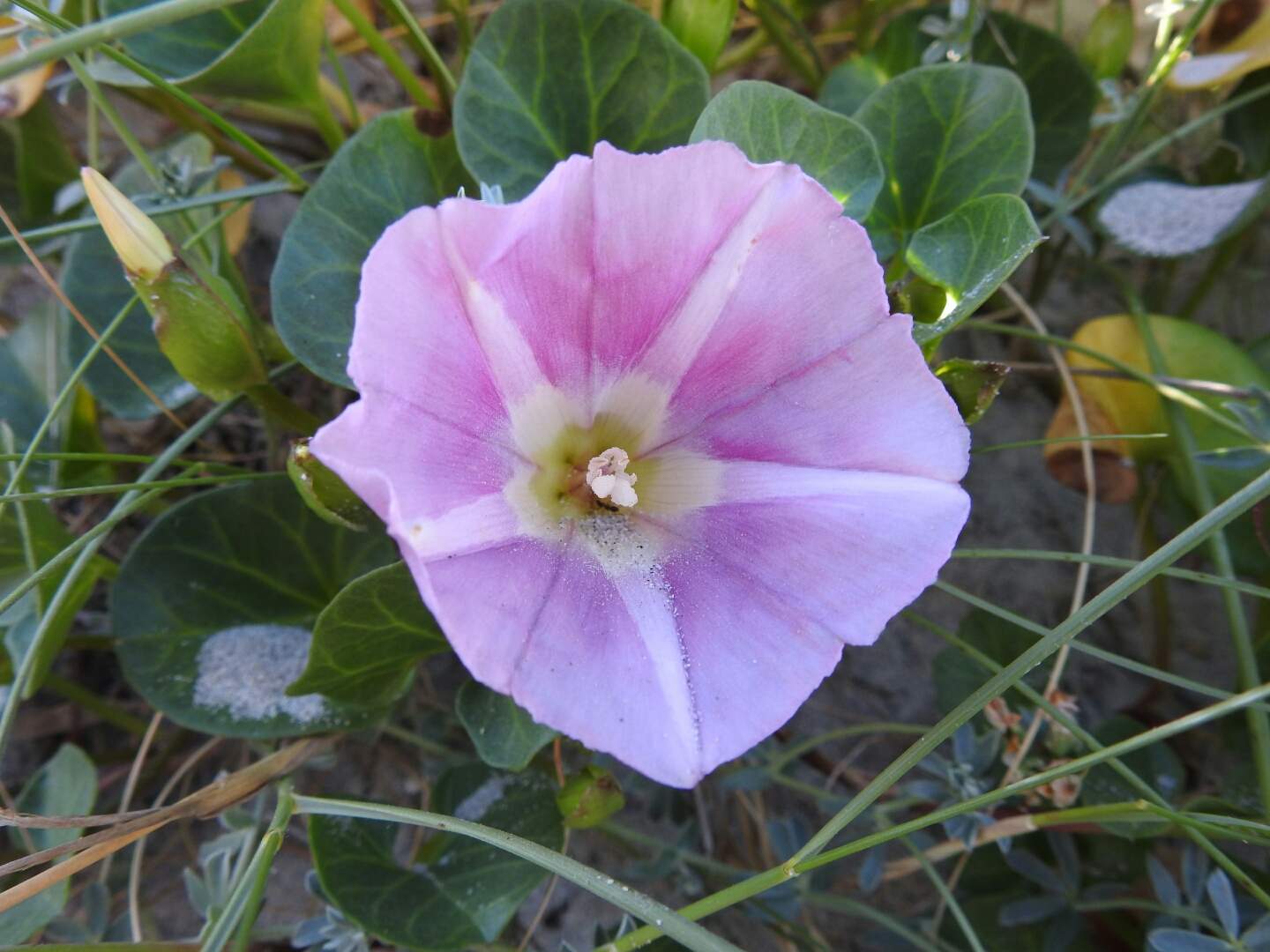
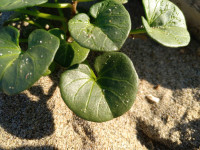
The leaves are small, reniform (inverted heart-shaped), thick and somewhat fleshy, with a crenulate margin. They are arranged alternately along the stem and have a long petiole. The leaf color is dark green with possible bluish shades, and their width can be twice the length. The basal auricles of the leaves are rounded and sometimes slightly sinuous.
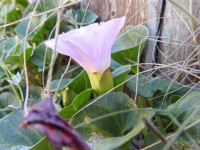
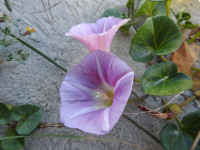
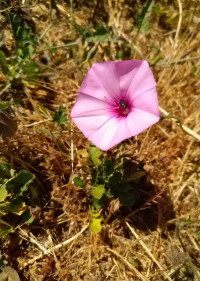
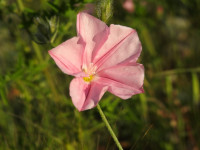
The flowers are single or arranged in pairs, borne on axillary peduncles 2 to 6 cm long, which can be longer or shorter than the leaves. The corolla is funnel-shaped, medium-large in size (4-5 cm in diameter), pink with five lighter longitudinal stripes, and with a glabrous surface. The calyx is glabrous, composed of five oval and obtuse lobes, partially enveloped by two oval-papery bracteoles that cover the calyx itself, a distinctive characteristic of the species compared to other related species of the genus. Each flower has five stamens, a superior ovary, and a bilobed stigma. The flowering is ephemeral: each flower lasts only one day.
The fruit is an ovoid capsule, glabrous, which opens along the central veins of the carpels by breaking the internal septa (septifragal), releasing four black, curved, and angular seeds.
Habitat and distribution
Typical species of coastal areas, it grows mainly on maritime sandy dunes, on well-preserved substrates with little human disturbance. It is a pioneer plant of dune environments, capable of colonizing and stabilizing beaches thanks to the rhizomatous system that penetrates deeply into the sand. The creeping habit and the ability to quickly emerge from the sand make it well adapted to the dynamic coastal environments.
In Italy it is present along all sandy coasts, from the Mediterranean Sea to the Adriatic Sea and the Tyrrhenian Sea, generally from the littoral belt to low altitude. It is also widespread in many other Mediterranean regions, as well as in other temperate areas of the world, with a cosmopolitan distribution.
Flowering period
Flowering extends from June to August in Italy, with possible local variations related to climate and exposure. In other Mediterranean areas and Western Europe, flowering can continue until October. The flowers are ephemeral, but the plant produces new flowers throughout the entire vegetative activity period.
Ecology and pollination
Being an evergreen perennial plant, the species plays an important role in dune ecosystems, contributing to fixing the sand and stabilizing the dunes. Pollination is mainly entomophilous: the flowers attract pollinating insects, particularly bees and other hymenopterans, attracted by the pink color and the funnel shape of the corolla.
Seed dispersal occurs through the septifragal capsule which, opening, releases the black and angular seeds. Their shape and size facilitate mechanical dispersal and probably also dispersal by wind or small animals, although no specific dispersal mechanisms are known.
Curiosities and traditional uses
This species, despite its beauty and important ecological role, is becoming increasingly rare due to growing anthropization of coastal areas and beach transformation. No significant traditional medicinal or food uses are documented, nor particular references in Italian folklore, but the plant is mainly appreciated for its aesthetic and environmental value.
Etymology
The genus name derives from the Latin convolvo, meaning “to wrap,” referring to the often twining and wrapping stems of many species in the genus. The specific name soldanella refers to the shape of the leaves, which resemble small coins, i.e., rounded and flat leaves. The Italian common names, “Convolvolo delle spiagge” or “Vilucchio marittimo,” indicate the peculiarity of the coastal habitat and the relationship with the genus Convolvulus.
Sources
- Acta Plantarum - Flora delle regioni italiane (scheda di Giuliano Salvai)
- Tela Botanica / H. Coste, "Flore descriptive et illustrée de la France"
Characteristics
Scheda botanica
| Famiglia | Convolvulaceae |
|---|---|
| Fioritura | giugno – agosto |
| Forma biologica | Rhizomatous |
| Habitat | creeping plant, with pink flowers, Perennial plant |
Domande frequenti
- Quando fiorisce Bindweed Family?
- Bindweed Family fiorisce giugno – agosto.
- Che tipo di pianta è Bindweed Family?
- Bindweed Family è una Geophytes (Rhizomatous) secondo la classificazione di Raunkiaer.
- A quale famiglia appartiene Bindweed Family?
- Bindweed Family appartiene alla famiglia botanica Convolvulaceae.
Where I found it (4 sightings)
Classification
- Kingdom
- Plantae
- Family
- Convolvulaceae
- Full name
- Convolvulus soldanella L.
- Synonyms
- Calystegia soldanella (L.) Roem. & Schult.
- Life form
- Geophytes rhizomatous
Similar species
Search for species with similar characteristicsFurther reading
Noticed an error in the identification? Write to me
Other species of the same family
Convolvulaceae
Explore
Other species of Convolvulaceae