Botanical species
Convolvulus arvensis
L.
Field Bindweed
Description
Morphological description
Perennial herbaceous plant with a root system formed by a long, fragile, whitish rhizome, which allows rapid regeneration even from very small fragments. The stems, thin and striated, are generally twining and can reach lengths exceeding 1 meter. They have an angled (hexagonal) cross-section, are glabrous or slightly pubescent, and often twisted to the left (levogyrous). The growth habit is creeping or climbing, with the ability to climb on nearby supports.
The leaves are alternate, petiolate (petiole length 0.3-3 cm), with an ovate, oblong-ovate or hastate (arrowhead-shaped) blade, 2 to 5 cm long and 1 to 4 cm wide. The margin is entire, often undulate or slightly revolute. The apex ranges from obtuse to subacute, sometimes mucronate. The upper leaves are progressively smaller and more lanceolate.
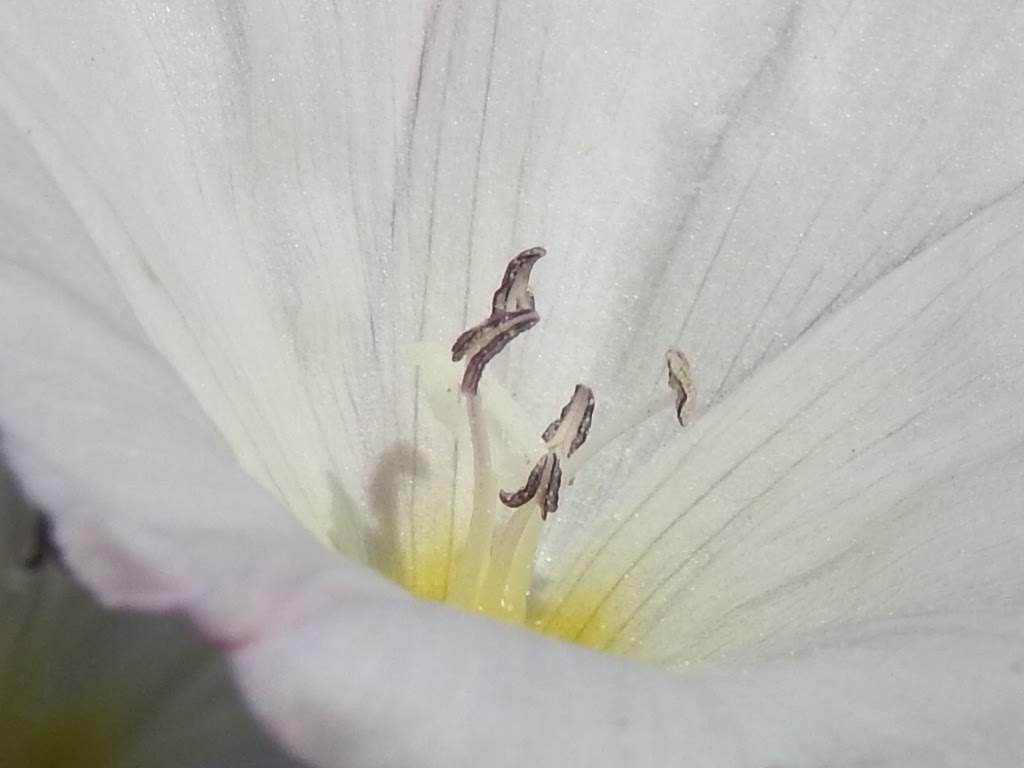
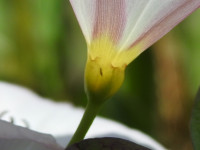
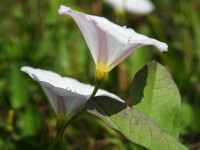
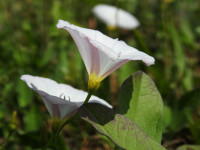
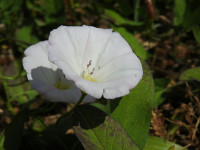
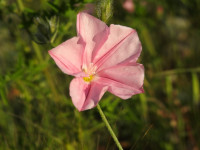
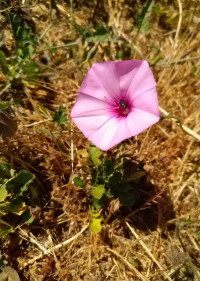
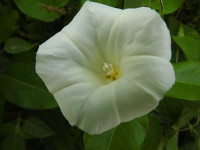
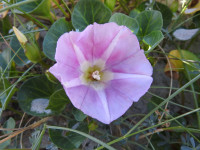
The flowers are solitary or in small groups of 2-3, located in the axils of the median leaves on peduncles up to 8 cm long, longer than the leaves themselves. Each flower is accompanied by two linear bracts about 3 mm long, spaced from the flower. The calyx is campanulate, formed by 5 oblong-elliptic sepals, glabrous or with slight pubescence on the back, 3.5 to 5 mm long, with an obtuse or slightly retuse apex. The corolla is funnel-shaped, 2-3 cm wide and 1.5 to 2.5 cm long, white or pink in color with five darker longitudinal stripes alternating with white bands; the outer surface has slight pubescence on the median bands. The flowers open in the morning and close in the afternoon, sometimes emitting a faint vanilla scent. The stamens are five, of variable length, with violet-colored anthers. The stigma is bifid, with two divergent white filiform lobes.
The fruits are spherical or ovoid capsules, glabrous, 5-8 mm long, generally containing four dark seeds, black or brown, ovoid in shape with a tuberculate surface.
Habitat and distribution
Cosmopolitan species, very common throughout Italy and widely distributed in the Mediterranean basin, it grows in a wide range of environments, preferring anthropized and disturbed areas. It is frequent in cultivated fields, vegetable gardens, gardens, hedges, road margins, meadows, uncultivated areas, and soils rich in clay and nitrogenous substances. It grows from the plains up to about 1500 meters altitude.
In Italy, in northern regions and more humid environments, the plant tends to be glabrous or nearly so, with a white or slightly pink-spotted corolla. In the South and in drier areas, hairier or more hirsute forms are found, with more or less reddened corollas and sometimes a lignified stem base, adaptations linked to local environmental conditions.
Flowering period
Flowering extends from April to October, with possible geographic variation: in more temperate and humid climates it tends to start earlier and last longer, while in warmer and drier areas it may be more concentrated in the central months of the warm season.
Ecology and pollination
The species multiplies effectively both vegetatively, thanks to the ability to regenerate from underground rhizomes and adventitious buds, and sexually through seeds. The flowers, which open in the morning and close in the afternoon, are pollinated by pollinating insects attracted by the slight scent and the color of the corolla, which presents pigmented bands visible as signals for pollinators. Seed dispersal occurs at maturity from the globose capsule, but the main capacity for spread and survival is given by the underground rhizome, which makes the species one of the most invasive and difficult to control in crops.
Curiosities and traditional uses
This species is known as one of the most harmful and resistant weeds, especially in cultivated fields such as potatoes, tomatoes, and tobacco, where it can also transmit viruses harmful to crops. In the United States, it is considered among the most harmful weed plants.
From an ethnobotanical point of view, the plant contains resin glycosides (convolvulin), tannins, flavonoids, starch, and crystallizable sugars. Traditionally it has been used as a medicinal plant, with cholagogue, purgative, diuretic, and laxative properties due to the presence of a purgative glycoside. It has been employed in the treatment of abdominal and hepatic dropsy and for chronic constipation or due to liver insufficiency. For external use, the fresh plant was crushed and applied to facilitate the maturation of abscesses and boils. However, it is a toxic plant and its pharmacological use must be carried out with caution and under medical supervision.
The common name “vilucchio” and “convolvolo” reflects the characteristic of the stems to coil and climb. In Venetian popular culture, it is also known as “broglia” or “trigarella,” terms from which Italian words like “imbrogliare” or “intrigare” may derive, probably referring to its climbing and invasive nature.
Etymology
The generic name "Convolvulus" derives from Latin “convolvere,” meaning “to wrap,” referring to the flexible and twining stems that coil around supports. The specific epithet “arvensis” means “of the plowed fields,” indicating its typical habitat in cultivated and disturbed soils. The Italian common name “vilucchio” is of popular and regional origin, while “convolvolo” is a direct translation of the Latin name and recalls the climbing character of the plant.
Sources
- Prof. S. Pignatti, "Flora d'Italia"
- Acta Plantarum - Flora delle regioni italiane (scheda di Marinella Zepigi)
- Tela Botanica / H. Coste, "Flore descriptive et illustrée de la France"
- World Flora Online (WFO)
Characteristics
Scheda botanica
| Famiglia | Convolvulaceae |
|---|---|
| Fioritura | aprile – ottobre |
| Forma biologica | Rhizomatous |
| Habitat | with white flowers, with pink flowers |
| Uso officinale | Pianta officinale |
Domande frequenti
- Quando fiorisce Field Bindweed?
- Field Bindweed fiorisce aprile – ottobre.
- Che tipo di pianta è Field Bindweed?
- Field Bindweed è una Geophytes (Rhizomatous) secondo la classificazione di Raunkiaer.
- A quale famiglia appartiene Field Bindweed?
- Field Bindweed appartiene alla famiglia botanica Convolvulaceae.
Where I found it (6 sightings)
Classification
- Kingdom
- Plantae
- Family
- Convolvulaceae
- Full name
- Convolvulus arvensis L.
- Life form
- Geophytes rhizomatous
Similar species
Search for species with similar characteristicsFurther reading
Noticed an error in the identification? Write to me
Other species of the same family
Convolvulaceae
Explore
Other species of Convolvulaceae