Botanical species
Chenopodium album
L.
Fat-hen
Description
Morphological description
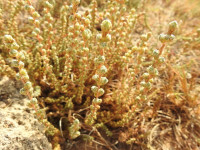
Annual herbaceous plant with an erect habit, which can reach variable heights from 10 up to 150 (sometimes 200) cm. The stem is simple or irregularly branched from the base, angular in section and longitudinally striated; the surface is glabrous, slightly glaucous and in some areas tends to be farinose, especially in the upper part. Some reddish striations may be present at the axil of the branches.
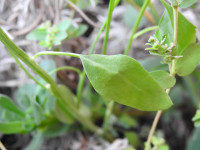
The leaves are alternate, generally petiolate, with petioles ranging from 1 to 4 cm depending on the leaf size. The blade has polymorphic shapes ranging from rhombic-ovate to lanceolate, with sizes from 3-4 cm in the smaller leaves up to 5-9 cm in the larger ones, which are generally 1.5 times longer than wide. The margins are variable: they can be entire, sinuously dentate or coarsely dentate with 3-6 teeth per side; the margins differ little between the left and right sides. The lower or younger leaves may present a farinose coating especially on the lower surface, which appears whitish or glaucous; localized reddening is sometimes observed near the petiole or along the leaf margin.
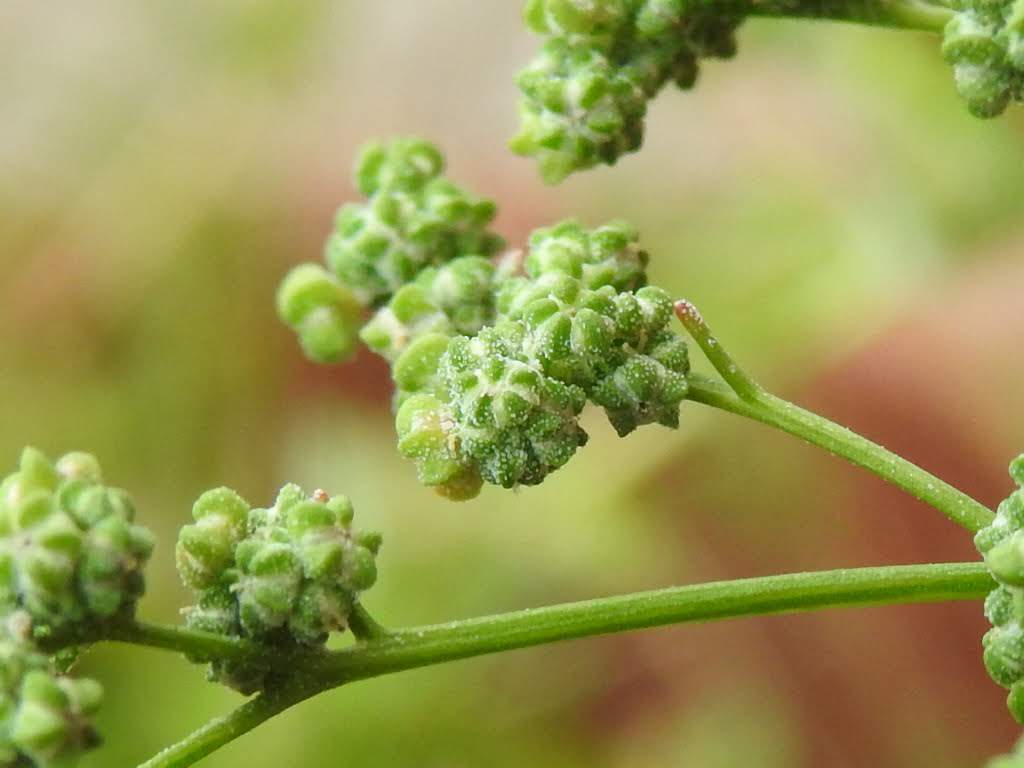
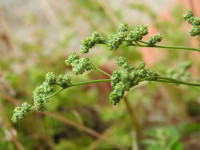
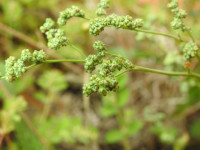
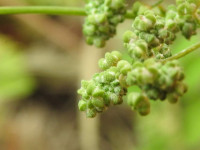
The inflorescence consists of compact, subglobose glomerules, 3-4 mm in diameter, arranged in spikes or panicles which may be naked or leafy at the base; the upper part tends to have more elongated and less leafy spikes. The flowers, hermaphroditic, are very small (about 1.5 mm in diameter) and greenish in color. The perianth is composed of five ovate-elliptic, keeled segments with membranous margins, which completely enclose the fruit until maturity.
The fruit is a depressed-ovoid utricle about 1.5 mm, containing a single black, shiny, lenticular and horizontal seed, with margins ranging from flattened to acute and a slightly rugose-keeled surface, with seed size from 1.2 to 1.6 mm.
The root system is taprooted, typical of annual herbaceous species, but not particularly extensive or deep.
Habitat and distribution
Cosmopolitan species, widespread in almost all Italian regions and throughout the Mediterranean basin, it grows in anthropized and natural environments. It frequents cultivated soils, vegetable gardens, hoeing areas, spring cereals, ruins, paths and nitrogen-rich soils, preferably in sunny exposures. It can be found from flatland up to 1500 meters above sea level, with isolated reports up to 2500 meters. It is a weed, often considered a pest, capable of competing with potato, wheat and vegetable crops.
Flowering period
Flowering extends from June to September-October, with some possible geographic variation linked to local climate and altitude. In more temperate and flat areas, flowering can begin as early as June, while in mountainous zones it can continue until autumn.
Ecology and pollination
The species is hermaphroditic and reproduces through small greenish flowers, which attract pollinating insects, although the presence of such a reduced and inconspicuous flowering also suggests a certain degree of self-pollination. Seed dispersal occurs mainly by wind and accidental transport by animals or human activities, facilitated by the presence of small, light seeds protected by membranous coverings.
Curiosities and traditional uses
Fat-hen is an edible species, known and used since prehistoric times in Europe and the Americas. The seeds, rich in lysine (an amino acid precursor of niacin), were used to produce flours for bread or polenta, while the leaves were consumed cooked as vegetables in soups or fillings. In Italy, especially in Tuscany, this plant is still used in traditional cuisine for ravioli fillings and to color fresh pasta.
From a medicinal point of view, in folk medicine it was used for its anti-inflammatory, laxative and antirheumatic properties, attributed to the content of iron and vitamins A, B and C. Despite its nutritional and therapeutic value, its use today is limited, partly replaced by related species such as Chenopodium bonus-henricus and spinach.
Historically, the species was cultivated in North America by indigenous peoples of the New Mexico, Arizona and Utah regions, and in Asia and India as a food resource to overcome famines. It is considered an invasive plant, capable of challenging agricultural crops due to its rapid growth and adaptability.
Etymology
The scientific name Chenopodium derives from the Greek “χήν” (chēn), meaning “goose”, and “πούς, ποδός” (pous, podos), “foot”, referring to the shape of the leaves which resemble a goose’s foot. The specific epithet “album” means “white”, recalling the characteristic farinose or glaucous coating that sometimes covers the plant, especially in the upper parts. The Italian common name “farinello” derives precisely from the presence of this farinose powder on the leaves and stem.
Sources
- Prof. S. Pignatti, Flora d'Italia
- Acta Plantarum - Flora delle regioni italiane (scheda di Antonino Messina)
- Tela Botanica / H. Coste, Flore descriptive et illustrée de la France
Characteristics
Scheda botanica
| Famiglia | Chenopodiaceae |
|---|---|
| Fioritura | giugno – settembre |
| Forma biologica | Scapose |
| Habitat | edible plant, with green flowers, annual plant |
| Uso alimentare | Commestibile |
Domande frequenti
- Quando fiorisce Fat-hen?
- Fat-hen fiorisce giugno – settembre.
- È commestibile Fat-hen?
- Fat-hen è considerata commestibile. Verifica sempre le parti eduli e la preparazione corretta prima del consumo.
- Che tipo di pianta è Fat-hen?
- Fat-hen è una Therophytes (Scapose) secondo la classificazione di Raunkiaer.
- A quale famiglia appartiene Fat-hen?
- Fat-hen appartiene alla famiglia botanica Chenopodiaceae.
Where I found it (5 sightings)
Classification
- Kingdom
- Plantae
- Family
- Chenopodiaceae
- Full name
- Chenopodium album L.
- Life form
- Therophytes scapose
Similar species
Search for species with similar characteristicsFurther reading
Noticed an error in the identification? Write to me
Other species of the same family
Chenopodiaceae
Explore
Other species of Chenopodiaceae