Botanical species
Salicornia fruticosa
(L.) L.
Shrubby Swampfire
Description
Morphological description
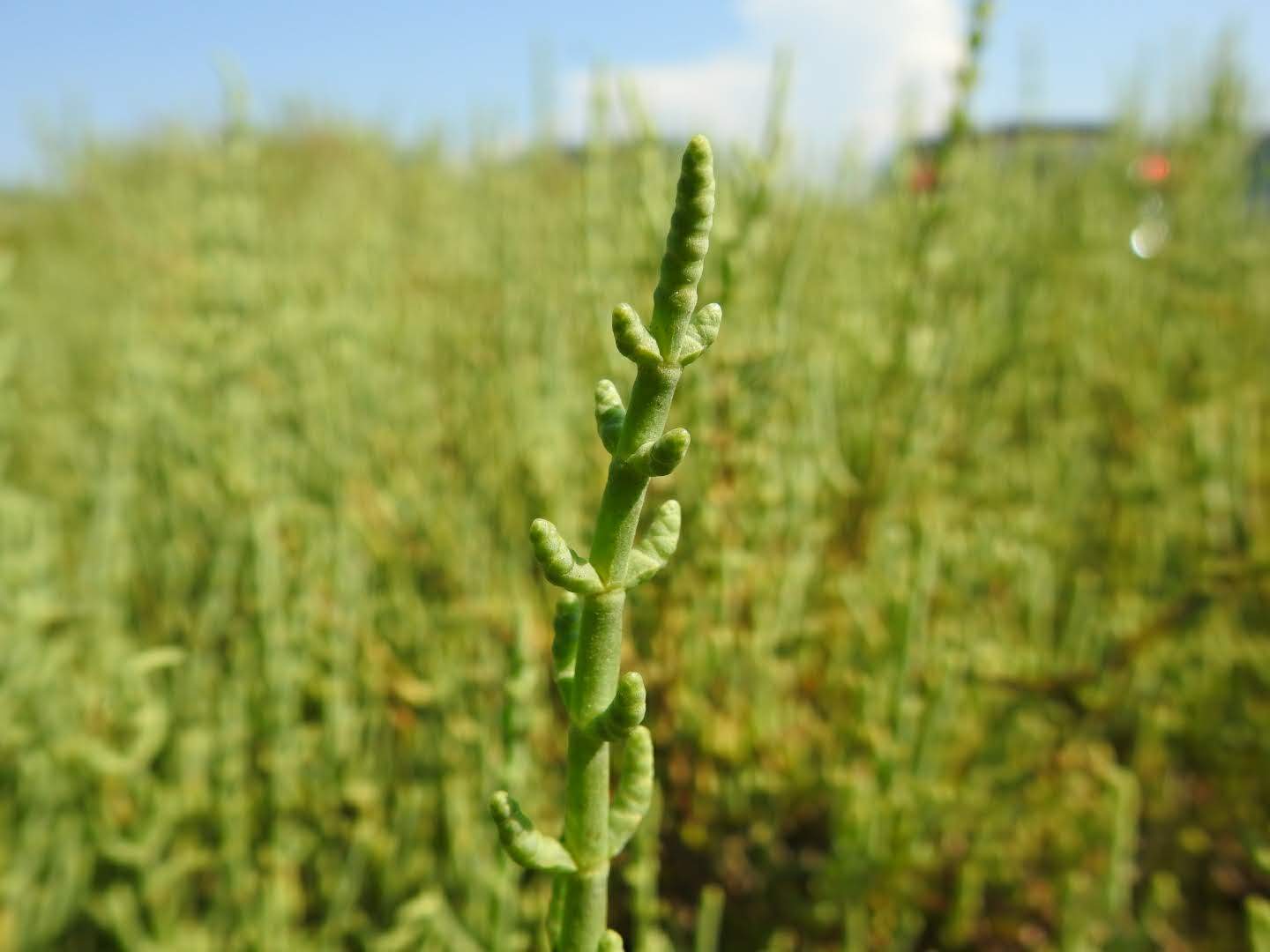
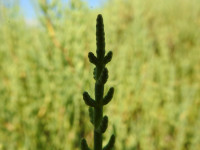
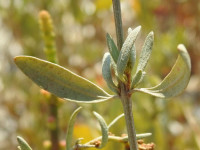
It is a perennial succulent shrub, with a bushy and highly branched habit, which can reach a height between 30 and 100 cm. The stem is erect, glaucous tending to reddish, especially in the fertile segments, and has a slightly waxy surface that gives a typical glaucous coloration. The lower branches are lignified and cylindrical, sometimes rooting at the nodes, while the upper ones are fleshy, erect, and never rooting.
The leaves are very reduced to fleshy scales, fused at the margins and adhering to the internodes, glaucous green in color which turns to reddish shades with the arrival of autumn. These scales are arranged oppositely and alternately along the stem.
The inflorescences consist of terminal spikes 1-5 cm long, formed by small flowers grouped in threes, of which the central one is slightly distinct from the two lateral ones, all very pale yellow in color. The flowers are often cleistogamous, that is, they self-pollinate without opening. Upon flower drop, a characteristic three-chambered locule remains in the fleshiness of the fertile segment, observable with a good magnifying glass.
The fruit is a fleshy utricle enclosed in the perianth, containing small, black seeds, achenes with short and stiff bristles. The root system is taprooted, allowing the plant to anchor firmly in sandy or clayey soils.
Habitat and distribution
The species is typical of Mediterranean coastal areas, present along the Italian coasts and in many other Eurymediterranean areas, with extensions also towards more northern and eastern regions. It prefers halophilic habitats, that is environments with saline soils periodically submerged by seawater, such as salt marshes, brackish lagoons, coastal swamps, and clayey edges.
It grows on sandy or silty substrates, often associated with other halophilic species such as Juncus maritimus, Puccinellia palustris, Arthrocnemum macrostachyum, Salicornia veneta and Halimione portulacoides. The growth altitude is generally low, typical of coastal and flat areas, up to a few meters above sea level.
Flowering period
Flowering mainly occurs between July and August, with possible extension until September-October in more temperate or Mediterranean areas. Anthesis is late and the flowers, although small, are well organized in terminal spikes, with a cycle well adapted to saline environmental conditions and strong summer irradiation.
Ecology and pollination
Shrubby Swampfire has a predominantly autogamous reproductive strategy, with often cleistogamous flowers that ensure seed formation without the need for external pollination. However, the floral structure also allows cross-pollination, although no specific pollinating insects are documented for this species.
Seed dispersal probably occurs by falling and water transport, given the conditions of the wet and brackish habitats in which it lives. The succulent structure and the ability to withstand high salinity allow the species to survive in extreme environments, with high water and salt stress.
Curiosities and traditional uses
The common name “salicornia” derives from the French salicorne, itself composed of sal (salt) and corne (horn), referring to the segmented morphology of the stems and the saline habitat. The specific name fruticosa indicates the shrubby appearance of the plant.
This plant has historically played an important role both from a food and medicinal point of view. Rich in minerals such as iodine, bromine and vitamin C, Shrubby Swampfire has been used since ancient times as a remedy for diseases related to deficiencies of these elements, such as scurvy and thyroid pathologies. The Vikings, for example, appreciated it as a source of vitamin C during long sea voyages.
In cooking, until the post-war period, young branches were collected and consumed as fresh vegetables, often seasoned with oil and lemon or preserved in vinegar with aromas such as bay leaf, pepper and garlic. It was a saline salad, with a characteristic flavor, paired with boiled meats or as a summer side dish.
Moreover, from the combustion of the plants, ashes rich in potassium carbonate were obtained, traditionally used for their cleaning properties and in glass production, making Shrubby Swampfire a resource also in the industrial field.
Etymology
The term Salicornia derives from the French salicorne, which combines sal (salt) and corne (horn), a clear reference to the plant's saline habitat and the segmented and horny shape of its stems. The specific epithet fruticosa means “shrub-like”, that is similar to a small shrub or bush, referring to its bushy and branched form.
Sources
- Prof. P.V. Arrigoni, "Flora analitica della Toscana", "Flora dell'Isola di Sardegna"
- Acta Plantarum - Flora delle regioni italiane (scheda di Mirna Medri)
- Tela Botanica / H. Coste, "Flore descriptive et illustrée de la France"
Characteristics
Scheda botanica
| Famiglia | Chenopodiaceae |
|---|---|
| Fioritura | luglio – agosto |
| Forma biologica | Succulents |
| Habitat | succulent plant, biennial plant, annual plant |
Domande frequenti
- Quando fiorisce Shrubby Swampfire?
- Shrubby Swampfire fiorisce luglio – agosto.
- Che tipo di pianta è Shrubby Swampfire?
- Shrubby Swampfire è una Chamaephyte (Succulents) secondo la classificazione di Raunkiaer.
- A quale famiglia appartiene Shrubby Swampfire?
- Shrubby Swampfire appartiene alla famiglia botanica Chenopodiaceae.
Where I found it (5 sightings)
Classification
- Kingdom
- Plantae
- Family
- Chenopodiaceae
- Full name
- Salicornia fruticosa (L.) L.
- Synonyms
- Arthrocnemum fruticosum (L.) Moq, Salicornia europaea L. var. fruticosa L., Sarcocornia fruticosa (L.) A.J.Scott
- Life form
- Chamaephyte succulents
Similar species
Search for species with similar characteristicsFurther reading
Noticed an error in the identification? Write to me
Other species of the same family
Chenopodiaceae
Explore
Other species of Chenopodiaceae