Botanical species
Salsola kali
L.
Prickly Saltwort
Description
Morphological description
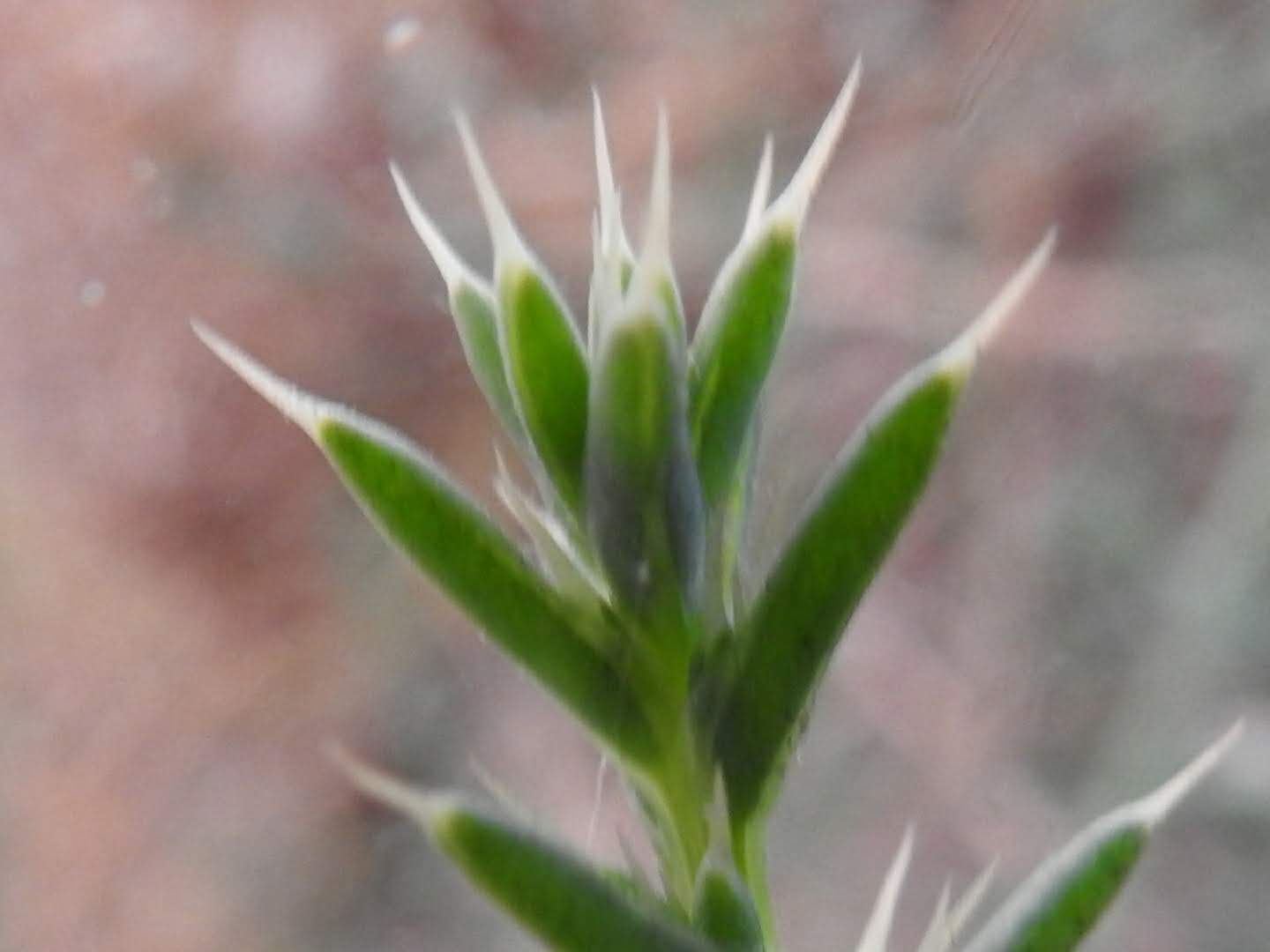
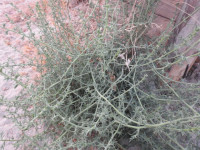
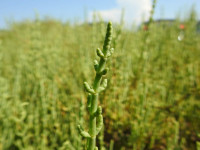
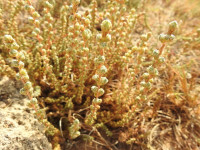
Annual herbaceous plant, Prickly Saltwort shows a variable habit, from prostrate to erect, with numerous reddish striated branches. Height can range from 10 to 60 cm. The stem generally has a quadrangular section, with patent branches often forming a cushion-like appearance. The stem surface can be slightly rough (hispidula) or almost glabrous.
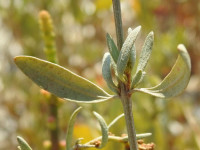
The leaves are oppositely arranged in the lower parts, while they tend to become alternate higher up. They are rather fleshy, linear-subulate in shape (i.e., tapering and pointed), 2 to 5 cm long and 1-2 mm wide, with a sharp apex. The upper leaves gradually reduce until they transform into spiny bracts that wrap and protect the flowers.
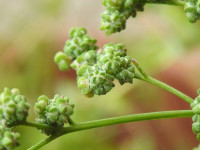
The flowers are small, white or whitish, solitary or grouped in clusters of 2-3 along short terminal spikes. Each flower is protected by two lanceolate and spiny bracts, which slightly protrude beyond the perianth. The latter consists of 4-5 cartilaginous, rigid tepals, with a characteristic membranous margin (wings) of obovate or horseshoe shape, up to 5-7 mm wide, which develop mainly in the fruit. The anthers are 5, barely protruding from the perianth.
The fruit is a small brown capsule, surrounded by papery wings generated by the tepals, facilitating dispersal by wind or water. The root system consists of a robust taproot anchoring the plant in sandy substrates.
Habitat and distribution
Prickly Saltwort is a typically psammophilous and coastal species, growing mainly in marine environments, on sandy or alluvial soils. In Italy it is widespread along the Mediterranean coasts and inland on sandy and gravelly deposits, also adapting to disturbed places such as roads and uncultivated areas. It is particularly present along beaches and coastal dunes, where it plays an important role in soil stabilization.
The species distribution is widely Eurasian and Mediterranean, extending from Europe to Asia, from Africa to America, with records also in Corsica. It grows from plains up to modest altitudes, where sun exposure and soil salinity conditions favor its development.
Flowering period
Flowering extends from May to September, with a peak that can vary from July to August. In some Mediterranean areas flowering continues until October. In more temperate and coastal regions, the species can exhibit prolonged flowering, while in drier inland areas the season is more concentrated.
Ecology and pollination
Prickly Saltwort is an annual herbaceous plant well adapted to harsh environmental conditions such as strong wind exposure and high salinity. Its reproductive strategy includes hermaphroditic flowers, with well-developed anthers and stigmas, favoring entomophilous pollination mainly by pollinating insects attracted to the white flowers.
Seed dispersal occurs thanks to the cartilaginous wings covering the fruit, facilitating transport by wind or marine waters, thus allowing colonization of new sandy and coastal habitats. The plant is considered invasive in some contexts, as it can rapidly occupy open and disturbed spaces.
Curiosities and traditional uses
Historically, some species of the genus Salsola have been used for soda (sodium carbonate) production due to their mineral salt content. Prickly Saltwort, in particular, is known for its ability to grow in saline and sandy environments, and in the past it was used as a raw material for soap and glass manufacturing.
No specific medicinal applications are known for this species, nor established traditional food uses, but the genus has been investigated for possible antioxidant properties and salt tolerance.
Etymology
The genus name Salsola derives from the Latin salsus, meaning "salty", referring to its preference for saline and coastal environments. The specific epithet kali recalls the ancient dialectal or vernacular term linked to plants used for potash or soda production, saline substances employed in chemistry and historically in industry.
The Italian common name "erba cali" is a transliteration of the Latin/scientific term and reflects the traditional use and presence of the plant in brackish environments.
Sources
- Prof. S. Pignatti, "Flora d’Italia"
- Tela Botanica / H. Coste, "Flore descriptive et illustrée de la France"
- World Flora Online (WFO)
Characteristics
Scheda botanica
| Famiglia | Chenopodiaceae |
|---|---|
| Fioritura | maggio – agosto |
| Forma biologica | Scapose |
| Habitat | psammophilous plant, annual plant |
Domande frequenti
- Quando fiorisce Prickly Saltwort?
- Prickly Saltwort fiorisce maggio – agosto.
- Che tipo di pianta è Prickly Saltwort?
- Prickly Saltwort è una Therophytes (Scapose) secondo la classificazione di Raunkiaer.
- A quale famiglia appartiene Prickly Saltwort?
- Prickly Saltwort appartiene alla famiglia botanica Chenopodiaceae.
Where I found it (4 sightings)
Classification
- Kingdom
- Plantae
- Family
- Chenopodiaceae
- Full name
- Salsola kali L.
- Synonyms
- Kali soda Moench, non (L.) Scop., Kali turgidum (Dumort.) Gutermann, Salsola turgida Dumort.
- Life form
- Therophytes scapose
Similar species
Search for species with similar characteristicsNoticed an error in the identification? Write to me
Other species of the same family
Chenopodiaceae
Explore
Other species of Chenopodiaceae