Botanical species
Camphorosma monspeliaca
L. subsp. monspeliaca
Camphorfume
Description
Morphological description
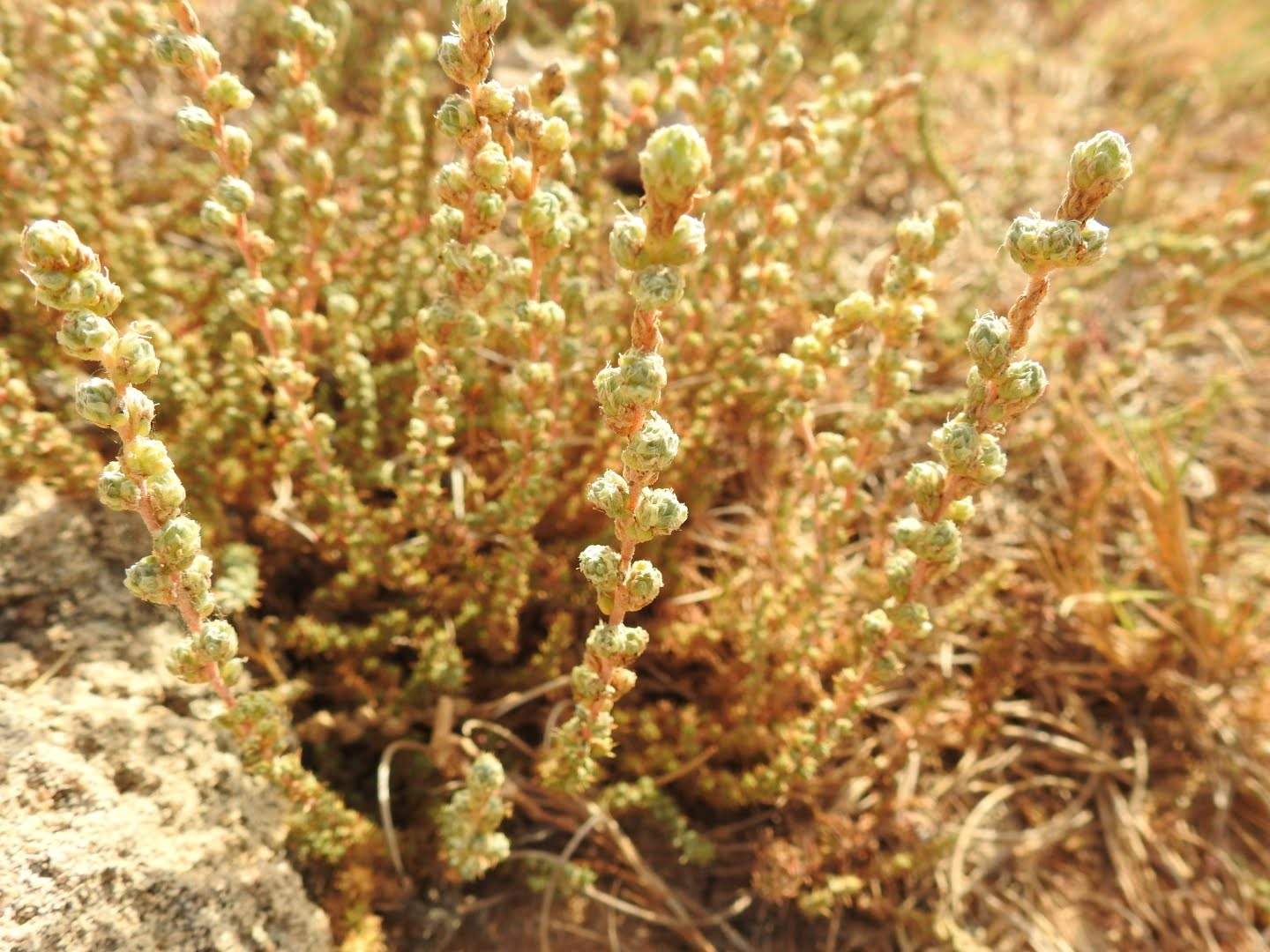
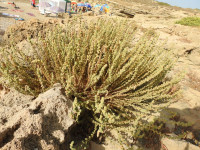
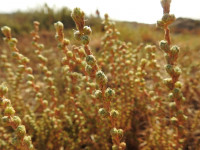
The Camphorfume is a small perennial suffruticose plant, reaching a height between 10 and 50 cm. It has numerous woody stems, characterized by a prostrate and twisted habit, often pressed to the ground. From these stems develop two types of annual herbaceous branches: non-flowering branches, very short and covered exclusively with leaves, and erect-ascending flowering branches, longer, with reddish and tomentose apices due to the presence of short and curly hairs.
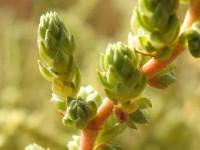
The leaves are sessile, strap-shaped (i.e. tongue-shaped), subcoriaceous, 3 to 10 mm long and 0.5 to 1.7 mm wide; in some plants with thinner branches they may take a filiform shape. The leaves are grouped in clusters and are covered by long erect hairs, giving a tomentose texture.
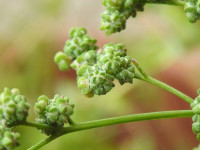
The flowers are hermaphroditic, greenish in color, arranged in bracteate glomerules forming dense spike-like inflorescences. The perianth is tetramerous and sepal-like, with a tubular structure of ellipsoid section, about 3 mm long and generally densely hairy on the outside, although in some specimens it may be glabrous. The upper part of the perianth has four teeth, two of which are shorter. The stamens are four, opposite the sepals, with long filiform filaments protruding from the corolla; the anthers are oblong and yellow-reddish in color. The ovary is ovoid, equipped with a long style and two filiform stigmas.
The fruit is an achene wrapped by the persistent perianth; the seeds are oblong-oval, black, flat, measuring between 1.5 and 2 mm, and have a glandular surface.
Habitat and distribution
The Camphorfume is a species typical of steppes and semi-desert areas. In Italy and the Mediterranean basin it grows mainly in coastal and subcoastal environments, up to about 300 meters above sea level. It prefers arid and subsaline environments, often characterized by sandy or clay soils with high mineral salt content. It is frequent on saline soils and in areas with water and salt stress conditions, typical of coasts and inland areas with high salinity.
The geographical distribution extends from Europe to Japan, indicating a strictly Eurasian distribution.
Flowering period
Flowering mainly occurs between May and September. No significant geographical variations are reported, although local environmental conditions may influence the duration and intensity of flowering.
Ecology and pollination
The flowers, although not particularly showy due to their greenish color, are hermaphroditic and probably attract specialized or generalist pollinating insects, although specific details on pollinating insects are not widely documented. The structure of the perianth and the presence of protruding anthers suggest an adaptation to entomophilous pollination. Seed dispersal occurs through light achenes, protected by the persistent perianth which may favor anemochory (wind dispersal), although secondary dispersal by other natural agents is not excluded.
Curiosities and traditional uses
The generic name "Camphorosma" derives from the Arabic "al-kafur" meaning camphor, and from the Greek "osme" indicating smell, referring to the characteristic camphor aroma released from the leaves when crushed. This scent is due to the presence of essential oils contained in the plant.
The leaves have been used in folk medicine for their medicinal properties: the plant is considered antiasthmatic, diaphoretic (promotes sweating), diuretic, emmenagogue (stimulates menstrual flow), expectorant, and stimulant. These uses are based on the activity of essential oils and other bioactive compounds present in the plant.
No significant alimurgical or food uses are documented, nor particular references in local folklore related to this species.
Etymology
The scientific name "Camphorosma monspeliaca" recalls two key elements: the term "Camphorosma" indicates the camphor-like odor of the leaves, while "monspeliaca" refers to the city of Montpellier, France, where the plant was probably described or studied significantly.
The Italian common name "Canforata di Montpellier" derives precisely from the camphor odor emitted by the leaves and the locality of Montpellier, reaffirming the identity and peculiarity of the species.
Sources
- Acta Plantarum - Flora delle regioni italiane (actaplantarum.org)
- Acta Plantarum - Flora delle regioni italiane (scheda di Patrizia Ferrari)
Characteristics
Scheda botanica
| Famiglia | Chenopodiaceae |
|---|---|
| Fioritura | maggio – settembre |
| Forma biologica | Fruticose |
| Habitat | with green flowers, Perennial plant |
| Uso officinale | Pianta officinale |
Domande frequenti
- Quando fiorisce Camphorfume?
- Camphorfume fiorisce maggio – settembre.
- Che tipo di pianta è Camphorfume?
- Camphorfume è una Chamaephyte (Fruticose) secondo la classificazione di Raunkiaer.
- A quale famiglia appartiene Camphorfume?
- Camphorfume appartiene alla famiglia botanica Chenopodiaceae.
Where I found it (12 sightings)
Classification
- Kingdom
- Plantae
- Family
- Chenopodiaceae
- Full name
- Camphorosma monspeliaca L. subsp. monspeliaca
- Life form
- Chamaephyte fruticose
Similar species
Search for species with similar characteristicsNoticed an error in the identification? Write to me
Other species of the same family
Chenopodiaceae
Explore
Other species of Chenopodiaceae