Botanical species
Halimione portulacoides
(L.) Aellen
Sea Purslane
Description
Morphological description
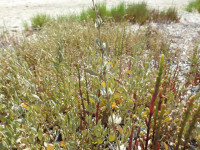
Perennial, evergreen plant, with a bushy habit and generally small size, Acanthus mollis has woody, prostrate and highly branched stems that extend horizontally rooting at the nodes and rise with ascending branches reaching a height of up to 75 cm. The stems are woody at the base, with a prostrate or prostrate-ascending habit, typical of plants living in sandy or brackish coastal environments.
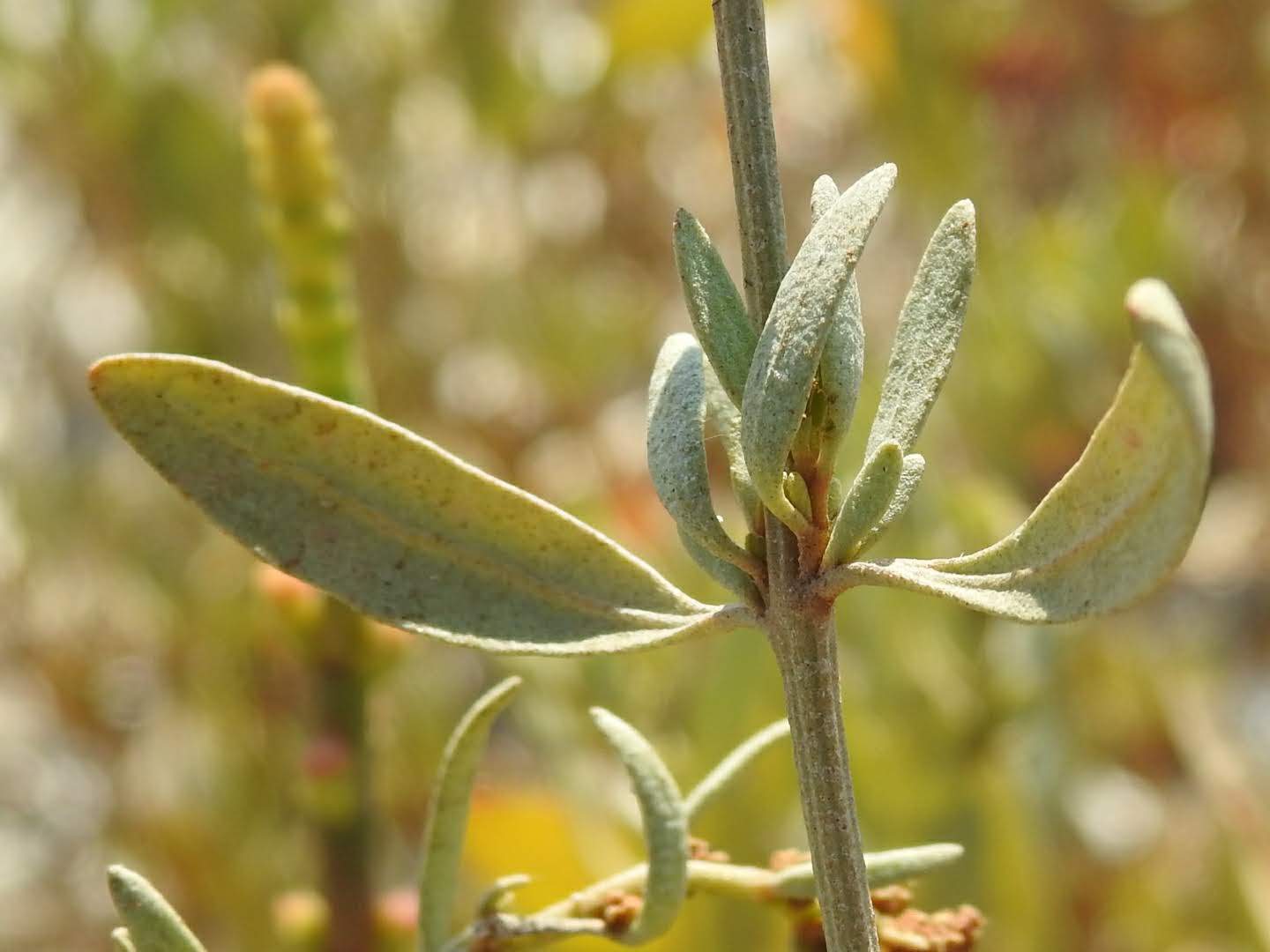
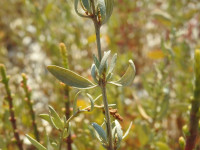
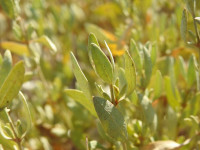
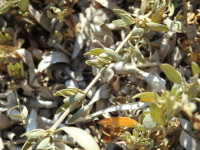
The leaves are opposite, ranging from linear-lanceolate to ovate-lanceolate in shape, with a length between 30 and 60 mm and a width up to 25 mm in the upper sub-asterisked leaves. They have entire margins, fleshy texture, and a glaucous surface due to the presence of tiny papery scales not visible to the naked eye. These scales contain air and play a protective role, creating a layer of humid air that reduces transpiration and reflects sunlight, counteracting dehydration caused by wind and direct sun exposure.
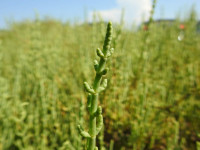
The flowers are sessile, gathered in elongated panicles, sometimes leafy, located at the apex of the branches or in the leaf axils. They are yellow, with clusters of small flowers supported by triangular bracteoles about 3-4 mm long, tridentate at the apex and with two tubercles on the back. Male flowers consist of 4-5 segments, while female flowers have two bracts and a long style. Flowering occurs in summer, generally from June to July, but can extend until October in some regions.
The fruit is a membranous utricle, enclosed within the perigonium, containing rust-colored seeds.
The root system is robust and adapted to anchoring in sandy and brackish substrates, typical of coastal environments where the species thrives.
Habitat and distribution
Acanthus mollis is a halophilic species typical of coastal environments, particularly widespread along brackish zones and marine shores of the Mediterranean, temperate-cold Europe, Western Asia, Northern Africa, and North America. In Italy, it is mainly found along coasts, including those of Sardinia and Corsica, preferring habitats such as salt marshes, brackish lagoons, sandy beaches, coastal dunes, and brackish wetlands.
It grows on soils rich in sodium salts, with predominant sun exposure and often under strong sea wind conditions. Its presence is typical of psammophilous and halophilous environments, where soil salinity and substrate instability represent difficult conditions for most other plant species.
The growth altitude is generally limited to the coastal plain, where the microclimate and salinity are favorable.
Flowering period
Flowering extends from June to July, with possible regional variations prolonging it until September-October, especially in warmer Mediterranean regions. The yellow flowers appear in terminal and lateral panicles, making the plant visible even from a distance during summer.
Ecology and pollination
The species adapts well to extreme coastal environments thanks to a defense strategy against dehydration, represented by fleshy, glaucous leaves with scales. The presence of sessile flowers in panicles favors pollination by pollinating insects, particularly small hymenoptera and diptera attracted by the yellow color. The plant has a predominantly entomogamous reproductive strategy.
The membranous fruits facilitate seed dispersal, which presumably occurs both by wind and water, thanks to proximity to coastal environments and the possibility of floating transport.
Curiosities and traditional uses
Acanthus mollis is an edible plant: its fleshy leaves can be consumed raw in salads, while the tips of young branches are often preserved in vinegar, similarly to other halophilic plants. These food uses have favored its traditional harvesting in coastal areas.
From an ethnobotanical point of view, although there are no detailed indications of specific medicinal uses, the plant has been considered a reserve food in coastal communities, exploiting its ability to grow in brackish conditions where few other plants thrive.
Etymology
The genus name derives from the Greek ἅλιμος (halimos), meaning "of the shore," referring to the typical marine habitat of the species. The specific epithet portulacoides indicates the similarity of the leaves to those of the genus Portulaca, characterized by fleshy shape and texture.
The Italian common name "porcellana di mare" refers to the similarity of the leaves to those of portulaca (also called porcellana in some regions) and to its coastal habitat.
Sources
- Prof. S. Pignatti, Flora d'Italia, Edagricole, Bologna, 1982
- Acta Plantarum - Flora delle regioni italiane (scheda di Marinella Zepigi)
- Tela Botanica / H. Coste, Flore descriptive et illustrée de la France
Characteristics
Where I found it (6 sightings)
Classification
- Kingdom
- Plantae
- Family
- Chenopodiaceae
- Full name
- Halimione portulacoides (L.) Aellen
- Synonyms
- Atriplex portulacoides L.; Obione cupani (Tineo) Nicotra; Obione portulacoides (L.) Moq.
- Life form
- Camefite fruticose
Similar species
Search for species with similar characteristicsFurther reading
Noticed an error in the identification? Write to me
Other species of the same family
Chenopodiaceae
Explore
Other species of Chenopodiaceae