Botanical species
Solanum dulcamara
L.
Bittersweet
Description
Morphological description
Perennial suffrutescent plant, Bittersweet presents woody stems at the base and herbaceous, slender, and trailing in the upper part. These can reach a height of 1-2 meters, sometimes up to 2 meters, and are generally very branched, with a glabrous or slightly pubescent surface from simple appressed white hairs. The bark of older branches takes on gray-yellowish tones.
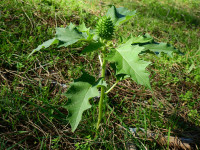
The leaves are alternate, with a very variable shape even along the same branch, ranging from simple to ternately pinnatifid. They can be oblong-ovate, lanceolate, or heart-shaped, with entire margins or often divided into 1-4 lateral subsessile lobes, giving a hastate appearance, especially in the upper leaves. The size varies from 2.5 to 7 cm in length and from 1.2 to 6 cm in width, with a winged petiole 0.5-3 cm long. The upper surface of the leaves is glabrous or moderately pubescent, while the lower surface may have denser pubescence.
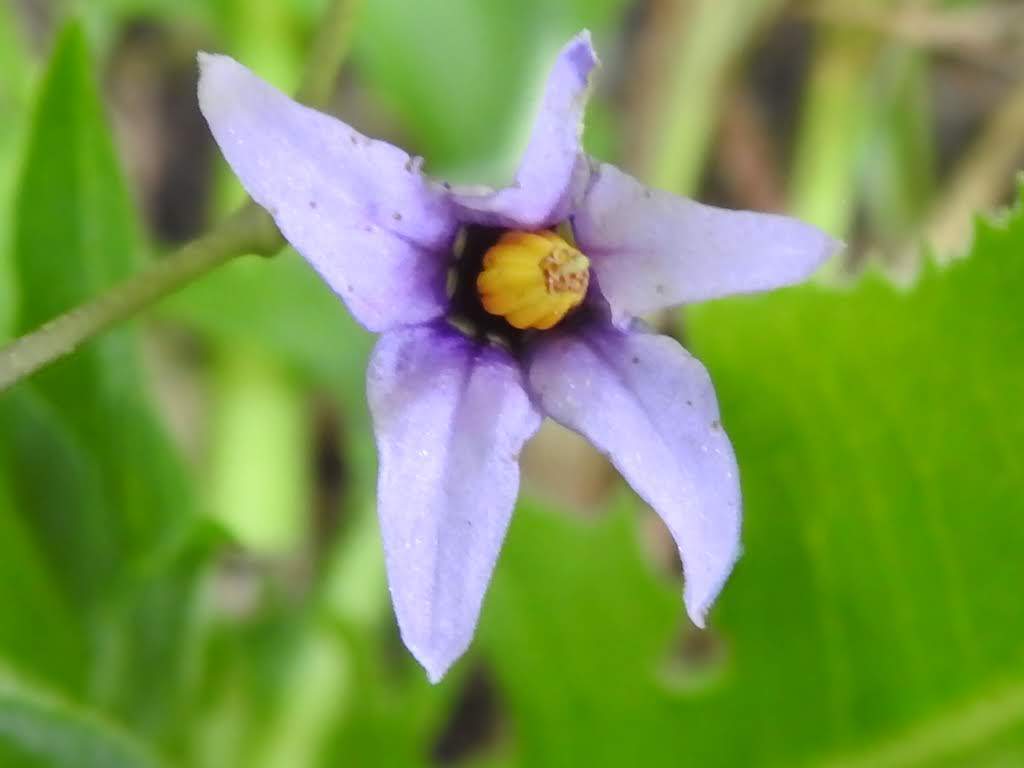
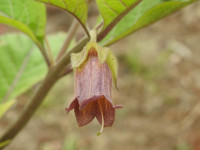
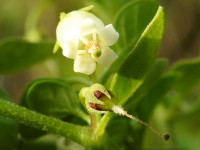
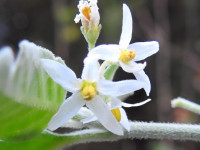
The flowers are hermaphroditic, actinomorphic, and grouped in terminal or intercalary inflorescences with umbelliform cymes, usually pendulous and branched, bearing 10 to 20 flowers per inflorescence, but can reach up to 40. The peduncles are articulated, 5-30 mm long, and often violet or green-purple in color. The calyx is gamosepalous, campanulate, and about 3 mm long, with 5 obtuse lobes that do not enlarge during fruiting. The corolla, 10-15 mm in diameter, is rotate with ovate-lanceolate and reflexed lobes; the predominant color is violet, more rarely white, with two green spots bordered in white at the base of each lobe that act as false nectaries. The stamens are five, with pubescent filaments and yellow fused anthers. The style is single, pubescent, with a capitate stigma.
The fruit is a fleshy berry, ovoid-elliptical, 10-15 mm long and 5-10 mm wide, initially green turning bright red at maturity. Inside it contains numerous finely reticulated reniform seeds. The root system is not described in detail, but the plant, being suffrutescent and climbing, develops stable woody roots at the base.
Habitat and distribution
Bittersweet is a species widespread throughout Italy and the Mediterranean basin, also present in Europe, Asia, and North Africa. In Italy, it preferably grows in moist woodland environments, uncultivated areas, hedges, ditches, thickets, and along watercourses, from the plains up to 1100-1450 meters of altitude. It prefers fresh and moist soils, often in semi-shaded or shady environments, with exposure varying from full sun to partial shade. It is common in riparian forests and wet environments, where it can climb on other plants or structures.
Flowering period
Flowering extends from April to July, with geographical variations that can prolong the presence of flowers until September in some Mediterranean or temperate regions. Generally, in Italy, flowering is more intense in spring and early summer.
Ecology and pollination
Bittersweet is mainly pollinated by pollinating insects, attracted by the bright color of the corolla and the green spots that simulate false nectaries. Pollination is entomogamous, facilitated by the presence of numerous flowers in branched inflorescences that open progressively. Seed dispersal occurs through the red fleshy berries, which attract birds; these consume the contents and contribute to the spread of the plants through endozoochorous dispersal.
Curiosities and traditional uses
Bittersweet is a toxic species, especially in young parts such as leaves and stems, which contain alkaloids like solanine, dulcamarine, and solanidine. These substances give the plant an initially bitter taste that becomes sweet after chewing, due to the chemical transformation operated by saliva.
Despite its toxicity, the plant has a long history of traditional medicinal use. It has been employed in the treatment of dermatitis, skin eruptions, bronchial congestion, rheumatism, jaundice, and ulcerative colitis. However, medicinal use must be carried out with caution and under medical supervision, as excessive doses can cause serious effects such as nervous system paralysis, slowing of heart rate and breathing, dizziness, convulsions, and potentially death.
The berries, although toxic to humans, are appreciated by birds and sometimes the plant is cultivated as an ornamental for the decorative value of the fruits. Bittersweet also plays an ecological role as a pioneer species in wet and wooded environments.
Etymology
The genus name Solanum could derive from the Latin "solor" (I console), referring to the calming properties of some species of the genus, or from "sol" (sun) for the star-shaped flowers. The specific epithet "dulcamara" comes from the Latin "dulcis" (sweet) and "amarus" (bitter), alluding to the plant’s changing taste from bitter to sweet.
The Italian common name "morella rampicante" refers to the climbing nature of the plant and the dark color of the berries, commonly called "morelle".
Sources
- Prof. S. Pignatti, "Flora d'Italia"
- Acta Plantarum - Flora delle regioni italiane (scheda di Anja Michelucci)
- Tela Botanica / H. Coste, "Flore descriptive et illustrée de la France"
- World Flora Online (WFO)
Characteristics
Scheda botanica
| Famiglia | Solanaceae |
|---|---|
| Fioritura | aprile – luglio |
| Forma biologica | Nano-Phanerophytes |
| Habitat | toxic plant, with purple flowers |
| Tossicità | Tossica — non consumare |
Domande frequenti
- Quando fiorisce Bittersweet?
- Bittersweet fiorisce aprile – luglio.
- È tossica Bittersweet?
- Bittersweet è una pianta tossica o velenosa. Non consumare nessuna sua parte senza aver consultato un esperto.
- Che tipo di pianta è Bittersweet?
- Bittersweet è una Phanerophytes (Nano-Phanerophytes) secondo la classificazione di Raunkiaer.
- A quale famiglia appartiene Bittersweet?
- Bittersweet appartiene alla famiglia botanica Solanaceae.
Where I found it (4 sightings)
Classification
- Kingdom
- Plantae
- Family
- Solanaceae
- Full name
- Solanum dulcamara L.
- Life form
- Phanerophytes nano-phanerophytes
Similar species
Search for species with similar characteristicsFurther reading
Noticed an error in the identification? Write to me
Other species of the same family
Solanaceae
Explore
Other species of Solanaceae