Botanical species
Salpichroa origanifolia
(Lam.) Baill.
Cock's eggs
Description
Morphological description
The plant appears as a perennial rhizomatous and suffruticose shrub, with woody, branched, prostrate or ascending stems that can reach a maximum height of about 80 cm. The stems, of modest size, are herbaceous and slightly pubescent especially in the apical part. The habit is trailing, with the ability to climb or spread on the ground.
The leaves are entire, bright light green in color, and present variable shapes between oval, spatulate, suborbicular or rhomboidal, with an obtuse apex. They taper into a long petiole measuring about 5-12 mm, and are often arranged irregularly but predominantly opposite along the stems. The leaf blade measures about 6-12 mm wide by 10-20 mm long.
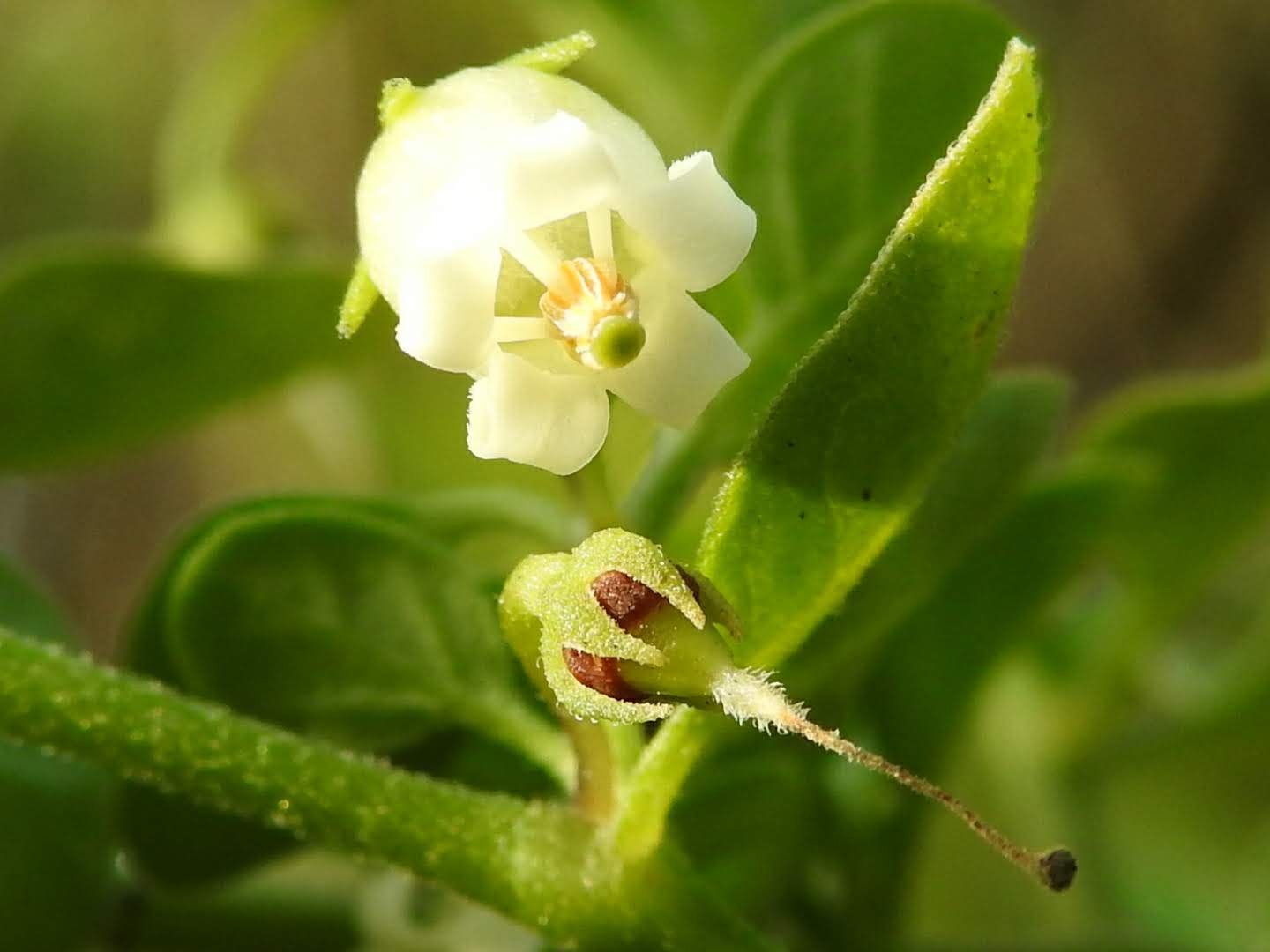
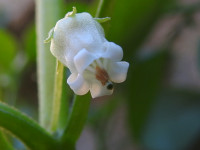
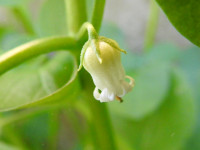
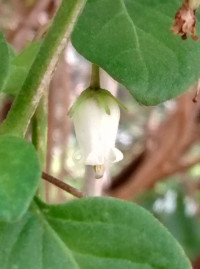
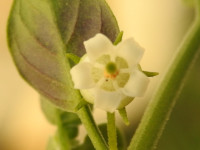
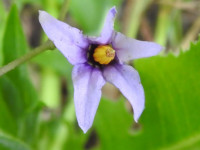
The flowers are hermaphroditic, actinomorphic, solitary and pendulous, inserted at the leaf axil by pedicels up to 14 mm long. The corolla is bell-shaped, gamopetalous, whitish tending to white, about 4 x 7-9 mm in size. It has five short lobes reflexed during anthesis and an inner surface densely villous-tomentose in the lower part of the corolla tube. The calyx is persistent and slightly enlarging during fruiting, formed by a very short tube and five linear-lanceolate, acute at the apex, pubescent lobes about 1.5 mm long.
The androecium consists of five stamens with short filaments inserted in the upper part of the corolla tube, the anthers are yellow and connate. The ovary is superior with a subcapitate stigma.
The fruit is an ovoid-elongated berry, initially green and resembling a small cucumber, about 8-15 mm long and 6-12 mm wide, which at maturity becomes light brown and resembles the shape of a swallow’s or hen’s egg. The seeds are rounded, brown in color and weakly alveolate.
The root system is rhizomatous, with roots containing toxic tropane alkaloids.
Habitat and distribution
Native to South America, Salpichroa origanifolia is a neophyte now naturalized and widespread in many Italian regions, especially in Mediterranean areas. It grows mainly up to 600 meters altitude, preferring typical environments such as walls, hedges, uncultivated lands and disturbed areas, often on moist substrates. The plant tends to become wild especially in ornamental cultivation sites, where it can also become invasive and weedy.
Its natural habitat is characterized by exposure to sun or partial shade, with a preference for well-drained but not excessively dry substrates. Its presence in Italy is mainly due to introduction as an ornamental plant.
Flowering period
Flowering mainly occurs in the summer months, from June to September, with possible local variations related to climate and altitude. The pendulous and solitary flowers are visible during this period, followed by fruit formation which matures from late summer to autumn.
Ecology and pollination
The flowers of this species are hermaphroditic and have features suitable for pollination by pollinating insects, probably small hymenopterans and flies, attracted by the white corolla and nectar. The pendulous arrangement of the flowers facilitates access for pollinating insects.
Seed dispersal occurs through the fleshy fruit, which at maturity takes on an inviting and sweetish appearance, similar to grapes. This facilitates ingestion by birds or other animals, which contribute to seed dispersal. The plant also propagates vegetatively via rhizomes, with the ability to rapidly colonize new spaces.
Curiosities and traditional uses
The plant is known for the presence of toxic tropane alkaloids in the root system, with documented hallucinogenic effects. For this reason, it is considered a toxic species and should be handled with caution.
The ripe fruits, on the other hand, are edible and are sometimes consumed for their sweetish taste reminiscent of grapes. Despite the toxicity of some parts, the berry has been used in some local traditions as food, albeit with caution.
Recent studies have shown that compounds extracted from the plant possess larvicidal properties, particularly against Musca domestica larvae, suggesting potential applications in biological and agricultural fields.
This dual nature, toxic and edible, makes the species interesting also from a pharmacological point of view, although there are no widely documented traditional medicinal uses. Cultivation is generally intended for ornamental purposes, thanks to the white flowers and decorative appearance.
Etymology
The genus name derives from the combination of two Greek terms: "salpix" meaning "trumpet" and "chroa" meaning "skin" or "hide", probably referring to the shape and color of the corolla which resembles a small trumpet with delicate skin.
The specific epithet "origanifolia" is composed of the Latin "origanum" (oregano) and "folium" (leaf), recalling the shape of the leaves which resemble those of oregano plants, rounded and slightly rhomboidal.
The Italian common name "salpicroa a foglie di origano" reflects this leaf characteristic, which facilitates species identification.
Sources
- Prof. S. Pignatti, "Flora d'Italia"
- Acta Plantarum - Flora delle regioni italiane (scheda di Anja Michelucci)
- Tela Botanica / H. Coste, "Flore descriptive et illustrée de la France"
Characteristics
Scheda botanica
| Famiglia | Solanaceae |
|---|---|
| Fioritura | giugno – settembre |
| Forma biologica | Fruticose |
| Habitat | with white flowers, edible plant, toxic plant |
| Tossicità | Tossica — non consumare |
Domande frequenti
- Quando fiorisce Cock's eggs?
- Cock's eggs fiorisce giugno – settembre.
- È tossica Cock's eggs?
- Cock's eggs è una pianta tossica o velenosa. Non consumare nessuna sua parte senza aver consultato un esperto.
- Che tipo di pianta è Cock's eggs?
- Cock's eggs è una Chamaephyte (Fruticose) secondo la classificazione di Raunkiaer.
- A quale famiglia appartiene Cock's eggs?
- Cock's eggs appartiene alla famiglia botanica Solanaceae.
Where I found it (13 sightings)
Classification
- Kingdom
- Plantae
- Family
- Solanaceae
- Full name
- Salpichroa origanifolia (Lam.) Baill.
- Synonyms
- Physalis origanifolia Lam.
- Life form
- Chamaephyte fruticose
Similar species
Search for species with similar characteristicsFurther reading
Noticed an error in the identification? Write to me
Other species of the same family
Solanaceae
Explore
Other species of Solanaceae