Botanical species
Datura stramonium
L.
Jimsonweed
Description
Morphological description
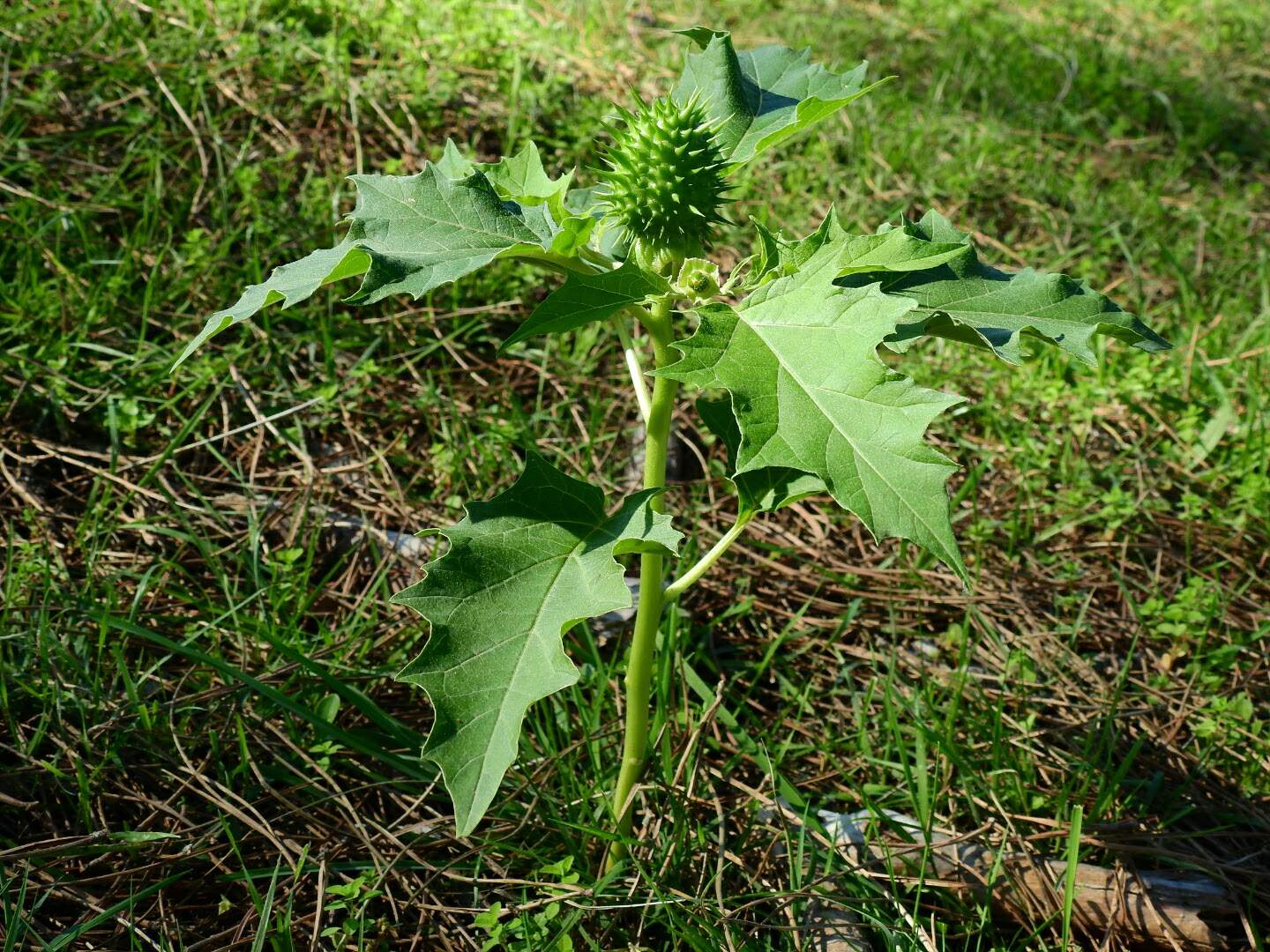
Annual herbaceous plant, with a bushy habit, commonly reaching a height between 30 and 120 cm, although it can sometimes exceed one meter. The stem, erect or ascending, is generally cylindrical, often dichotomous and branched, with a glabrous or pubescent surface, and sometimes shows violet hues or reddish glands especially in young specimens. The root system is taproot, robust and fusiform.
The leaves are alternate, broad and ovate or oblong in shape, with variable dimensions from 6 up to 20 cm in length and 5-15 cm in width. The blade is generally membranous or subcoriaceous, with irregularly toothed or crenate-toothed margins and acute or obtuse teeth. The leaf base is often truncate or slightly attenuated, while the apex is acute or acuminate. The upper surface is dark green, the lower lighter and almost glabrous. The petiole is 2-9 cm long, often bearing a row of hairs and sometimes also with reddish glands.
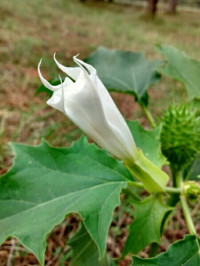
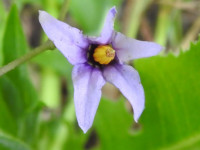
The flowers are solitary, borne on short peduncles (3-15 mm), located in the leaf axils or at the ends of the branches. The corolla, funnel-shaped and tubular, is 6 to 10 cm long and generally white in color, sometimes with violet or mauve shades, especially on the inner parts or in some varieties (e.g. Datura tatula). The five lobes of the corolla are elongated, strap-shaped and divergent, up to 15 mm long. The calyx is tubular, 4-8 cm long, with five lanceolate and acute lobes, often pubescent and lignified in fruiting.
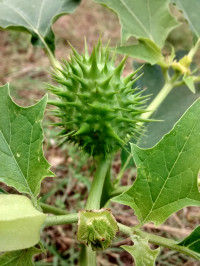
The fruit is a woody capsule, ovoidal or subglobose in shape, about the size of a walnut (3-5 cm in diameter), erect and densely covered with rigid and pointed spines 5-15 mm long, which can be glabrous or slightly pubescent at the base. The capsule opens apically into four locules, containing numerous black, kidney-shaped, wrinkled seeds about 3-4 mm thick.
Habitat and distribution
Species native to tropical America, it was introduced to Europe and Italy after 1500, probably as an ornamental and medicinal plant. Today it is naturalized and widespread throughout the Italian territory and the Mediterranean basin, as well as in much of Europe, Asia and Africa.
It prefers nitrophilous and ruderal environments, commonly growing in disturbed places such as wastelands, roadsides, ruins, sandy soils along coasts, dry areas and river deposits. It occurs from sea level up to about 900-1300 meters altitude. Its presence is favored by sunny exposures and well-drained soils, often poor but rich in nitrogen nutrients.
Flowering period
Flowering extends from July to October, with minimal variations depending on climatic and geographic conditions. In some regions, especially in the warmer areas of the Mediterranean, it can persist until November or December.
Ecology and pollination
The flowers, solitary and tubular, are adapted to entomophilous pollination, mainly by pollinating insects such as bees and butterflies, which are attracted by the light color and shape of the corolla. The plant produces numerous seeds contained in the spiny capsules, which are dispersed mainly by falling and mechanical movement, contributing to its ability to rapidly infest open and disturbed areas. Being an ephemeral annual species, it disappears quickly when the surrounding vegetation closes and competes for light and space.
Curiosities and traditional uses
Jimsonweed has been known since antiquity for its toxic and pharmacological properties, linked to the presence of tropane alkaloids such as scopolamine, atropine and hyoscyamine. These compounds confer narcotic, hypnotic, analgesic, sedative and hallucinogenic effects to the plant. The highest concentration of toxins is found in the seeds, but they are present in all parts of the plant.
Historically, it was used in folk medicine to treat disorders such as asthma, neuralgia and Parkinson’s disease. It was employed both for internal use in controlled doses and externally in the form of poultices to relieve abscesses and inflammations. However, the medicinal use of Jimsonweed is now almost completely abandoned due to its high toxicity and the availability of safer and more effective drugs.
In ethnobotanical tradition, indigenous American species and pre-Columbian populations such as the Aztecs used Datura stramonium in religious and magical rituals to induce euphoric and hallucinatory states, employing it in initiation ceremonies. Its name derives from the Indian “dhatura,” meaning “thorn apple,” referring to the spiny fruits. In Europe, the plant was probably introduced by gypsies for medicinal purposes.
Jimsonweed poisoning is dangerous and can cause symptoms such as dry mouth, tachycardia, hallucinations, coma and in severe cases death. Numerous incidents are known especially among children who have ingested flowers or seeds.
Etymology
The genus name “Datura” derives from the Indian word “dhatura,” meaning “thorn apple,” recalling the shape and spiny covering of the fruit. The specific epithet “stramonium” has uncertain origins, but could derive from the Latin “solor” (I console), alluding to the narcotic and euphoric effects the plant induces, once believed capable of “consoling.” The common Italian name “stramonio” directly reflects the scientific denomination, established in popular use.
Sources
- Prof. S. Pignatti, "Flora d'Italia"
- Acta Plantarum - Flora delle regioni italiane (scheda di Marinella Zepigi)
- Tela Botanica / H. Coste, "Flore descriptive et illustrée de la France"
- World Flora Online (WFO)
Characteristics
Scheda botanica
| Famiglia | Solanaceae |
|---|---|
| Fioritura | luglio – ottobre |
| Forma biologica | Scapose |
| Habitat | with white flowers, toxic plant, annual plant |
| Tossicità | Tossica — non consumare |
Domande frequenti
- Quando fiorisce Jimsonweed?
- Jimsonweed fiorisce luglio – ottobre.
- È tossica Jimsonweed?
- Jimsonweed è una pianta tossica o velenosa. Non consumare nessuna sua parte senza aver consultato un esperto.
- Che tipo di pianta è Jimsonweed?
- Jimsonweed è una Therophytes (Scapose) secondo la classificazione di Raunkiaer.
- A quale famiglia appartiene Jimsonweed?
- Jimsonweed appartiene alla famiglia botanica Solanaceae.
Where I found it (1 sightings)
Classification
- Kingdom
- Plantae
- Family
- Solanaceae
- Full name
- Datura stramonium L.
- Synonyms
- Datura inermis Juss. ex Jacq.; Datura stramonium L. subsp. tatula (L.) Nyman; Datura stramonium L. var. inermis (Juss. ex Jacq.) Fernald; Datura stramonium L. var. tatula (L.) Torr.; Datura tatula L.; Stramonium vulgare Moench, nom. illeg.; Stramonium vulgatum Gaertn.
- Life form
- Therophytes scapose
Similar species
Search for species with similar characteristicsFurther reading
Noticed an error in the identification? Write to me
Other species of the same family
Solanaceae
Explore
Other species of Solanaceae