Botanical species
Atropa bella-donna
L.
Belladonna
Description
Morphological description
Perennial herbaceous plant, 50 to 160 cm tall, characterized by an erect habit with slenderly grooved stems branched in the upper part. The stem is relatively thin but robust and has a slightly grooved surface with glandular hairs that give a pubescent appearance and an unpleasant odor.
The root system consists of a large cylindrical, superficial rhizome, which allows the plant to overwinter and regenerate each year.
The leaves are alternate on the lower part of the stem, while in the upper portion they appear paired two by two on the same side, with one larger and one smaller leaf. They are petiolate, oval-lanceolate in shape, with entire margins and acute apex. The leaves have a fleshy texture and are medium green in color.
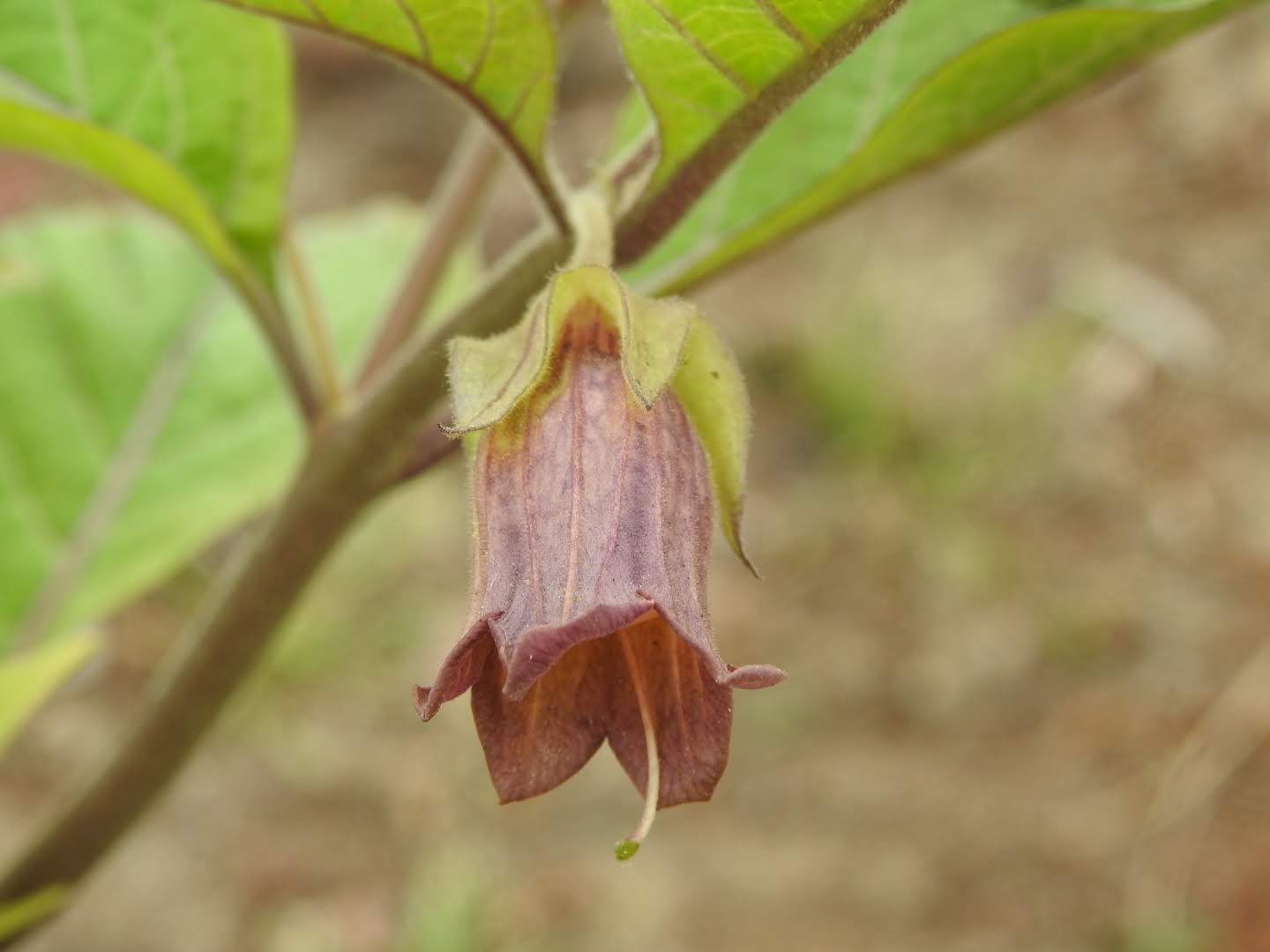
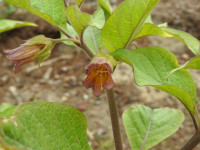
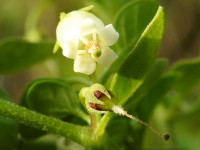
The flowers are solitary and pendulous, borne on long peduncles inserted at the leaf axils. The corolla is campanulate and tubular, about 2.5-3.5 cm long, with 5 short lobes turned outward, rounded at the apex. The color varies from purplish-violet to brown-violet shades with green-yellowish hues at the base; inside there are dense purplish veins. The calyx is made up of five sepals that open star-like around the fruit at maturity.
The fruit is a spherical, shiny, black berry at maturity, about the size of a cherry (13-18 mm in diameter). The berries are extremely toxic. The seeds, kidney-shaped or subreniform, are brown, alveolate, and 1.3 to 1.8 mm long.
Habitat and distribution
The species is present throughout the Italian territory, although rarely, and prefers woodland environments and clearings, especially in areas with sandy or clay soils rich in calcium. It grows from the plains up to 1,400 meters altitude, mainly in hilly and mountainous habitats.
The range of belladonna is typically Mediterranean-mountainous, with affinities to steno-Mediterranean or Euro-Mediterranean species, but limited to mountainous areas. In the Mediterranean basin, it is mainly widespread in temperate and cool zones, in open or semi-shaded woodland habitats.
Flowering period
Flowering generally extends from May to September, with possible variations depending on altitude and latitude. In warmer climates and at lower elevations, flowering may start earlier and last longer, while at higher elevations it is more concentrated in the summer months.
Ecology and pollination
Belladonna is mainly pollinated by pollinating insects attracted by the purplish-violet color of the flowers and their bell-shaped form. Among the most frequent visitors are bees and other pollinating insects that facilitate fertilization and fruit production.
Seed dispersal probably occurs through the action of frugivorous animals that consume the berries, although their high toxicity strongly limits this phenomenon. The black and shiny berries are visually attractive but can be lethal; this suggests that only species adapted to tolerate the toxicity can contribute to dispersal.
Curiosities and traditional uses
Belladonna has been known since antiquity for its toxic and medicinal properties. The entire plant contains potent and poisonous alkaloids such as atropine, scopolamine, and hyoscyamine, which act on the central nervous system with narcotic, antispasmodic, and analgesic effects.
Historically, it has been used as a medicinal herb in controlled doses for various pathologies, such as asthma, kidney and gallstones, and Parkinson’s disease. It has also been employed as a preoperative preparation to reduce secretions and induce mydriasis (pupil dilation) during eye examinations.
The cosmetic use is the basis of the specific name "bella-donna": Venetian courtesans used an eye drop based on belladonna to dilate the pupil, giving a more seductive and appreciated look during the Renaissance.
In folklore, belladonna is linked to the figures of witches, who used it along with other hallucinogenic plants to prepare ointments and potions. Legend has it that these witches attended sabbaths riding brooms soaked with such preparations, which probably induced states of hallucination and psychic journeys.
Before the advent of modern anesthetics, the "witch’s ointment," based on belladonna, was applied to the skin to induce unconsciousness in patients before surgical interventions.
Warning: belladonna is highly toxic and its pharmacological use must always be under strict medical supervision. Accidental ingestion of leaves, flowers, or berries can cause severe poisoning and death.
Etymology
The genus name Atropa derives from the Greek “Átropos,” one of the three Fates of Greek mythology, responsible for cutting the thread of life, indicating the deadly danger of the plant.
The specific name "bella-donna" refers to its cosmetic use for pupil dilation, which made the female gaze particularly attractive. Another hypothesis derives the name from the French "belle femme," a medieval term used to indicate witches, who employed the plant in their magical and ritual practices.
Sources
- Acta Plantarum - Flora delle regioni italiane (actaplantarum.org)
- Acta Plantarum - Scheda di Marinella Zepigi
- World Flora Online (WFO)
Characteristics
Scheda botanica
| Famiglia | Solanaceae |
|---|---|
| Fioritura | maggio – settembre |
| Forma biologica | Scapose |
| Habitat | toxic plant, with purple flowers, Perennial plant |
| Tossicità | Tossica — non consumare |
| Uso officinale | Pianta officinale |
Domande frequenti
- Quando fiorisce Belladonna?
- Belladonna fiorisce maggio – settembre.
- È tossica Belladonna?
- Belladonna è una pianta tossica o velenosa. Non consumare nessuna sua parte senza aver consultato un esperto.
- Che tipo di pianta è Belladonna?
- Belladonna è una Hemicryptophytes (Scapose) secondo la classificazione di Raunkiaer.
- A quale famiglia appartiene Belladonna?
- Belladonna appartiene alla famiglia botanica Solanaceae.
Where I found it
The sighting locations of this species are not public for conservation reasons.
Classification
- Kingdom
- Plantae
- Family
- Solanaceae
- Full name
- Atropa bella-donna L.
- Life form
- Hemicryptophytes scapose
Similar species
Search for species with similar characteristicsNoticed an error in the identification? Write to me
Other species of the same family
Solanaceae
Explore
Other species of Solanaceae