Botanical species
Solanum nigrum
L.
Black Nightshade
Description
Morphological description
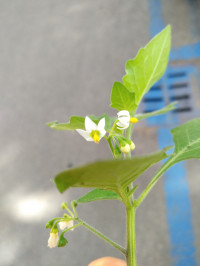
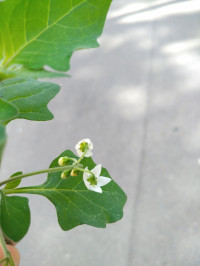
Annual herbaceous plant or sometimes perennial in warmer regions, generally 10 to 80 cm tall, with an erect or ascending habit. The stem is cylindrical, glabrous or slightly pubescent, often angular and with two well-marked longitudinal stripes. Sometimes it can lignify at the base in southern climates, assuming a suffrutescent appearance.
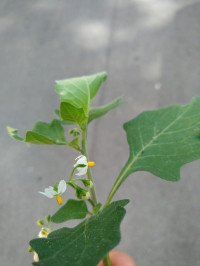
The leaves are alternate, with a partially winged petiole 1-3 cm long and an asymmetrical blade of oval or lanceolate shape, varying in size from 3-8 cm in length and 5-8 cm in width. The margin is toothed or sinuate-toothed and the surface generally glabrous or slightly hairy.
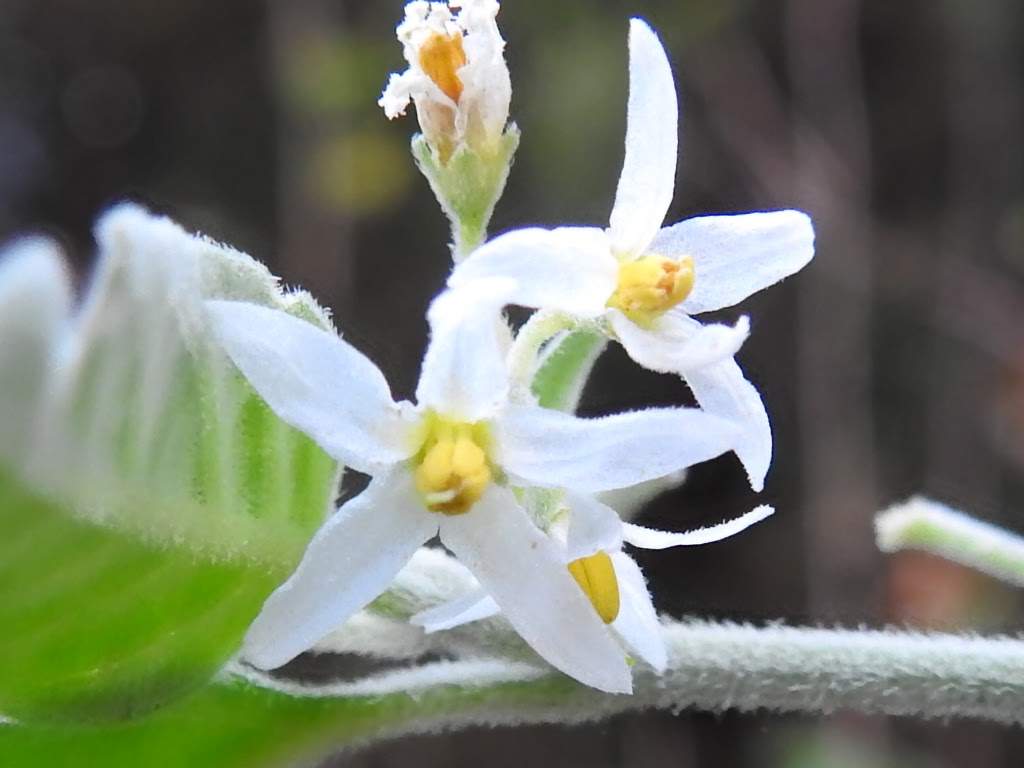
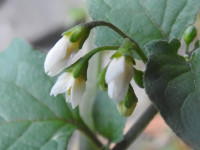
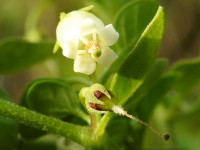
The flowers, small and white, are gathered in scapose inflorescences in the form of umbellate or elongated racemiform cymes, with 3-10 pedicellate flowers. Each flower has a conical gamosepalous calyx about 2.5 mm long, divided into five ovate segments with obtuse apex, which becomes more or less appressed at fruiting, with acute lobes. The corolla is rotate, white, 6-8 mm in diameter, and has acute lobes with glandular hairs on the margin; the anthers are yellow, connate, protruding from the throat. The ovary is bilocular, superior, with one style and bifid stigma. Peduncles, pedicels, and calyx are covered with short glandular hairs, tiny and almost sessile.
The fruits are globose berries, 6-7 mm in diameter, initially green and, at maturity, shiny black, sometimes yellowish but never red-orange, divided into several locules containing light brown ellipsoid seeds about 1.8-2 mm by 1.4-1.8 mm. These berries are rather opaque compared to related species and not particularly shiny. The fruit pedicels are diffusely scattered or slightly curved. The root system is taprooted.
Habitat and distribution
Cosmopolitan species, very common throughout the Italian territory and much of the Mediterranean area, it grows mainly in anthropized environments, ruins, road edges, cultivated lands, particularly infesting maize and beet crops. It tolerates a wide range of environmental conditions, preferring moderately rich, fresh, and well-drained soils, with sunny or partially shaded exposure.
Its growth altitude ranges from sea level up to about 1000 m a.s.l., with some variants having a more suffrutescent habit in the southern Italian regions.
Flowering period
Flowering generally extends from June to November, with some local variations due to climate. In the Mediterranean, the most intense season is summer and autumn, while in colder areas flowering may be shorter.
Ecology and pollination
The plant reproduces mainly through entomogamous pollination, favored by small pollinating insects attracted by the white flowers and the presence of protruding anthers. The umbellate cyme inflorescence facilitates access to pollinator visitors. Seed dispersal occurs via berry fruits that can be ingested and possibly transported by animals, although no particular dispersal strategies are known. The species is characterized by some morphological and genetic variability, with more monomorphic populations in Europe compared to Asian ones, where greater differences are observed in flower size and the presence of sclerified cells in the fruits.
Curiosities and traditional uses
Black Nightshade is a toxic plant, containing alkaloids such as solanine and solamargine, as well as saponins and tannins. Toxicity mainly involves the green parts and in some cases also the fruits, which is why cases of poisoning in children and domestic animals have been reported. However, some historical sources report that mature berries were consumed as food, with some variability in toxicity depending on plant populations.
In the past, the plant was used in folk medicine for its antispasmodic, analgesic, narcotic-sedative, emollient, febrifuge, diuretic, and purgative properties. The leaves, crushed, were applied to wounds, burns, and boils. In Bohemia, leaves were used in baby cradles to promote sleep. In the Mauritius islands and some areas of South Africa, the leaves were consumed as a vegetable similar to spinach.
In the 13th century, the juice extracted from the plant was used as an anesthetic in surgical operations and for toothache; crushed berries were used to keep flies away from animal wounds. The genus name recalls the ancient narcotic and sedative properties attributed to the plant.
Etymology
The scientific name derives from Latin "solanum," meaning "consoler," referring to the narcotic and sedative properties traditionally attributed to the plant. The specific epithet "nigrum" indicates the black color of the mature fruits.
The Italian common name "morella" refers precisely to the dark color of the berries, while in other languages it is known as "morelle nere" (French), "Black Nightshade" (English) or "tomatillo del diablo" (Spanish), all references to the color of the fruits and the toxicity of the species.
Sources
- Prof. S. Pignatti, "Flora d'Italia"
- Acta Plantarum - Flora delle regioni italiane (scheda di Marinella Zepigi)
- Tela Botanica / H. Coste, "Flore descriptive et illustrée de la France"
- World Flora Online (WFO)
Characteristics
Scheda botanica
| Famiglia | Solanaceae |
|---|---|
| Fioritura | febbraio – novembre |
| Forma biologica | Scapose |
| Habitat | with white flowers, toxic plant, annual plant |
| Tossicità | Tossica — non consumare |
Domande frequenti
- Quando fiorisce Black Nightshade?
- Black Nightshade fiorisce febbraio – novembre.
- È tossica Black Nightshade?
- Black Nightshade è una pianta tossica o velenosa. Non consumare nessuna sua parte senza aver consultato un esperto.
- Che tipo di pianta è Black Nightshade?
- Black Nightshade è una Therophytes (Scapose) secondo la classificazione di Raunkiaer.
- A quale famiglia appartiene Black Nightshade?
- Black Nightshade appartiene alla famiglia botanica Solanaceae.
Where I found it (9 sightings)
Classification
- Kingdom
- Plantae
- Family
- Solanaceae
- Full name
- Solanum nigrum L.
- Synonyms
- Solanum americanum Mill.
- Life form
- Therophytes scapose
Similar species
Search for species with similar characteristicsFurther reading
Noticed an error in the identification? Write to me
Other species of the same family
Solanaceae
Explore
Other species of Solanaceae