Botanical species
Sherardia arvensis
L.
Field Madder
Description
Morphological description
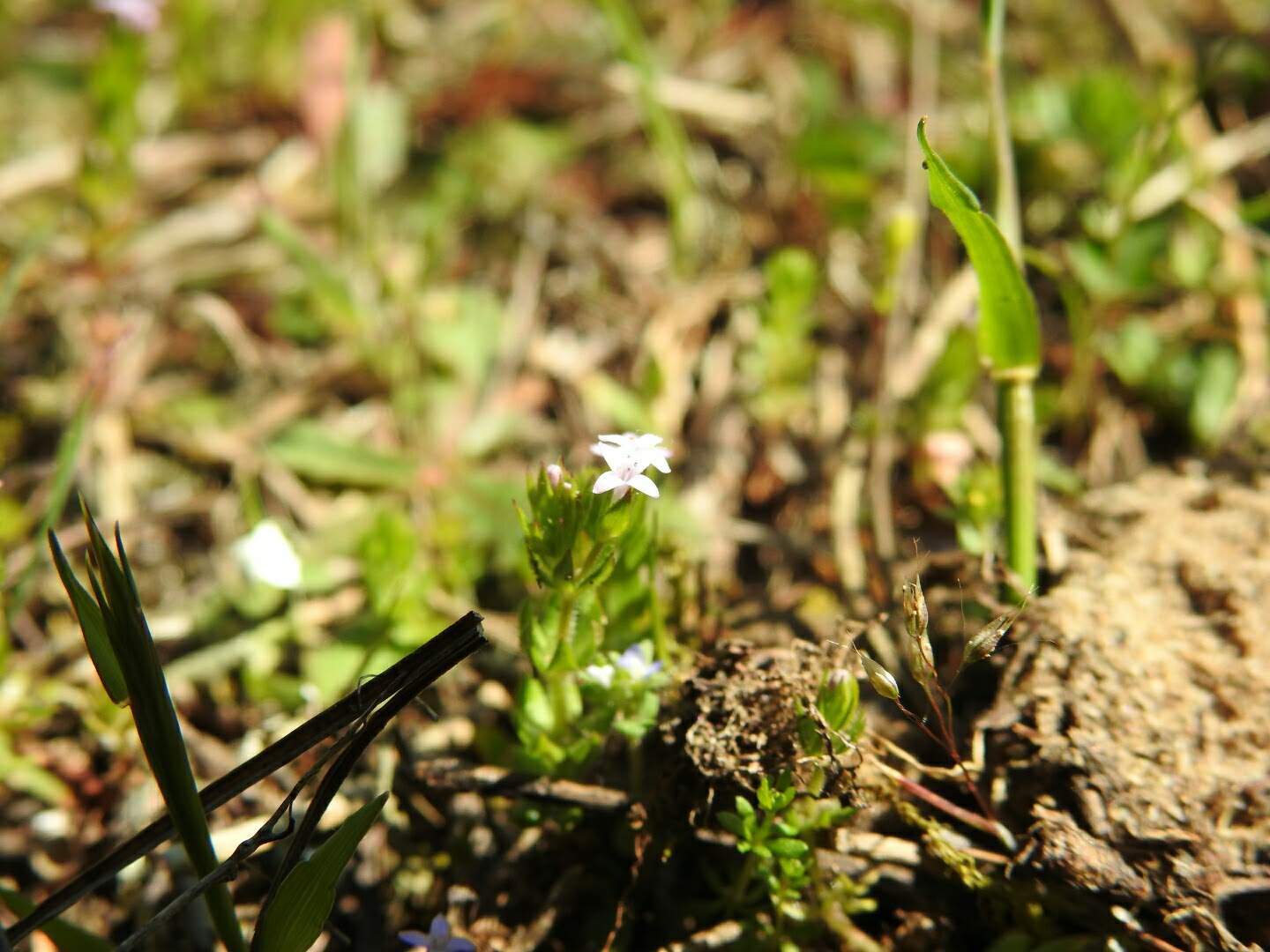
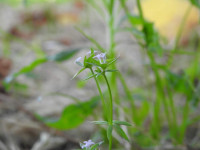
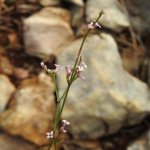
Small annual herbaceous plant, generally 5 to 20 cm tall, but can also reach up to 40 cm. The habit is prostrate or ascending, with thin, slender stems, branched from the base and quadrangular to the touch. The surface of the stems is rough, with curved prickly hairs that make them scabrous to the touch, especially along the angles.
The leaves are arranged in whorls, 4 in the lower part, 6 in the upper part, with a spiral arrangement along the stem. They are lanceolate, small in size (about 2-8 mm long and 1-5 mm wide), with scabrous and mucronate margins, i.e. ending with a sharp point or a short spine. The leaf is uninetveined, tapered towards the base and often with ciliate margins.
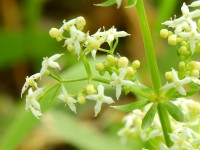
The flowers are gathered in terminal or axillary inflorescences, formed by small few-flowered heads (from 2 to 10 flowers), surrounded and often exceeded by an involucre composed of 6-10 lanceolate bracts, arranged in a star shape, scabrous along the margins and fused at the base. The flowers are tetramerous, with hypocrateriform corolla (funnel-shaped with expanded edges), predominantly pink-lilac in color, although white-flowered specimens can sometimes be found. The corolla measures about 4-5 mm, with a cylindrical tube about 1.5 times the lobes (3-4 mm tube and 1-1.5 mm lobes). There are four stamens with filaments inserted on the corolla tube.
The calyx is persistent and enlarging in the fruit, with 4-6 subulate and triangular teeth 0.3-1 mm long, rough and scabrous due to short hairs. The fruit is a bilocular schizocarp of 2-5 mm, composed of two mericarps fused at the base and each crowned by three persistent and rough calyx teeth. The root system consists of a thin and slender root.
Habitat and distribution
The species is widely distributed throughout the Italian territory, present in almost all regions and altitudes up to about 1900 m a.s.l. It grows preferably in open and ruderal environments, such as cultivated fields, uncultivated land, pastures, garrigues, path edges, vineyards and grassy places. It is often considered a weed in agricultural crops due to its ability to adapt to different soils, generally well-drained and sunny.
In the Mediterranean basin it is present in almost the entire area, from southern Europe to western Asia and North Africa, especially in temperate and Mediterranean climate zones. It prefers sunny exposures and fresh but well-aerated soils, with a certain hardiness that allows it to rapidly colonize disturbed habitats.
Flowering period
Flowering extends from March to July, with possible extensions up to September in some Mediterranean areas or under favorable climatic conditions. The long flowering period allows the plant to complete its annual life cycle in a wide range of environmental conditions. In Italy the flowering peak generally occurs in late spring.
Ecology and pollination
Sherardia arvensis is an annual plant with a rapid life cycle, adapted to colonize temporary or disturbed environments. The hermaphroditic flowers, small and gathered in terminal heads, attract various pollinating insects, particularly small hymenopterans and dipterans, which promote pollination. The elongated and lobed tubular corolla is structured to facilitate access to nectar by insects with suitable mouthparts.
Seed dispersal occurs through schizocarps that separate into two mericarps, favoring mechanical dissemination and potentially accidental transport by animals or agricultural machinery. The presence of rough hairs on the fruit can facilitate adhesion to the hairs or fleece of animals, contributing to dispersal.
Curiosities and traditional uses
In the past, the thin roots of this plant were used to extract a red pigment, employed in fabric dyeing. However, the limited yield and the less intense color compared to that obtained from Rubia tinctorum (madder) prevented the development of large-scale commercial cultivation. There are no established medicinal or food uses, nor significant references in Italian folklore, although the common name “Field Madder” suggests a popular tradition linked to the touch or manual use of the plant, perhaps due to its rough surface.
Etymology
The genus name, Sherardia, is a tribute to William Sherard (1659-1728), an English botanist from Oxford, student of Tournefort and Hermann. The specific epithet arvensis derives from the Latin arvum, meaning “field,” indicating the typical habitat of the species, i.e. cultivated or open land.
The Italian common name “toccamano” seems to refer to the tactile sensation caused by the roughness of the stems and leaves, a distinctive characteristic of the plant, but its historical origin is not precisely documented.
Sources
- Prof. S. Pignatti, Flora d’Italia
- Acta Plantarum – Flora delle regioni italiane (sheet by Anja Michelucci)
- Tela Botanica / H. Coste, Flore descriptive et illustrée de la France
- World Flora Online (WFO)
Characteristics
Scheda botanica
| Famiglia | Rubiaceae |
|---|---|
| Fioritura | marzo – luglio |
| Forma biologica | Scapose |
| Habitat | with white flowers, with small flowers, annual plant |
Domande frequenti
- Quando fiorisce Field Madder?
- Field Madder fiorisce marzo – luglio.
- Che tipo di pianta è Field Madder?
- Field Madder è una Therophytes (Scapose) secondo la classificazione di Raunkiaer.
- A quale famiglia appartiene Field Madder?
- Field Madder appartiene alla famiglia botanica Rubiaceae.
Where I found it (9 sightings)
Classification
- Kingdom
- Plantae
- Family
- Rubiaceae
- Full name
- Sherardia arvensis L.
- Life form
- Therophytes scapose
Similar species
Search for species with similar characteristicsFurther reading
Noticed an error in the identification? Write to me
Other species of the same family
Rubiaceae
Explore
Other species of Rubiaceae