Botanical species
Galium verum
L.
Lady's Bedstraw
Description
Morphological description
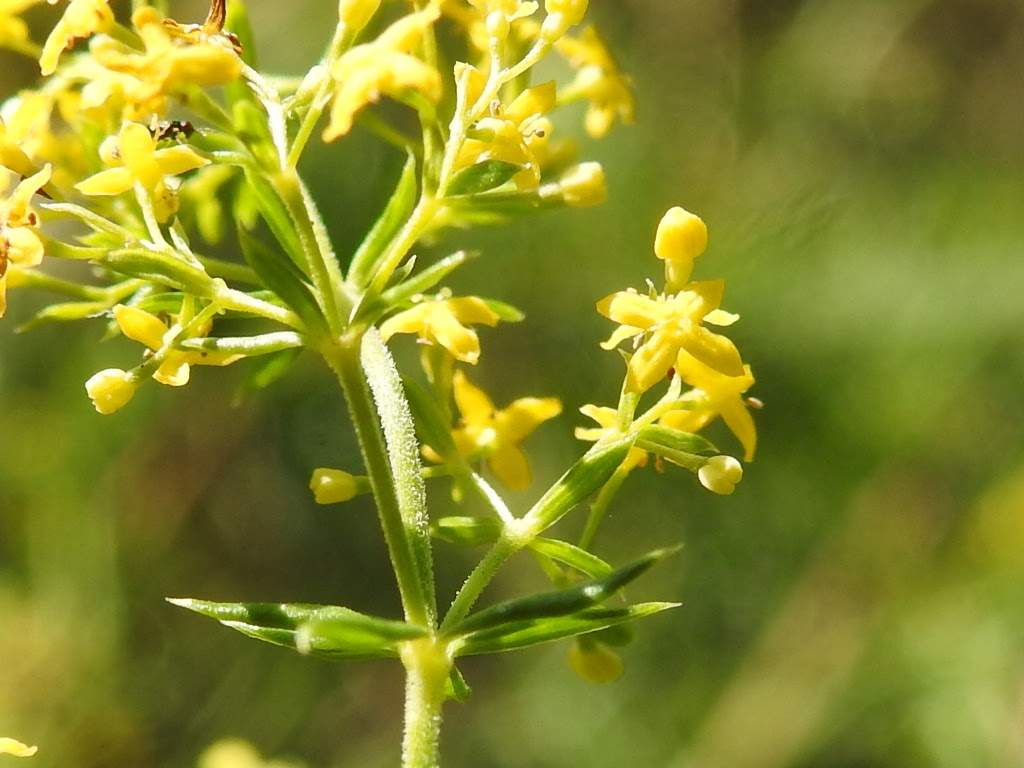
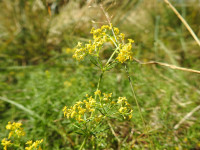
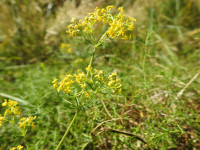
Perennial herbaceous plant, rhizomatous, with erect or ascending stems, reaching a variable height from 20 to 120 cm. The stem is cylindrical in the basal part, becoming tetragonal or quadrangular in the upper part; it is generally glabrescent but may show 4 lines of upward-facing hairs along the axis. The dried plant tends to blacken, a distinctive characteristic useful for recognition.
The leaves are arranged in whorls of 8-12 sessile elements, located at the stem nodes. Each leaf is linear or filiform, about 15-20 mm long and 1-2 mm wide, with strongly revolute margins and leathery texture. The upper surface is shiny and generally glabrous or with few hairs, while the lower surface is pubescent or tomentose. The leaves have a well-visible central vein and are acute or mucronate, with a sharp apex up to 1.5 mm.
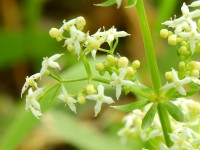
The inflorescence consists of ovoid, erect, dense panicles, both terminal and axillary, up to 30 cm long, borne on peduncles of 2-3 cm. The bracts, similar to the leaves, are present inside the inflorescences. The flowers, hermaphroditic and actinomorphic, are small (about 2-4 mm in diameter), with a yellow or yellow-greenish corolla, rotate and divided into four acute and lanceolate lobes. The stamens are four, with brown anthers, inserted between the corolla lobes. The ovary is inferior and bilocular, with a style bearing a globose or capitate stigma.
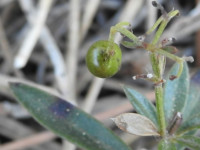
The fruits consist of two small ellipsoid, laterally flattened mericarps, each containing one seed. The fruit surface can be glabrous or provided with few straight hairs.
The root system is rhizomatous, allowing the plant's perenniality and its ability to regenerate vegetatively from buds located at ground level.
Habitat and distribution
This species is widely distributed throughout the Italian territory, from sea level up to about 2050 meters altitude. It prefers mountainous environments but is also present in hilly and flat areas. It commonly grows in dry and poor meadows, along paths, at forest edges, in anthropized places, sandy or rocky areas. It shows a marked preference for basic or calcareous soils, highlighting a calciphilous and basiphilous character.
Its distribution extends throughout the Eurasian area, from Europe to Japan, typical of the temperate regions of the continent.
Flowering period
Flowering typically occurs between June and September. In some locations and favorable climatic conditions, it may start as early as April or extend until August. The plant produces fragrant flowers that give a lively appearance to the meadows and open environments where it grows.
Ecology and pollination
The flowers, hermaphroditic and fragrant, are adapted to entomogamous pollination, mainly attracting pollinating insects such as bees and butterflies. The larvae of various butterfly species feed on plants of this species, which thus plays an important role in the local ecological cycle.
Seed dispersal occurs through the fruits consisting of two mericarps, which can also be transported by small interactions with the soil or by animals. The plant also reproduces vegetatively through the rhizome, allowing local population expansion.
Curiosities and traditional uses
The common name "Lady's Bedstraw" derives from the traditional use of this plant in milk coagulation for cheese production; indeed, the genus Galium owes its name to the Greek “gálion”, linked to the term "gála" (milk). Several Galium species were used as natural rennet in the past, although today commercial rennet is mainly obtained from the abomasum of suckling calves.
The flowers are used to obtain a yellow dye employed in fabric dyeing and as a food coloring. The roots, on the other hand, provide a reddish color useful in artisanal dyeing.
From an herbalist perspective, the plant contains active principles such as galisolin (an anthraquinone glycoside), asperuloside, tannins, aucubin, and flavonoids. These compounds confer astringent, diuretic, spasmolytic, and alterative properties to the plant. Traditionally it has been used for kidney and gallbladder disorders, as well as externally for the treatment of dermatoses and difficult-to-heal wounds. The infusion applied locally is also considered useful to reduce freckles.
The tender shoots are edible and can be consumed raw, even in spring salads. The seeds were sometimes used as a coffee substitute. In the past, the dried plant was used to fill mattresses, as it was said to be effective in keeping fleas away.
This species is also appreciated in gardening for its ability to create bright yellow patches, used both in borders and hedges.
Etymology
The scientific name of the genus derives from the Greek "gálion", a plant traditionally used to curdle milk (“gála” means milk). The specific name “verum” indicates the "true" or "authentic" rennet, distinguished from other similar Galium species, but it can also refer to its wide distribution and common presence.
The Italian name “Lady's Bedstraw” recalls both the traditional use as natural rennet and the sulfur-yellow color of the flowers.
Sources
- Prof. S. Pignatti, Flora d’Italia
- Acta Plantarum - Flora delle regioni italiane (scheda di Marinella Zepigi)
- World Flora Online (WFO)
Characteristics
Where I found it (8 sightings)
Classification
- Kingdom
- Plantae
- Family
- Rubiaceae
- Full name
- Galium verum L.
- Life form
- Terofite scapose
Similar species
Search for species with similar characteristicsFurther reading
Noticed an error in the identification? Write to me
Other species of the same family
Rubiaceae
Explore
Other species of Rubiaceae