Botanical species
Cynanchica pyrenaica
(L.) P.Caputo & Del Guacchio
Stellina comune
Description
Morphological description
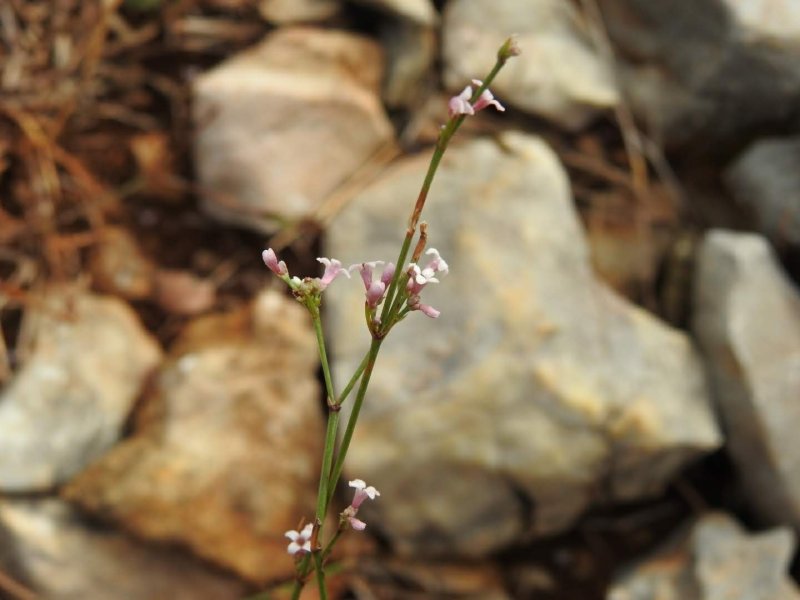
Cynanchica is a perennial plant belonging to the Rubiaceae family, characterized by a tufted habit and a height ranging from 8.5 to 43, sometimes 65 cm. The plant has a woody root at the base and features a creeping or arcuate-ascending stem, which can be glabrous, papillose, or covered with puberulent hairs on the lower and middle internodes, as long as the leaves; the upper internodes are instead glabrous.
The leaves are arranged in whorls of 4-6 elements, sessile and opposite, with an erect habit. Their shape varies from linear to lanceolate-linear, elliptical or oblanceolate, with thickened or revolute margins. The lower leaves measure from 1.1 to 8 mm in length and from 0.5 to 2 mm in width, while the middle and upper ones are larger, from 5 to 26 (up to 31) mm in length and from 0.5 to 2.1 mm in width. The upper leaves have a median nerve less than three-quarters of their width and can be glabrous or papillose.
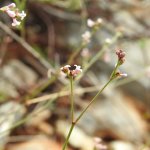
The inflorescence is corymbose, few-flowered and subsessile, with a diameter ranging from 2 to 15, sometimes up to 23 cm, composed of divaricate branches ending in dichasial cymes containing 2-4 flowers on peduncles about as long as the axillary leaves. The bracts, arranged in whorls of 4 (two wide and two short), are lanceolate-ovate or linear, 1.3 to 6.5 (up to 9) mm long and 0.4 to 1.2 mm wide, generally free or weakly connate; the bracteoles, longer than the pedicels, measure from 0.5 to 2.7 mm in length and from 0.1 to 1.4 mm in width.
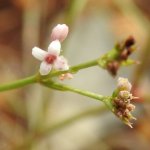
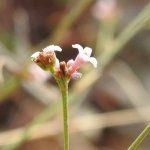
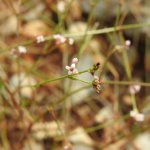
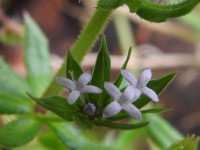
The flowers, almost always tetramerous and subsessile, have a funnel-shaped-obconic corolla of pinkish-white color, sometimes with external pubescence or rarely scabrous, with a diameter between 2 and 4.5 (up to 5.2) mm and a corolla tube length from 1.3 to 2.9 mm. There are four stamens with filaments about 0.3 mm long, inserted in the corolla tube, and violet anthers longer than the filament.
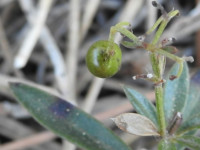
The fruit is an ovoid or ellipsoid achene, covered with thin darker-colored papillae.
Habitat and distribution
Cynanchica is a euri-Mediterranean species, with a range centered on the Mediterranean coasts and extending northwards and eastwards, including the area of Vite. In Italy it is mainly found in dry environments and calcareous pastures, as well as on screes, from the plain level up to about 1000 meters above sea level, with rare occurrences up to 2000 meters.
It therefore prefers calcareous, dry and well-drained soils, often in sunny exposures, typical of Mediterranean and submontane habitats.
Flowering period
Flowering extends from June to October, with possible local variations related to altitude and specific climatic conditions of the site.
Ecology and pollination
The plant is characterized by a scapose habit, with an elongated floral axis often leafless, typical of scapose hemicryptophytes. The tetramerous flowers, small in size and pinkish-white in color, are probably pollinated by pollinating insects attracted by the funnel-shaped corolla and the bright color, although specific data on pollinating insects are not detailed in the sources.
Seed dispersal occurs via achenes equipped with papillae, which can facilitate adhesion to substrates or animals, contributing to the spread of the species in suitable environments.
Curiosities and traditional uses
The genus Cynanchica owes its name to ancient medical tradition: it derives from the Greek συνάγχη (synanche), a term indicating an acute inflammation of the throat with suffocation, known as cynanche or quinsy, suggesting a traditional use of the plant as a remedy for these ailments. The etymology may reflect the plant’s attributed ability in treating such disorders, although historical pharmaceutical applications are to be considered for informational purposes and not as substitutes for medical treatments.
In floriculture, Cynanchica is appreciated for its erect-prostrate appearance, making it suitable for excellent ground covers in alpine and rock gardens; several cultivated varieties of this species have also been obtained.
Etymology
The scientific name "Cynanchica" derives from ancient Greek, where συνάγχη (synanche) means “to strangle together” or “to suffocate,” referring to the ancient throat disease known as cynanche or quinsy. Some scholars trace the term to συν (with) and ἄγχω (to strangle), while others link it to κύων (dog), probably referring to the canine cough.
The Italian common name "stellina comune" probably refers to the shape and corymbose arrangement of the flowers which, small and delicate, resemble a little star.
Sources
- Acta Plantarum - Flora delle regioni italiane (actaplantarum.org)
- Acta Plantarum - Flora delle regioni italiane (sheet by Antonino Messina)
Characteristics
Where I found it (6 sightings)
Classification
- Kingdom
- Plantae
- Family
- Rubiaceae
- Full name
- Cynanchica pyrenaica (L.) P.Caputo & Del Guacchio
- Synonyms
- Asperula cynanchica L.; Asperula nitens Guss.; Asperula cynanchica L. subsp. pyrenaica (L.) Nyman; Asperula pyrenaica L.
- Life form
- Emicriptofite scapose
Similar species
Search for species with similar characteristicsNoticed an error in the identification? Write to me
Other species of the same family
Rubiaceae
Explore
Other species of Rubiaceae