Botanical species
Galium aparine
L.
Cleavers
Description
Morphological description
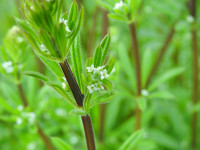
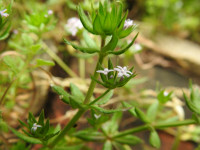
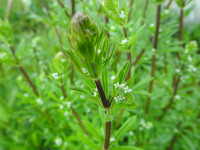
Annual herbaceous plant belonging to the Rubiaceae family, Cleavers presents a creeping or ascending habit, often climbing on other plants, thanks to its robust and tenacious structure. The stems, which can reach lengths of up to 2 meters, are angular, quadrangular, and marked by rigid and backward-pointing spiny projections, which give the plant a rough and sticky surface to the touch. The stem surface is also pubescent or hirsute, with reflexed hairs and spines that increase its ability to cling to external supports.
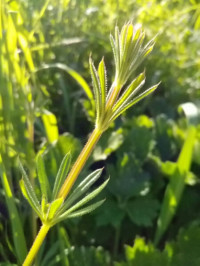
The leaves are arranged in whorls of 6-9 elements, ranging from oblanceolate to ovate-lanceolate in shape, with sizes varying from 30 to 50 mm in length and 3-8 mm in width. The texture is herbaceous, with spinulose margins and central veins also spinulose, while the lower surface may have rows of stiff hairs. The leaf apices are obtuse or mucronate, with a well-marked central vein.
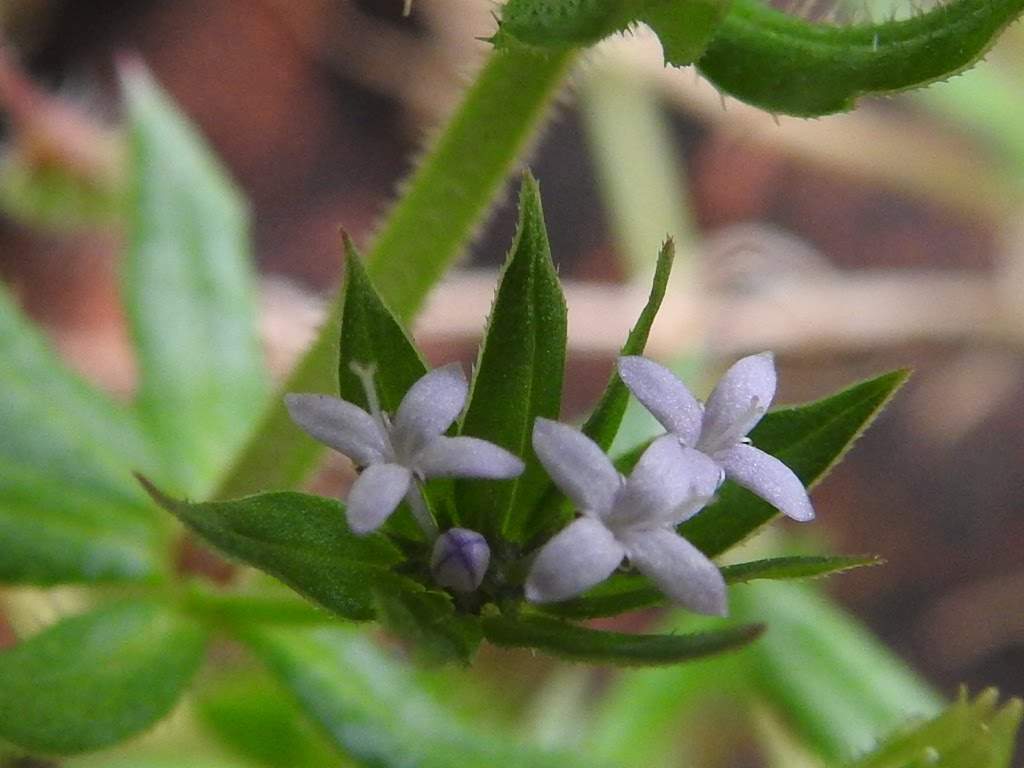
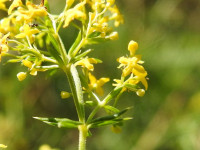
The flowers, small in size (1.5-2.5 mm in diameter), are white-greenish or white, with corollas having four well-defined lobes, triangular or ovate in shape, and with acute apices. They are arranged in biparous cymes, axillary and pedunculated, composed of 1 to 7 flowers, which develop beyond the level of the leaves. The peduncles and pedicels can be more or less divergent and sometimes curved under the fruit.
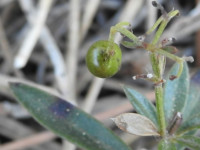
The fruit is a subglobose or reniform cypsela, 3-5 mm in diameter, covered with a dense hairiness of hooked, rough, and tuberculate hairs at the base. These hooked hairs facilitate adhesion to animal hairs or clothing, promoting dispersal. The root system is relatively thin and poorly branched, typical of annual plants.
Habitat and distribution
Cleavers is a Eurasian species widespread throughout Italy, including islands, and present in much of Europe, western and northern Asia, as well as northern Africa. It commonly grows in anthropized environments such as roadsides, uncultivated fields, hedges, and thickets, from lowlands up to subalpine hill and mountain elevations, up to about 1,700 meters altitude.
It prefers well-drained soils, even poor and disturbed, with exposure from sunny to partially shaded. Its ability to climb on other plants or structures makes it common in shrubby or bushy areas, where it exploits support to rapidly expand.
Flowering period
Flowering mainly extends from May to July, with possible variations that can reach up to October in some regions or favorable climatic conditions. During this period, the flowers, although small and inconspicuous, are numerous and contribute to the species' prolificacy.
Ecology and pollination
Cleavers is a hermaphroditic plant that relies mainly on entomogamous pollination. The small white flowers attract small pollinating insects, such as hymenopterans and dipterans, which facilitate fertilization. The structure of the inflorescence and the arrangement of the flowers allow good exposure for insect access.
Seed dispersal occurs thanks to the mericarps equipped with hooked hairs, which easily attach to mammal hairs or human clothing, facilitating colonization of new habitats. This dispersal strategy explains the species' natural tendency to become invasive in disturbed and cultivated environments.
Curiosities and traditional uses
Cleavers is known in herbal medicine and phytotherapy for its medicinal properties. The aerial parts of the plant are slightly bitter and have a salty taste; they are used as a refreshing, diuretic, depurative, anti-inflammatory, astringent, and tonic for the lymphatic system. It is used both internally for glandular fevers, tonsillitis, cystitis, and skin diseases such as eczema and psoriasis, and externally for ulcers and skin inflammations.
In cooking, in some traditions such as the Chinese one, it is used as a vegetable, while the toasted seeds can serve as a coffee substitute. Chemically, many species of the genus Galium, including Cleavers, contain asperuloside, a compound that during storage transforms into coumarin, giving a characteristic freshly cut hay smell to dried leaves.
Historically, North American indigenous populations such as the Penobscot used decoctions based on this plant in the treatment of gonorrhea. Moreover, some roots of Galium are known to contain red pigments similar to those of Rubia tinctorum, used as natural dyes.
Etymology
The genus name Galium derives from the Greek “γάλα” (gála), meaning “milk,” referring to the use of some species for milk coagulation during cheese production. The specific name aparine derives from the Greek “ἀπἄρίνη” (aparine), a plant cited by Theophrastus, and according to some interpretations derives from “ἀπαίρω” (apaíro), meaning “to remove” or “to carry away,” alluding to the characteristic of stems and fruits to cling and detach easily from any surface.
The Italian common name “Cleavers” directly refers to the ability of the spiny fruits and stems to firmly adhere to clothes or animal fur, thus facilitating the species' dispersal.
Sources
- Prof. S. Pignatti, Flora d’Italia
- Acta Plantarum - Flora delle regioni italiane (scheda di Marinella Zepigi)
- Tela Botanica / H. Coste, Flore descriptive et illustrée de la France
- World Flora Online (WFO)
Characteristics
Where I found it (7 sightings)
Classification
- Kingdom
- Plantae
- Family
- Rubiaceae
- Full name
- Galium aparine L.
- Life form
- Terofite scapose
Similar species
Search for species with similar characteristicsFurther reading
Noticed an error in the identification? Write to me
Other species of the same family
Rubiaceae
Explore
Other species of Rubiaceae