Botanical species
Galium album
Mill.
White Bedstraw
Description
Morphological description
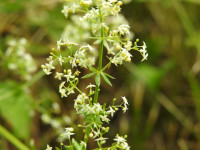
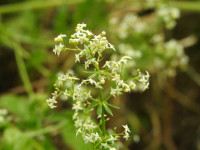
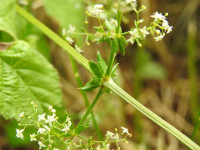
Perennial herbaceous plant, Galium album presents a scapose habit, generally reaching a height between 50 and 150 cm. The stem is erect, sometimes branched and can also be drooping or almost prostrate. Its section is quadrangular with well-defined angles, often covered with upward-facing hairs 0.5-1.5 mm long, which give a slight roughness to the touch.
The leaves are sessile, arranged in whorls of 6 to 8 elements, lanceolate, with dimensions ranging from 1.5 to 5 mm in width and from 10 to 30 mm in length. They are generally coriaceous, with the upper surface glossy and dark green in color. The leaves gradually narrow towards the tip, which can be more or less aristate. The margin is often slightly revolute (rolled downward), giving a slightly rough appearance.
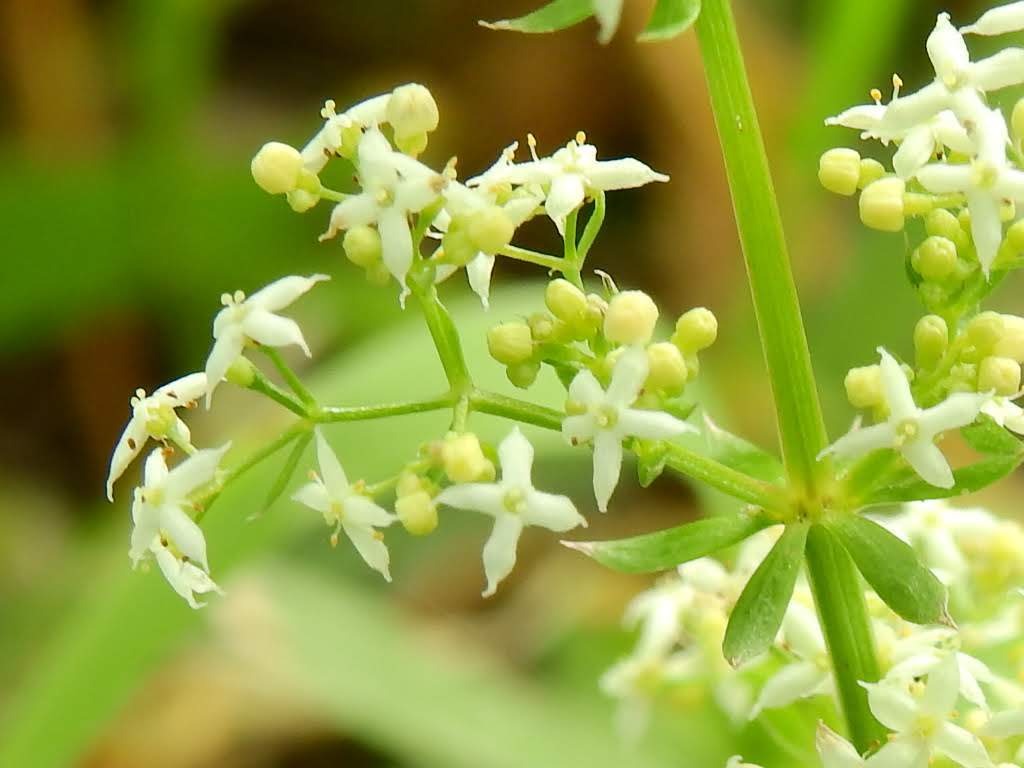
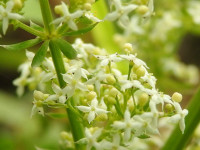
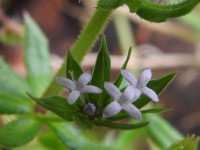
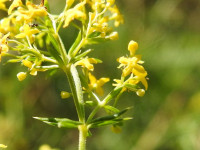
The inflorescence is a dense elongated pyramid formed by small white flowers with a tetramerous corolla (four petals), actinomorphic and about 3-3.5 mm in diameter, with apiculate petals. The flowers, hermaphroditic, are borne on pedicels without bracteoles, 1-3 mm long, generally shorter than the diameter of the corolla and often erect after flowering. The stamens are four with yellow anthers, while the ovary is inferior, formed by two carpels; the style is single with a capitate stigma.
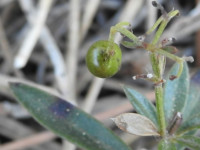
The fruit is a single indehiscent achene, smooth or weakly rugose, not enveloped as in other Galium, therefore visible from the outside, consisting of two lobes each containing one seed.
The root system, as in many species of the genus, consists of elongated underground stolons that allow the plant to perennialize and spread vegetatively.
Habitat and distribution
Galium album is widely distributed in Eurasian regions, from the vast European area to Japan. In Italy it is present in numerous regions, especially in hilly and mountainous environments up to subalpine altitudes (about 600-1000 m). It is frequent in meadows, pastures, hedges and roadsides, preferring open or semi-shaded habitats such as light woods and scrublands. It prefers well-drained soils, often with medium fertility, and adapts to exposures with good light.
The species is ecologically versatile but tends to avoid environments that are too wet or extremely dry. In Italy its presence is more marked in central-northern regions and on the major islands such as Sardinia and Sicily.
Flowering period
The flowering of Galium album generally extends from May to September, with a higher concentration in the summer months (June-August). In some cooler or mountainous climate areas flowering may start later and extend until September, while in warmer climate zones it tends to start already in late spring.
Ecology and pollination
The species reproduces mainly sexually through entomophilous pollination. The most common pollinating insects are flies and beetles that visit the small white flowers in search of nectar or pollen. The flowers, being hermaphroditic and actinomorphic, are accessible to various pollinating insects.
Seed dispersal occurs through the indehiscent fruit, which can be transported by animals or water, although no specific long-distance dispersal strategies are documented. The ability to spread vegetatively through underground stolons also allows the plant to effectively colonize favorable environments, forming stable populations.
Curiosities and traditional uses
The generic name "Galium" derives from the Greek γάλα (gála), meaning "milk", because some species of this genus were traditionally used to coagulate milk in cheese production, hence the Italian name "Caglio". Galium album owes its specific name to the light coloration of the flowers.
No specific medicinal or food uses are documented for this species, unlike others belonging to the same genus. However, some Galium species have historically been used for diuretic properties or as folk remedies. Galium album is mainly appreciated for its ecological role in natural habitats and for its beauty in meadows and grassy borders.
Etymology
The scientific name Galium album derives from two terms: "Galium", from the Greek γάλα (gála, milk), for the traditional use of some species in milk coagulation, and "album", from the Latin albus, meaning white, referring to the color of the species' flowers. The Italian common name "White Bedstraw" recalls both these characteristics: the function related to milk (rennet) and the light tone of the flowers.
Sources
- Prof. P.V. Arrigoni, "Flora analitica della Toscana", "Flora dell'Isola di Sardegna"
- Acta Plantarum - Flora delle regioni italiane (scheda di Roberta Alberti)
- World Flora Online (WFO)
Characteristics
Where I found it (9 sightings)
Classification
- Kingdom
- Plantae
- Family
- Rubiaceae
- Full name
- Galium album Mill.
- Life form
- Emicriptofite scapose
Similar species
Search for species with similar characteristicsFurther reading
Noticed an error in the identification? Write to me
Other species of the same family
Rubiaceae
Explore
Other species of Rubiaceae