Botanical species
Rubia peregrina
L.
Wild Madder
Description
Morphological description
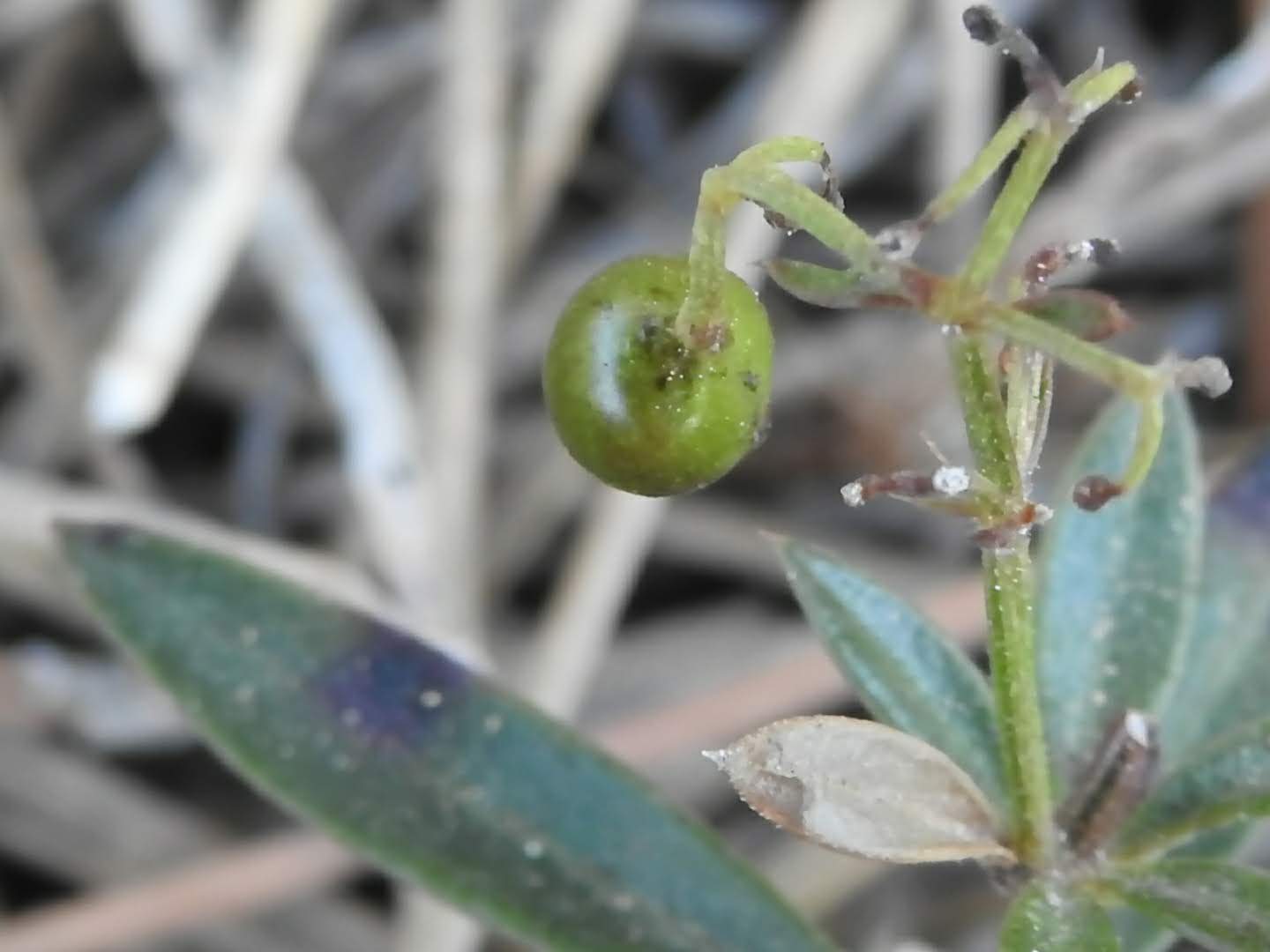
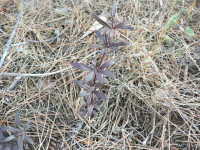
Perennial evergreen plant belonging to the Rubiaceae family, Wild Madder appears as a woody suffrutex with a climbing or prostrate habit. The height generally varies between 30 and 120 cm, but it can exceed one meter under favorable conditions. The stem is characterized by a tetragonal shape, with four cartilaginous wings 1-2 mm wide that make the surface angular to the touch. The basal part of the stem takes on a woody and persistent consistency, while the upper part develops into flexible, tenacious, and spreading branches, capable of climbing and entwining thanks to the presence, on the corners, of small downward-curved hooks that facilitate anchoring to surrounding plant supports.
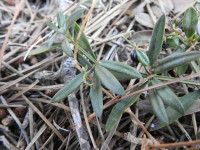
The leaves are arranged in whorls comprising from 3 up to 6-8 specimens per node. They are generally sessile, ovate-lanceolate or ovate in shape, leathery in texture, glossy and rough to the touch. The margin is crenate-dentate and is provided with hook-like spines, also present on the central vein; these spines contribute to the plant's defense and anchoring to the substrate. The leaves are persistent and do not show a network of secondary veins, but have a single main vein.
The flowers are rather small, greenish-yellow in color, with a rotate corolla 5-7 mm in diameter composed of 4-6 ovate lobes fused at the base and ending abruptly in an elongated pointed tip (aristate). The inflorescence is cymose-panicle, formed by dense axillary flower clusters, opposite or terminal, pedunculated and provided with lanceolate bracts. The flowers are hermaphroditic with five stamens inserted on the corolla tube, nearly rounded anthers, and two styles partially fused at the base, ending with capitate stigmas. The ovary is inferior.
The fruit is a black, shiny, fleshy drupe, almost spherical, about 4-6 mm in diameter, containing a single globose seed (monocarp). This berry resembles a small black berry and is typical of the species.
The root system consists of long and creeping roots that contribute to the plant's ability to spread in the substrate.
Habitat and distribution
Wild Madder is a thermophilic and calciphilous species typical of the Mediterranean maquis, widespread in southern and western Europe, up to Ireland, and in North Africa. In Italy, it is mainly present in regions with a Mediterranean climate, from the coastal belt up to 1000 m altitude, growing both in full sun and in semi-shaded areas.
It prefers sparse holm oak woods, oak woods, and pine forests, on well-drained soils, from very dry to dry, with calcareous substrates. It is absent or very rare in the colder and wetter areas of northern and northeastern Italy. It is also reported in Corsica.
Flowering period
Flowering generally extends from April to June, with peaks between May and June. In some Mediterranean areas, such as southern France, flowering can extend until August. The greenish-yellow flowers, not very showy, are arranged in numerous and compact inflorescences.
Ecology and pollination
Wild Madder relies on entomophilous pollination, with pollinating insects attracted by the small herbaceous flowers. The hermaphroditic flowers allow sexual reproduction, while the structure of the branches with hooks favors vegetative dispersion and anchoring. Seed dispersal occurs through the fleshy drupes, which are consumed by birds and small mammals, contributing to dissemination. The plant is thus well adapted to both sexual and vegetative reproduction, ensuring good colonization of suitable habitats.
Curiosities and traditional uses
The genus name Rubia derives from the Latin ruber, meaning "red," and refers to the dyeing properties of the roots of some species of the genus, historically used to obtain natural red dyes for fabrics and paintings. Wild Madder also has roots from which a coloring substance can be extracted, although to a lesser extent than the better-known Rubia tinctorum (common madder), which is a herbaceous plant cultivated for this purpose.
From a medicinal point of view, Wild Madder is known for its diuretic, emmenagogue, laxative, and tonic properties. These uses are traditional and require caution, as pharmaceutical applications must always be evaluated by experts.
In ethnobotany, the plant was appreciated in Mediterranean cultures for its dyeing properties and some medicinal uses, although less widespread than common madder. No particular folkloric traditions linked to this species are known.
Etymology
The scientific name Rubia peregrina derives from two Latin terms: ruber ("red") recalls the color of the pigment extracted from the roots, while peregrina probably refers to the plant's ability to extend and spread widely in territories, from the Latin peragrare ("to traverse, to cross" from per + agrare, "to walk over fields").
The Italian common name "robbia selvatica" emphasizes the belonging to the madder genus, distinguishing it from the cultivated species, and its natural habitat, typical of wooded environments and Mediterranean maquis.
Sources
- Acta Plantarum - Flora delle regioni italiane (scheda di Mirna Medri)
- Tela Botanica / H. Coste, Flore descriptive et illustrée de la France
Characteristics
Scheda botanica
| Famiglia | Rubiaceae |
|---|---|
| Fioritura | aprile – giugno |
| Forma biologica | Lianescent |
| Habitat | spiny plant, with green flowers, Perennial plant |
Domande frequenti
- Quando fiorisce Wild Madder?
- Wild Madder fiorisce aprile – giugno.
- Che tipo di pianta è Wild Madder?
- Wild Madder è una Phanerophytes (Lianescent) secondo la classificazione di Raunkiaer.
- A quale famiglia appartiene Wild Madder?
- Wild Madder appartiene alla famiglia botanica Rubiaceae.
Where I found it (9 sightings)
Classification
- Kingdom
- Plantae
- Family
- Rubiaceae
- Full name
- Rubia peregrina L.
- Synonyms
- Rubia peregrina L. subsp. longifolia (Poir.) O.Bolòs; Rubia peregrina L. subsp. requienii (Duby) Cardona & Sierra
- Life form
- Phanerophytes lianescent
Similar species
Search for species with similar characteristicsFurther reading
Noticed an error in the identification? Write to me
Other species of the same family
Rubiaceae
Explore
Other species of Rubiaceae