Botanical species
Orobanche minor
Sm.
Common Broomrape
Description
Morphological description
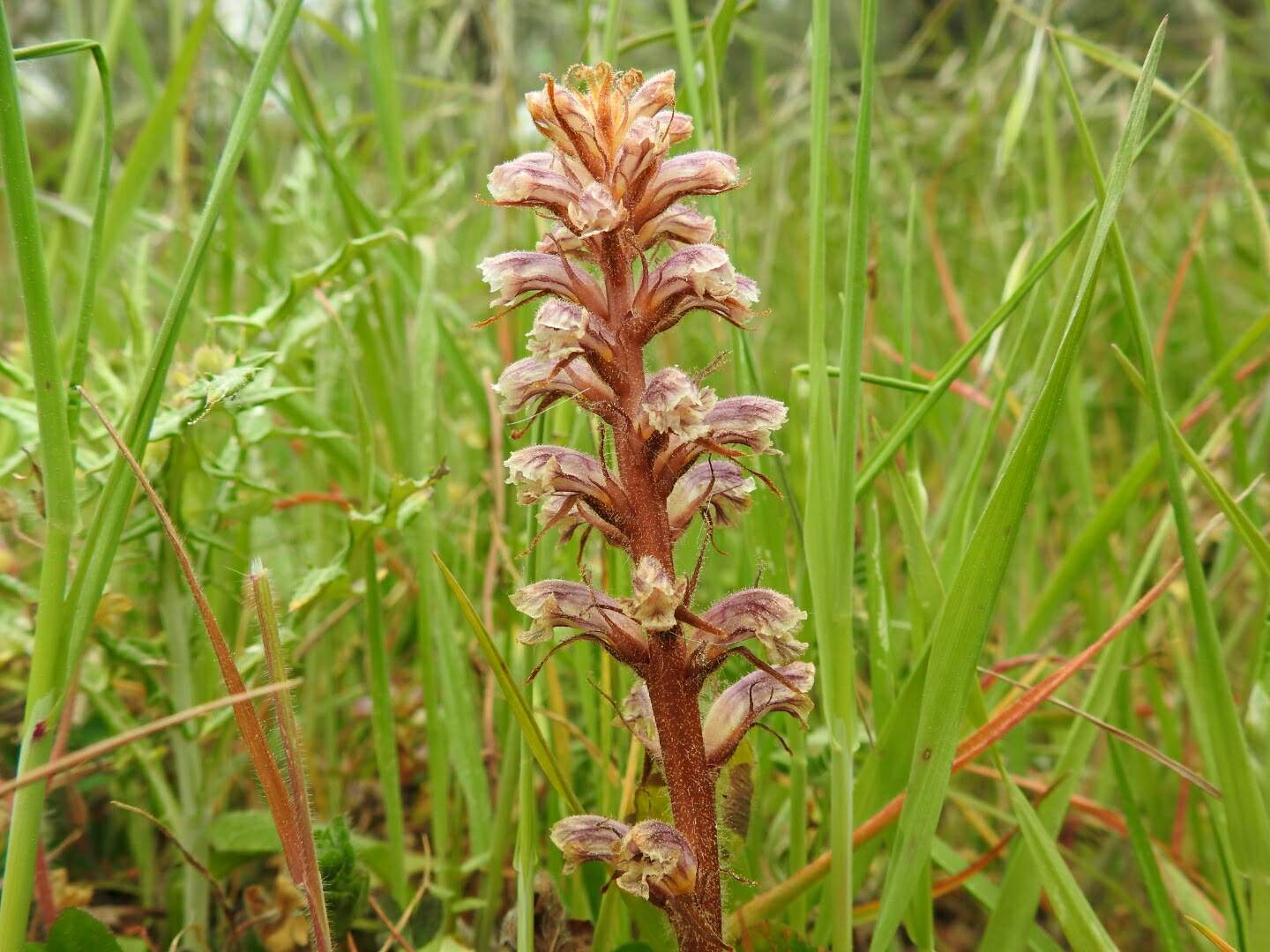
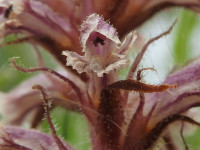
Annual herbaceous parasitic plant belonging to the family Orobanchaceae, lacking chlorophyll and therefore incapable of autonomous photosynthesis. It has an erect habit, with height varying from 10 to 60 cm, generally between 15-40 cm. The stem is cylindrical, sometimes grooved in taller specimens, often swollen and bulbous at the base, yellowish or purplish in color, covered with dense tomentose and microglandular hairs that give a rough and bristly surface. The stem is also characterized by reduced leaf-like scales, ovate-lanceolate, brown-black in color, scattered along the axis.
The leaves are reduced to lanceolate or ovate-lanceolate scales, arranged imbricately at the swollen base of the stem, lacking chlorophyll.
The inflorescence is a terminal spike, sparse, up to 20 cm long, with sessile flowers often well spaced from each other. Each flower is wrapped at the base by a triangular-elongated leaf-like bract, about 7-15 mm long, accompanied by a bifid or entire calyx lobe, of similar or slightly smaller size. The calyx is divided into bifid lateral segments, with filiform and elongated appendages that can exceed one centimeter.
The corolla, about 10-18 mm long, is tubular and dorsally curved, with an upper bilobed or retuse lip and a trilobed lower lip, with the central lobe larger than the lateral ones. The coloration varies from creamy white with purplish or pinkish veins and shades towards the apex, to pale yellow rarely uniform. The surface of the corolla can be glabrous or slightly pubescent, with hairy stamen filaments in the lower part, inserted 2-3 mm above the base of the corolla. The anthers are glabrous. The stigma is bilobed, purple or rarely yellow in color.
The fruit is a loculicidal capsule, ovoid, containing numerous microscopic black seeds.
The root system is modified into parasitic organs (haustoria) that insert into the roots of host plants, mainly belonging to the family Fabaceae.
Habitat and distribution
Species widespread throughout almost all of Italy and the Mediterranean basin, also present in large areas of Europe, Asia Minor, and North Africa. It grows from the plains up to about 1500 meters above sea level. It prefers open environments such as cultivated fields, meadows, forest edges, and clearings, often on well-drained soils and sunny or partially shaded exposure.
It is typically parasitic on many species of Fabaceae, with particular affinity for clover (Trifolium spp.), but can also be found on other legumes. The plant often behaves as a weed in the cultivation of these plants.
Flowering period
Flowering generally extends from May to July, with possible local variations extending it until August. The appearance of inflorescences is influenced by altitude and local climatic conditions.
Ecology and pollination
Being a chlorophyll-lacking and obligate parasitic plant, it depends entirely on the host for nutrition, absorbing sap and nutrients through the root haustoria.
The flowers, scentless, are visited by pollinating insects that facilitate pollination; however, the specific entomofauna involved is not always well documented. The flower structure with an upper bilobed lip and a trilobed lower lip favors access to small pollinating insects.
Seed dispersal, very small and light, occurs mainly by wind, facilitated by the capsule that opens at maturity.
Curiosities and traditional uses
No established food or medicinal uses of this species are known in Italy, nor particular references in local folklore. Its parasitic nature makes it better known as a weed in cultivated fields, especially of legumes, often causing economic damage.
Etymology
The generic name Orobanche derives from the Greek "orobos" (legume) and "anchein" (to strangle, choke), referring to the characteristic of species of this genus to parasitize leguminous plants, hindering their growth. The specific name "minor" indicates the often smaller size of the plant compared to related species.
The Italian common name "succiamele minore" refers to the parasitic capacity of the plant ("to suck" the sap) and its generally smaller size compared to other Orobanche.
Sources
- Prof. P.V. Arrigoni, "Flora analitica della Toscana", "Flora dell'Isola di Sardegna"
- Acta Plantarum - Flora delle regioni italiane (scheda di Gianluca Nicolella)
- Tela Botanica / H. Coste, "Flore descriptive et illustrée de la France"
- World Flora Online (WFO)
Characteristics
Scheda botanica
| Famiglia | Orobanchaceae |
|---|---|
| Fioritura | marzo – luglio |
| Forma biologica | Parasitic |
| Habitat | with white flowers, with yellow flowers, parasitic plant |
Domande frequenti
- Quando fiorisce Common Broomrape?
- Common Broomrape fiorisce marzo – luglio.
- Che tipo di pianta è Common Broomrape?
- Common Broomrape è una Therophytes (Parasitic) secondo la classificazione di Raunkiaer.
- A quale famiglia appartiene Common Broomrape?
- Common Broomrape appartiene alla famiglia botanica Orobanchaceae.
Where I found it (5 sightings)
Classification
- Kingdom
- Plantae
- Family
- Orobanchaceae
- Full name
- Orobanche minor Sm.
- Life form
- Therophytes parasitic
Similar species
Search for species with similar characteristicsFurther reading
Noticed an error in the identification? Write to me
Other species of the same family
Orobanchaceae
Explore
Other species of Orobanchaceae