Botanical species
Bellardia viscosa
(L.) Fisch. & C. A. Mey.
Sticky parentucellia
Description
Morphological description
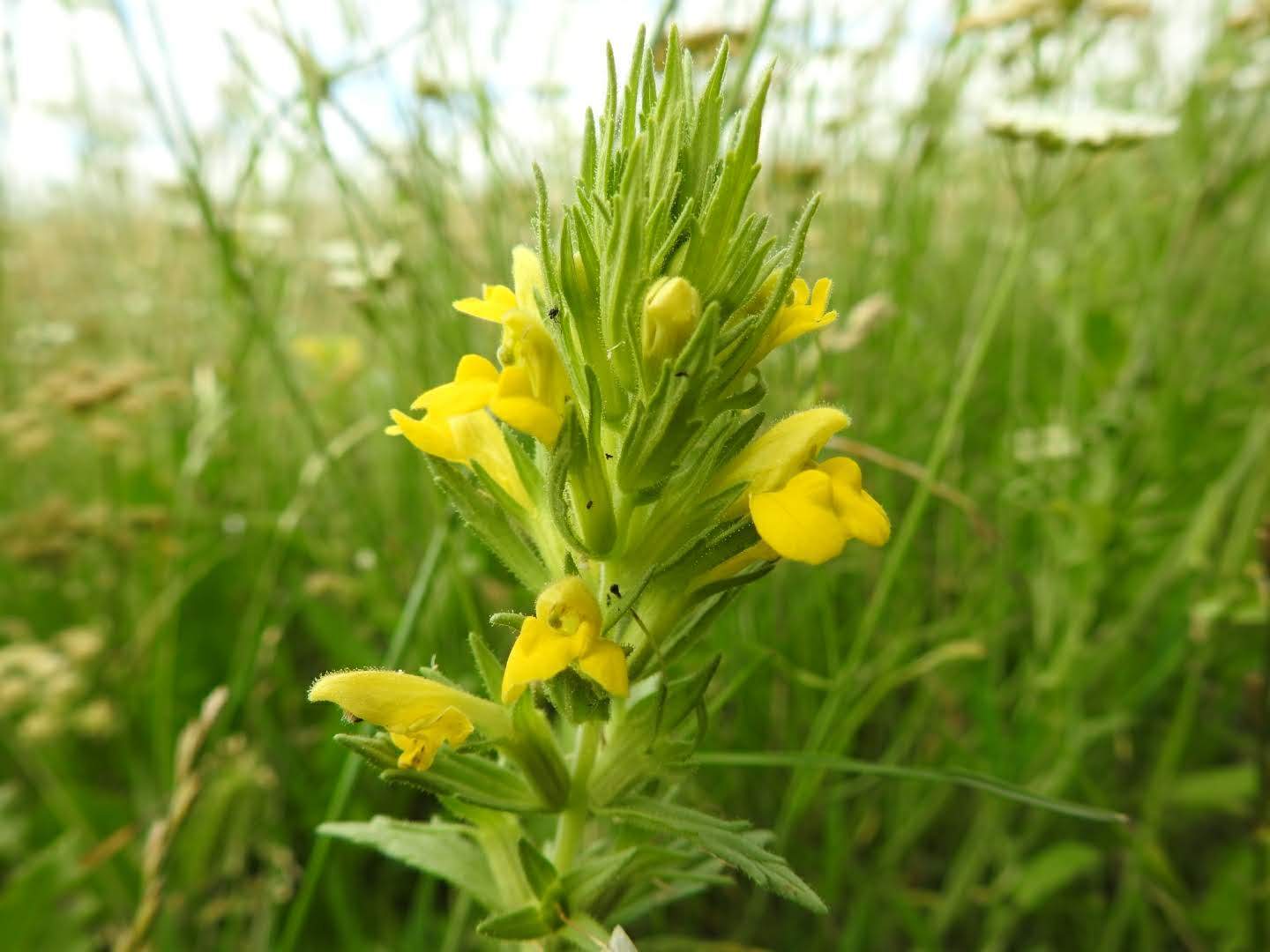
Annual herbaceous plant, Sticky parentucellia presents erect stems, simple or slightly branched, with a height ranging between 30 and 90 cm. The stem is characterized by a square section, often angular, and covered by a dense pubescence of patent glandular hairs, about 0.3-0.6 mm long, which give the plant a sticky appearance and a tomentose and hirsute surface.
The leaves are arranged both alternately and oppositely along the stem; they have a linear or lanceolate shape, with variable dimensions from 2-6 mm in width and 30-80 mm in length for the smaller leaves, up to 15-20 mm in width and 40-50 mm in length for the larger leaves. The leaf margin is toothed, often with prominent teeth, and the leaves can be patent or reflexed, with an acute apex and rounded base. During drying, the leaves tend to blacken.
The inflorescence is a dense pyramidal spike, consisting of yellow flowers inserted in the axils of oval or linear bracts, 15-30 mm long, which form a compact tuft in the apical parts. The flowers, borne on short pedicels, have a cylindrical calyx with a tube 9-11 mm long and teeth 6-7 mm long, which during fruiting exceed the capsule. The corolla is bright yellow, irregular and bilabiate, 18-24 mm long; the lower lip is trilobed and longer than the upper one, while the upper lip is convex, entire and forms a hood that covers anthers and stigma. The corolla is early deciduous.
The fruit is an oblong capsule, 6-9 mm long, pubescent and sticky, which opens loculicidally and contains numerous finely reticulated seeds.
Habitat and distribution
This species has a typically Mediterranean-Atlantic range, present along the Atlantic and Mediterranean coasts with extensive inland penetration. In Italy it is commonly found in moist pasture environments, on sandy-loamy soils and areas with moderate humidity. It grows preferentially from 0 up to about 700 meters of altitude.
It prefers sunny exposures but in environments with some soil moisture, typical of grasslands and open spaces that are not too arid.
Flowering period
Sticky parentucellia flowers mainly between March and May. In some areas, especially warmer ones with favorable conditions, flowering can start already in early spring and end by late spring.
Ecology and pollination
The plant is mainly pollinated by pollinating insects, attracted by the bright yellow color of the flowers and the bilabiate structure of the corolla, which favors entomophilous pollination. The upper lip that protects anthers and stigma ensures effective contact with pollinating insects during flower visits.
Seed dispersal occurs through the capsule that opens loculicidally, releasing numerous finely reticulated seeds. The sticky and pubescent surface of the capsule may favor adhesion to animals or transport by wind or water, although specific data on the dispersal mode are not available.
Curiosities and traditional uses
No significant traditional food or medicinal uses are documented for this species. The common name "Sticky parentucellia" distinguishes this plant from other similar ones of the genus Bellardia, such as Perlina minore (Bellardia trixago) and Perlina rossiccia (Parentucellia latifolia). The term “perlina” probably refers to the shiny and slightly sticky appearance of the flowers and bracts.
Etymology
The genus Bellardia is dedicated to Carlo Antonio Lodovico Bellardi (1741-1826), a botanist from Turin. The specific epithet "viscosa" derives from the Latin "víscum," meaning mistletoe or sticky, referring to the characteristic secretion of glandular hairs that make the plant sticky to the touch.
The Italian common name "Sticky parentucellia" refers to the relatively large size of the flowers compared to other related species of the same genus or related genera.
Sources
- Prof. S. Pignatti, "Flora d'Italia"
- Acta Plantarum - Flora delle regioni italiane (sheet by Marinella Zepigi)
Characteristics
Where I found it (3 sightings)
Classification
- Kingdom
- Plantae
- Family
- Orobanchaceae
- Full name
- Bellardia viscosa (L.) Fisch. & C. A. Mey.
- Synonyms
- Parentucellia viscosa (L.) Caruel
- Life form
- Terofite scapose
Similar species
Search for species with similar characteristicsNoticed an error in the identification? Write to me
Other species of the same family
Orobanchaceae
Explore
Other species of Orobanchaceae