Botanical species
Rhinanthus minor
L.
Yellow-Rattle
Description
Morphological description
Annual herbaceous hemiparasitic plant belonging to the family Orobanchaceae, generally 5 to 50 cm tall. The stem is erect, often simple or sometimes bent at the base, with a glabrous or slightly pubescent surface, characterized by more or less evident dark stripes. The root system is taproot, allowing the plant to anchor firmly to the soil while drawing nutrients from host plants.
The leaves are sessile, arranged alternately or oppositely depending on the section, lanceolate or oblong-lanceolate in shape, with variable sizes from 3 x 24 mm up to 15 x 25 mm. The leaf margin is regularly toothed, with evident but not aristate teeth. The leaf surface is glabrous or slightly pubescent.
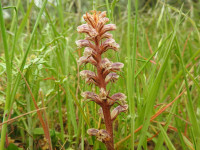
The inflorescence consists of a terminal spicate raceme, dense and compact, with contiguous flowers during flowering; in fruiting, the lower flowers tend to space out slightly. The bracts, green or green-reddish in color, are glabrous or slightly rough, 10-20 mm long, generally longer or slightly shorter than the calyx, with larger lower teeth compared to the upper ones, all non-aristate.
The calyx is ovate, laterally compressed, 6-8 mm long, glabrous or with sporadic simple hairs, with teeth about 2 mm long.
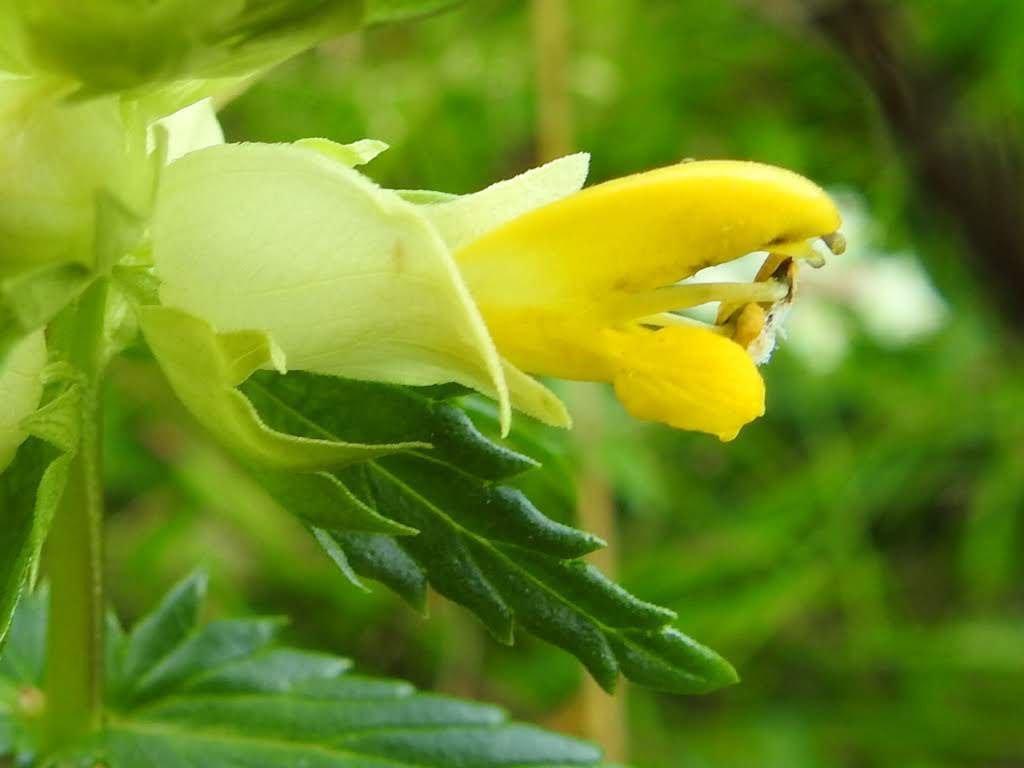
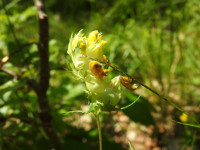
The flower is characterized by a yellow bilabiate corolla, 13-18 mm long, with a straight tube and a well-open throat. The corolla features a protuberance on the upper lip called the “nose,” hemispherical and about 0.5 mm long, generally violet or yellow in color, making it particularly recognizable. The corolla lips diverge from 45 to 90°, giving an open and well-visible throat.
The androecium is didynamous (4 stamens, 2 long and 2 short), with velvety anthers, bilocular and with arrow-shaped pollen sacs. The gynoecium consists of a bilocular ovary, ovate-elliptic and laterally compressed, with a slightly curved filiform style and capitate stigma.
The fruit is a loculicidal capsule, subcircular and laterally compressed, 9-12 mm long, enclosed by an accrescent and apiculate calyx. The seeds are discoidal, dark brown, 4.4-5 x 2.8-3.5 mm, surrounded by a translucent wing 0.5-0.8 mm wide, which facilitates dispersal.
Habitat and distribution
The species has a circumboreal distribution, present in temperate-cold Europe, Asia, and North America. In Italy, it is mainly widespread in mountainous and pre-alpine regions, found in wet meadows and mountain pastures up to subalpine altitudes, generally on silty-clayey soils poor in carbonates.
It prefers environments characterized by fresh and moist soils, rarely dry, and is frequently found in poor meadows or low-fertility pastures. Exposure is usually well-lit, in open areas or slightly shaded by surrounding herbaceous vegetation.
In the Mediterranean basin, its presence is more limited and localized in cooler mountainous areas, as it prefers moderate temperatures and constant humidity conditions.
Flowering period
Flowering mainly occurs from May to September, with geographic variations depending on altitude and local climatic conditions. In mountain areas, flowering tends to concentrate in the summer months, from June to August, while in lower or temperate regions it can start as early as May and extend until September.
Ecology and pollination
Hemiparasitic plant, partially nourished by absorbing water and mineral salts from the roots of host plants, while maintaining good photosynthetic capacity thanks to the presence of chlorophyll in the leaves and stem. This strategy allows it to survive in nutrient-poor environments and compete effectively with other herbaceous species.
Pollination is entomophilous, mainly carried out by pollinating insects attracted by the bright yellow flowers and the open shape of the corolla that facilitates access to nectar and pollen. The bilabiate structure of the corolla and the presence of the “nose” promote effective contact between pollinating insects and the plant’s reproductive organs.
Seed dispersal occurs mainly by anemochory, favored by the presence of the translucent wing surrounding the seeds, allowing them to be carried by the wind over short distances.
Curiosities and traditional uses
The common name "Yellow-Rattle" derives from the resemblance of the flower to a rooster's comb, although smaller than that of related species. The plant is also known by names in other languages, such as "Yellow rattle" in English and "Kleiner Klappertopf" in German, all referring to the characteristic sound produced by the seeds inside the dry fruit.
The entire plant is slightly toxic due to the presence of aucubin, a substance that can cause harmful effects if ingested in significant quantities. For this reason, it is not used for food or medicinal purposes in popular tradition.
However, its ability to act as a parasite on some grasses has been studied for the natural control of invasive herbaceous species or for maintaining biodiversity in traditional meadows, as it reduces the vigor of host plants favoring the presence of other herbaceous species.
Etymology
The generic name Rhinanthus derives from ancient Greek ῥίς, ῥῑνός (rhís, rhinós), meaning "nose," and ἄνϑοϛ (ánthos), "flower," referring to the characteristic “nasal” protuberance present on the upper lip of the corolla.
The specific epithet minor indicates the smaller size of the species compared to other related species of the genus, as suggested by the Latin comparative term "minor" or "smaller."
The Italian common name “cresta di gallo minore” recalls the shape of the flower, similar to a small rooster’s comb, distinguishing it from similar species with larger combs.
Sources
- Prof. S. Pignatti, "Flora d'Italia"
- Acta Plantarum - Flora delle regioni italiane (sheet by Roberta Alberti)
- Tela Botanica / H. Coste, "Flore descriptive et illustrée de la France"
- World Flora Online (WFO)
Characteristics
Scheda botanica
| Famiglia | Orobanchaceae |
|---|---|
| Fioritura | maggio – settembre |
| Forma biologica | Scapose |
| Habitat | with yellow flowers, annual plant |
Domande frequenti
- Quando fiorisce Yellow-Rattle?
- Yellow-Rattle fiorisce maggio – settembre.
- Che tipo di pianta è Yellow-Rattle?
- Yellow-Rattle è una Therophytes (Scapose) secondo la classificazione di Raunkiaer.
- A quale famiglia appartiene Yellow-Rattle?
- Yellow-Rattle appartiene alla famiglia botanica Orobanchaceae.
Where I found it (5 sightings)
Classification
- Kingdom
- Plantae
- Family
- Orobanchaceae
- Full name
- Rhinanthus minor L.
- Synonyms
- Rhinanthus personatus (Behrendsen) Bég.
- Life form
- Therophytes scapose
Similar species
Search for species with similar characteristicsFurther reading
Noticed an error in the identification? Write to me
Other species of the same family
Orobanchaceae
Explore
Other species of Orobanchaceae