Botanical family
Orobanchaceae
Description
Botanical characteristics
The plants belonging to this family are predominantly herbaceous, annual or perennial, often with an erect habit and a height that rarely exceeds one meter. The stem, generally cylindrical, can be thin and branched or simple, sometimes with a swollen base; the texture varies from fleshy to woody, and the surface can be pubescent or glabrous, with simple or glandular hairs.
The leaves are usually reduced to bracts or, when present, have simple shapes ranging from ovoid to lanceolate, with entire or toothed margins, arranged alternately or spirally. In some genera they are very scarce or transformed into sessile scales. Stipules are absent.
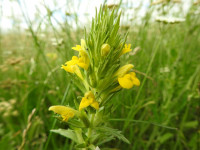
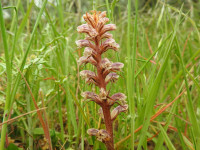
The inflorescence is a spike or an elongated raceme, with sessile or shortly pedicellate flowers, arranged more or less densely. The bracts are ovate, sometimes aristate, and can have colors ranging from red to violet or purple.
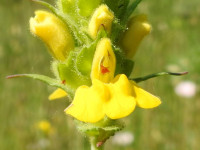
The flowers are hermaphroditic, zygomorphic and bilabiate, with four whorls and a pentamerous structure in the corolla. The calyx is gamosepalous, reduced to 3-5 teeth or lobes, sometimes with calycular bracteoles. The corolla, sympetalous and tubular, ends in a bilabiate limb with five lobes; it can be cylindrical, campanulate or spatulate, with a woolly or glabrous surface and colors ranging from yellow-brown to red, passing through orange-violet and white.
The androecium includes four didynamous stamens, rare cases of only two stamens; the anthers are transversely arranged, often with two locules, and dehiscence occurs through longitudinal slits. The gynoecium consists of a superior bicarpellary ovary (rarely tricarpellary), unilocular or bilocular, with parietal placentation and numerous ovules. The style is filiform, with a capitate or lobed stigma.
The typical fruit is a loculicidal capsule, sometimes a drupe or berry, containing numerous minute, black and angular seeds, with a rudimentary embryo composed of few cells.
A distinctive characteristic of the family is the parasitic nature of many species, which feed through haustoria connected to the roots of host plants. Some species are holoparasites, lacking chlorophyll and incapable of photosynthesis, while others are hemiparasites, capable of photosynthesis but also able to absorb nutrients from other plants.
Distribution and diversity
The Orobanchaceae are mainly distributed in the northern hemisphere, with a significant presence in Europe, Asia and North America, but some species are also found in other parts of the world. The family includes numerous genera and species, with biological diversity ranging from annual parasitic therophytes to perennial parasitic geophytes equipped with specialized underground organs.
Main genera and representative species
Among the best-known genera are Orobanche, Rhinanthus, Castilleja, Euphrasia, Lathraea, Lindenbergia and Rehmannia. In Italy there are species of Orobanche (such as Orobanche purpurea), Rhinanthus and Euphrasia, often recognizable for their ecological role as parasitic plants of other plant species.
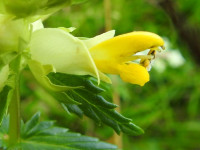
The species of Orobanche are holoparasites, incapable of photosynthesis and exclusively dependent on the host; Rhinanthus and Euphrasia are hemiparasites, capable of photosynthesis but also able to extract nutrients from nearby plants.
Etymology
The family name derives from Greek: òrobos means “legume” and anchéin “to strangle”, recalling the parasitic character of many species that act to the detriment of Leguminosae. The term was used in antiquity to indicate parasitic plants of vetch (Vicia sativa). The scientific name was formally defined in 1799 by the French botanist Étienne Pierre Ventenat.
Sources
- Wikipedia
Explore
Other botanical families