Botanical species
Bellardia trixago
(L.) All.
Mediterranean lineseed
Description
Morphological description
Bellardia trixago is an annual herbaceous hemiparasitic plant, generally reaching a height between 10 and 60 cm, exceptionally up to 70 cm. The stem is erect, simple or sparsely branched, covered with a pubescence of stiff and retrorse hairs, often glandular, with hairs directed downwards. This characteristic gives the plant a viscous or sticky surface to the touch.
The leaves are arranged oppositely along the stem, sessile, lanceolate or lanceolate-linear in shape, with sizes varying from 1 to 6 cm in length and about 2-10 mm in width. The lower leaves are generally subspatulate, the middle ones narrower, and the upper ones triangular and sometimes bract-like. The margin is toothed with about 4-6 blunt and spaced teeth on each side. The leaf surface is herbaceous, often glandular.
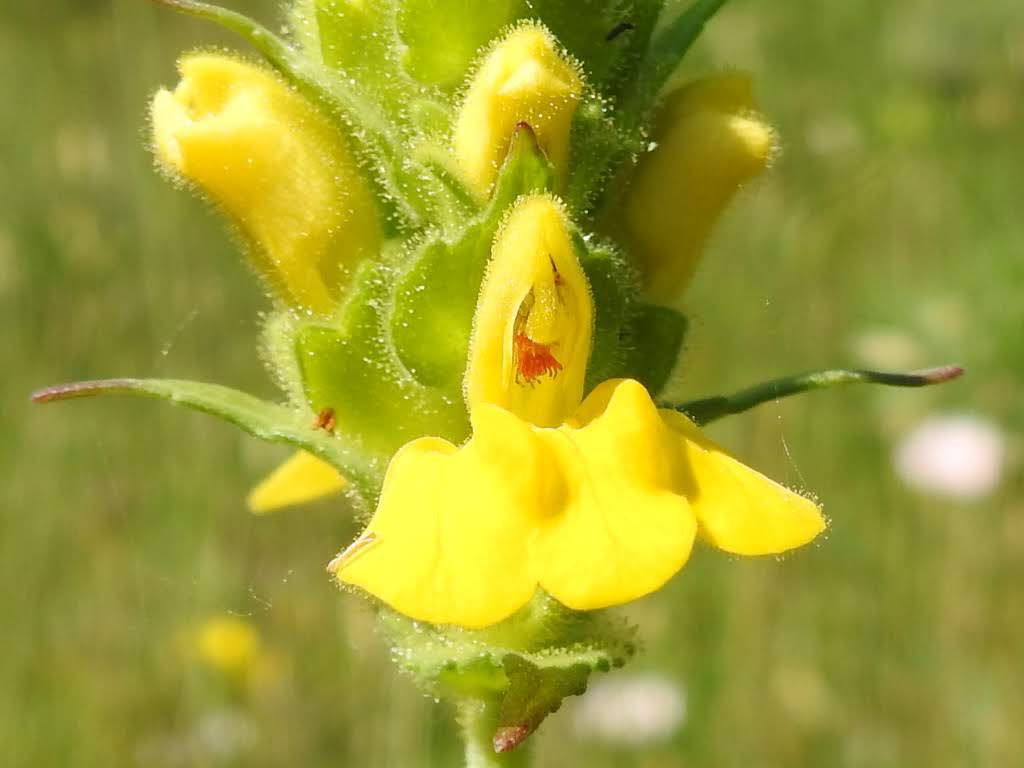
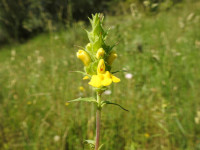
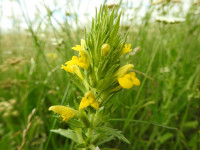
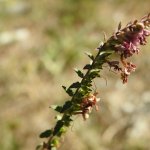
The inflorescence is a terminal spike-like raceme, short and compact during flowering, with a scapose habit (elongated floral axis almost leafless). The spike is pyramidal and quadrangular in shape, very glandular. The flowers are hermaphroditic, zygomorphic, oriented in all directions. The calyx is swollen, 7-12 mm long, with wide triangular teeth, shallow and less than a quarter the length of the calyx tube.
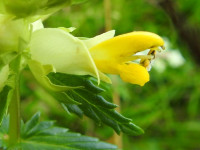
The corolla is bilabiate and measures between 17 and 24 mm. It has a characteristic gibbosity at the throat, with the upper lip convex, purplish and white or completely yellow, while the lower lip is trilobed and reflexed with lobes of similar size. The ovary is superior and bilocular.
The fruit is an ovoid loculicidal capsule, as long as the calyx (7-11 mm), apiculate and slightly laterally compressed, densely villous. Inside it contains numerous ellipsoid, subreniform, light chestnut seeds, with longitudinal grooves and transverse striations.
Habitat and distribution
Bellardia trixago is typical of mountainous and submontane environments, present from the plains up to about 1200 m altitude. It grows preferably in pastures, uncultivated lands, garrigues, sandy and dry places. It is a heliophilous and thermophilous species, favoring sunny exposures and areas with a Mediterranean climate.
In Italy, its distribution is mainly reported along coastal regions and in the inland areas of the Peninsula up to Romagna, with occurrences also in Sardinia, Sicily, and Corsica. It is also present in the Eure-Mediterranean regions and in some areas of the Northeast such as Cuneese and the province of Venice, extending also to Istria, although with sparser and localized populations.
Flowering period
Bellardia trixago mainly flowers in April and May. In some warmer climate areas or particular situations, the flowering period may extend slightly, but it is generally concentrated in spring.
Ecology and pollination
Being a hemiparasitic plant, Bellardia trixago partially feeds on other host plants through specialized roots, while maintaining the ability to photosynthesize thanks to the presence of chlorophyll. This strategy allows it to survive in relatively nutrient-poor environments.
Pollination is mediated by pollinating insects, attracted by the bright yellow color of the flowers and their bilabiate shape which facilitates access to nectar. The zygomorphic arrangement and the trilobed lower lip serve as a landing platform for pollinators, which likely include bees and other hymenopterans.
Seed dispersal occurs through the loculicidal capsule which, once mature, opens releasing numerous small and slightly grooved seeds, favoring effective dissemination especially in open and sunny environments.
Curiosities and traditional uses
Bellardia trixago, like many Orobanchaceae, has developed an interesting evolutionary adaptation: although hemiparasitic, it retains photosynthetic function, unlike other fully parasitic species such as Orobanche.
No particular medicinal applications or traditional food uses related to this species are known, nor specific folklore concerning it. However, the genus name recalls a Piedmontese botanist of the 18th century, Carlo Antonio Lodovico Bellardi, to whom the scientific denomination is dedicated.
Etymology
The genus name Bellardia is a tribute to the botanist Carlo Antonio Lodovico Bellardi (1741-1826), active in Turin. The specific epithet trixago derives from Greek and refers to an ancient term for a similar plant, probably with reference to the shape of the trilobed lower lip of the corolla, which resembles the structure of plants cited by Pliny.
The Italian common name “perlina minore” refers to the relatively small size of the plant and the presence of small yellow flowers, which can resemble small pearls scattered on the flowering spike.
Sources
- Prof. S. Pignatti, "Flora d'Italia"
- Acta Plantarum - Flora delle regioni italiane (sheet by Anja Michelucci)
Characteristics
Where I found it (4 sightings)
Classification
- Kingdom
- Plantae
- Family
- Orobanchaceae
- Full name
- Bellardia trixago (L.) All.
- Synonyms
- Bartsia trixago
- Life form
- Terofite scapose
Similar species
Search for species with similar characteristicsFurther reading
Noticed an error in the identification? Write to me
Other species of the same family
Orobanchaceae
Explore
Other species of Orobanchaceae