Botanical species
Odontites luteus
(L.) Clairv.
Yellow Odontites
Description
Morphological description
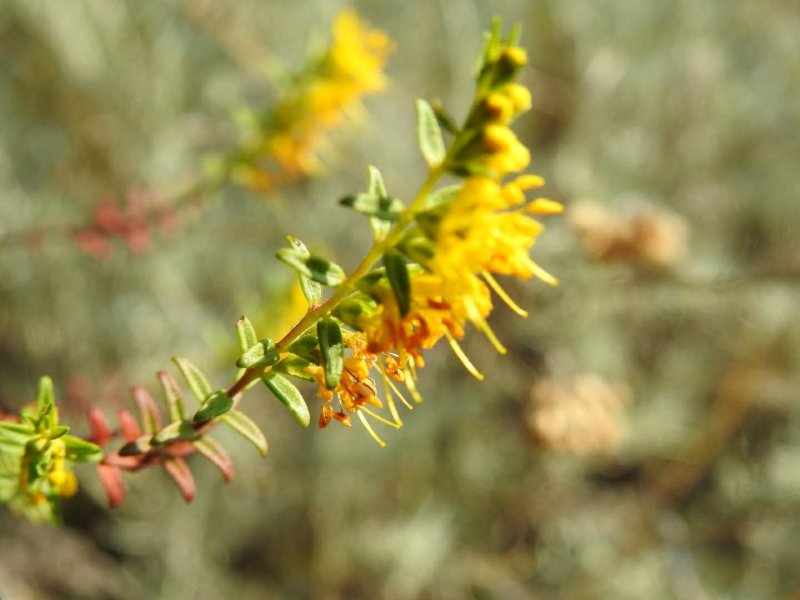
Odontites luteus is an annual herbaceous plant reaching a height between 15 and 50 cm. It has a scapose habit, with erect stems branched in the upper part; the branches are arched, pendulous at the apex, and often exceed the main stem. The stem is woody at the base, brown-reddish in color, and can be glabrescent or covered with a slight non-glandular pubescence.
The leaves are arranged oppositely along the stem, sessile and lanceolate or ovate-lanceolate in shape, with entire margins or sometimes with two lateral teeth. They are acuminate and uninerve, with a generally entire blade and a glabrous or slightly pubescent surface.
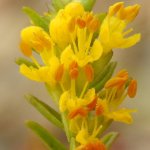
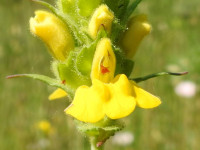
The flowers are hermaphroditic, bilabiate and bright yellow, sometimes with yellow-greenish shades. The corolla, 5-6 mm long, is pubescent especially along the ciliate margins, with an entire and slightly arched upper lip and a lower lip divided into three obtuse lobes. The inflorescences appear as unilateral racemose spikes, located in the axils of the upper leaves, with linear bracts slightly shorter than the flowers. The calyx is a flared tube, pubescent, divided into 3-5 triangular and pointed lobes. The anthers are glabrous, yellow in color, and visibly protrude from the throat of the corolla.
The fruits are loculicidal capsules, oval or elliptical, 4-5 mm long, longer than the calyx, containing numerous small brownish seeds. The plant's root system is characterized by haustoria that allow it to establish hemiparasitic relationships with roots of other host plants, from which it extracts nutrients.
Habitat and distribution
Odontites luteus is a species typical of Mediterranean regions, with a range centered on the Mediterranean coasts but extending northwards and eastwards. In Italy it is present throughout the national territory, from the plains up to about 800 m altitude, with occasional findings up to 1,400 m a.s.l.
It prefers dry and sunny habitats, such as rocky slopes, calcareous soils and poor terrains, often in dry pasture environments, garrigues and sparse pine woods. It adapts to bright exposures and prefers well-drained substrates. In the Mediterranean basin it also frequents hill and subalpine mountain environments.
Flowering period
Flowering mainly occurs between August and October, with possible geographic variation in which the appearance of flowers can extend from late summer to early autumn, adapting to local climatic conditions.
Ecology and pollination
This species is hemiparasitic, meaning it maintains a partial parasitic relationship with other herbaceous or shrubby plants through root haustoria, from which it absorbs water and nutrients, while retaining the ability to photosynthesize. The presence of this ecological strategy allows it to thrive in resource-poor environments.
The yellow, bilabiate and protruding flowers are adapted for pollination by pollinating insects, particularly hymenopterans such as bees and bumblebees, which, attracted by the color and shape of the flower, facilitate fertilization.
Seed dispersal occurs through the dehiscence of the capsules which release numerous minute seeds, presumably transported by abiotic agents such as wind and surface water, or by small animals.
Curiosities and traditional uses
Odontites in general are known for their hemiparasitic behavior, which makes them interesting for ecological studies on trophic relationships among plants. No particular ethnobotanical applications or traditional medicinal uses of Odontites luteus are known, nor documented food uses.
The common name "perlina gialla" (yellow bead) refers to the bright color of the flowers, which can resemble small golden pearls scattered on dry slopes.
Etymology
The genus name Odontites derives from the Greek "odóus, odóntos," meaning "tooth," referring to the tooth-like points present at the base of the anthers. The specific epithet "luteus" means "yellow" in Latin and indicates the characteristic color of the flowers of this species.
The Italian common name "perlina gialla" refers to the appearance of the small yellow flowers, similar to golden pearls scattered along the stems.
Sources
- Acta Plantarum - Flora delle regioni italiane (actaplantarum.org)
- Acta Plantarum - scheda di Marinella Zepigi
- World Flora Online (WFO)
Characteristics
Where I found it (8 sightings)
Classification
- Kingdom
- Plantae
- Family
- Orobanchaceae
- Full name
- Odontites luteus (L.) Clairv.
- Life form
- Terofite scapose
Similar species
Search for species with similar characteristicsFurther reading
Noticed an error in the identification? Write to me
Other species of the same family
Orobanchaceae
Explore
Other species of Orobanchaceae