Botanical family
Saxifragaceae
Description
Botanical characteristics
Plants belonging to this family are generally herbaceous, both annual and perennial, with some species exhibiting succulent characteristics. The typical habit ranges from small groundcover plants to more robust forms, often with basal leaves. The leaves can be simple or compound, and are generally arranged alternately or basally.
The flowers are hermaphroditic and regular, with a well-defined structure usually presenting 4 or 5 petals. The stamens number 5 or 10, contributing to often showy flowering. The fruit is predominantly in the form of a follicle or capsule, containing seeds that ensure the propagation of the species.
These traits, combined with the presence of regular flowers and a particular fruit structure, constitute distinctive elements of the family.
Distribution and diversity
The family has a typically boreal distribution, present in the main regions of the northern hemisphere: Europe, Asia, North America, and North Africa. It is also widespread in marginal areas such as Greenland, the Svalbard Islands, and other islands of the Arctic Ocean, where it reaches the extreme limits of vegetation. Beyond the boreal hemisphere, some species are also found in the Andes in South America, evidence of the ability to adapt to cold and mountainous climates.
Globally, the family includes about 640 species distributed in 34 genera, with remarkable diversity especially in the most representative genus, which accounts for more than half of the total species. In Europe, 12 genera of this family are spontaneous.
Main genera and representative species
Among the 34 genera included in this family, some are particularly well-known and important for their distribution and botanical interest:
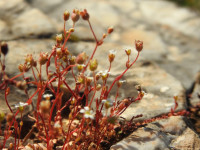
- Saxifraga: the largest genus, with about 470 species, many of which are common also in Italy. They are often high mountain plants with delicate and appreciated flowers.
- Heuchera: known for its ornamental leaves and clustered flowers.
- Bergenia: valued for its robustness and leathery leaves.
- Chrysosplenium: characterized by small plants growing in moist environments.
- Tiarella and Mitella: other genera with species widespread in temperate regions.
In Italy, the most common species belong to the genus Saxifraga, frequent especially in mountainous and rocky environments, where they play an important role in the alpine and Apennine ecosystems.
Etymology
The name of the family derives from the main genus, which is formed by two Latin terms: "saxum" meaning "rock" and "frangere" meaning "to break". This name refers to the ability of some species to grow between rock crevices, almost “breaking” them, and to the traditional use of some species as remedies for kidney stones, metaphorically associated with the "breaking" of stones in the body.
Sources
- Wikipedia
Species of the family
1 species catalogued
Explore
Other botanical families