Botanical species
Urtica membranacea
Poir. ex Savigny
Mediterranean Nettle
Description
Morphological description
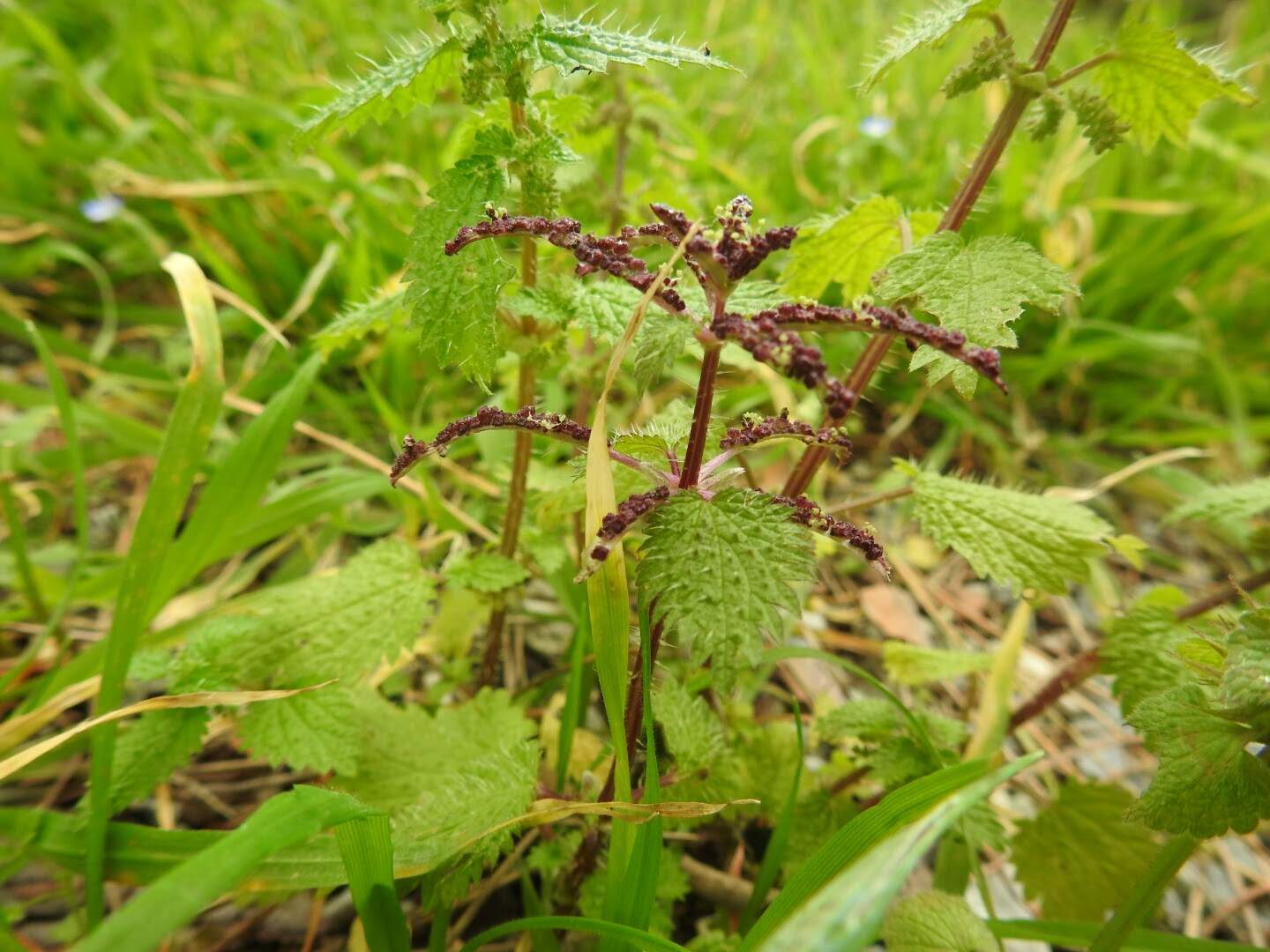
Annual herbaceous plant belonging to the family Urticaceae, it presents an erect and branched habit, generally between 20 and 30 cm tall, but can exceptionally reach up to 80 cm. The stem is grooved, angular, and covered with slight hairiness (hirsute), a characteristic that together with the presence of stinging hairs makes the plant stinging to the touch.
The leaves are medium-large in size, with an ovate or lanceolate blade, about 15-30 mm long and 18-30 mm wide, with a cordate or rounded base and a serrated margin with 8-15 teeth per side. The petiole is approximately the same length as the blade and at its base there are two ovate-lanceolate stipules, fused in pairs, giving the appearance of two bidentate stipules. The upper surface of the leaves is covered with stinging hairs, while the lower surface is moderately hairy.
The inflorescence is scapose, consisting of unisexual racemes, monoecious in most cases, although occasionally hermaphrodite or dioecious flowers may appear. The male racemes are longer than the petiole, often protruding and located at the apex of the stem; they have a flattened axis widened on the sides by characteristic membranes, with flowers arranged unilaterally on the upper side and greenish with violet shades. The female racemes, on the other hand, are shorter than the petiole, cylindrical in shape, positioned lower and inserted in an axillary position.
The flowers are small, greenish, and monochlamydeous, with a membranous perianth composed of 4 segments: the male ones are subequal, elliptical, pubescent, and with 4 protruding stamens, while the female ones have 4 unequal segments, with the two inner ones larger, glabrous, and a superior unilocular ovary with a capitate and subsessile stigma.
The fruit is an ovoid, compressed, and shiny achene (schizocarp), wrapped by the two inner accrescent parts of the perianth.
Habitat and distribution
A typical species of Mediterranean regions, it is mainly distributed along the southern Atlantic and Mediterranean coasts, with documented presence in several Italian regions, including Liguria, Tuscany, Campania, and Sicily. It frequently grows in ruderal environments, on nitrophilous soils, uncultivated areas, and near walls and ruins up to an altitude of about 1000 meters.
It prefers sunny or partially shaded positions and well-drained soils, often disturbed by human activity, where it acts as a weed. Its distribution also extends to some coastal areas of France (Pyrénées-Orientales, Gard, Bouches-du-Rhône, Var, Alpes-Maritimes) and Corsica.
Flowering period
The flowering period extends from March to August, with some variability linked to climatic and geographic conditions. During this period the plant produces its characteristic unisexual racemes, thus ensuring reproduction even in environments with different ecological conditions.
Ecology and pollination
The species is predominantly monoecious, with male and female flowers separated on the same plant, although hermaphrodite or dioecious flowers may occasionally appear. The flowers are small, inconspicuous, and lacking a strong scent, indicative of predominantly anemophilous (wind) pollination.
The unilateral arrangement and membranous structure of the floral axis, typical of the male racemes, facilitate pollen dispersal by the wind. The fruit, a light and shiny achene, is dispersed mainly by gravity and through small animals or human agents, contributing to the rapid colonization of disturbed environments.
Curiosities and traditional uses
The Mediterranean Nettle is a plant with several medicinal properties and traditional uses. The leaves, once boiled to neutralize the stinging hairs, are used in cooking to prepare fillings, omelets, and side dishes, especially in southern Italian regions.
From a medicinal point of view, the species is known for its emmenagogue, anti-inflammatory, and remineralizing properties. Traditionally, in Southern Italy, it has been used to relieve cough and angina. Furthermore, it has been used in animal feeding: mixed into chicken mash it would increase egg production, while included in the diet of cows it would increase milk production.
It is important to emphasize that these uses are to be considered traditional and of ethnobotanical interest, and should not replace professional medical advice.
Etymology
The generic name "Urtica" derives from the Latin urere, meaning "to burn," referring to the painful sensation caused by the stinging hairs present on the plant. The specific name "membranacea" refers to the characteristic membranes present in the inflorescence axis and in the perianth segments, which are thin, membranous, and clearly visible in the male inflorescences.
The Italian common name "ortica membranosa" reflects precisely this distinctive morphological characteristic that differentiates it from other nettle species.
Sources
- Prof. S. Pignatti, Flora d’Italia, Edagricole, Bologna 1982
- Acta Plantarum – Flora delle regioni italiane (scheda di Giuliano Salvai)
- Tela Botanica / H. Coste, Flore descriptive et illustrée de la France
Characteristics
Scheda botanica
| Famiglia | Urticaceae |
|---|---|
| Fioritura | tutto l'anno |
| Forma biologica | Scapose |
| Habitat | stinging plant, annual plant |
| Tossicità | Tossica — non consumare |
Domande frequenti
- Quando fiorisce Mediterranean Nettle?
- Mediterranean Nettle fiorisce tutto l'anno.
- È tossica Mediterranean Nettle?
- Mediterranean Nettle è una pianta tossica o velenosa. Non consumare nessuna sua parte senza aver consultato un esperto.
- Che tipo di pianta è Mediterranean Nettle?
- Mediterranean Nettle è una Therophytes (Scapose) secondo la classificazione di Raunkiaer.
- A quale famiglia appartiene Mediterranean Nettle?
- Mediterranean Nettle appartiene alla famiglia botanica Urticaceae.
Where I found it (1 sightings)
Classification
- Kingdom
- Plantae
- Family
- Urticaceae
- Full name
- Urtica membranacea Poir. ex Savigny
- Life form
- Therophytes scapose
Similar species
Search for species with similar characteristicsFurther reading
Noticed an error in the identification? Write to me
Other species of the same family
Urticaceae
Explore
Other species of Urticaceae