Botanical family
Urticaceae
Description
Botanical characteristics
The Urticaceae are a family of predominantly herbaceous plants, including both annual and perennial species. The plants can be monoecious, dioecious, or polygamous, generally herbaceous in habit but occasionally also shrubby or lianous. The leaves vary in size, are simple and arranged alternately or oppositely, sometimes with stipules, sometimes without.
The flowers are small, generally unisexual or hermaphroditic, arranged in often inconspicuous inflorescences. The male flowers have 3 or 4 stamens opposite the perianth lobes, while the female flowers have a superior unilocular ovary. The perianth consists of 3-4 sepal-like segments, which may be free or fused together. The fruit is an achene, covered by the remains of the calyx, a distinctive character of the family.
One of the best-known characteristics of Urticaceae is the presence, in some species such as nettle, of stinging hairs that release irritating substances upon contact.
Distribution and diversity
The family Urticaceae includes about 50 genera and about 1300 species, with a worldwide distribution. They are mainly widespread in humid tropical regions, but are also found in temperate and Mediterranean areas, absent in arctic regions. In Italy, the family is represented by some well-known and widespread genera.
Main genera and representative species
Among the most important and widespread genera in Italy are:
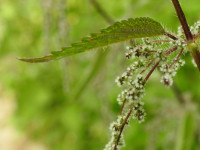
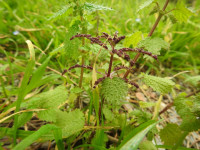
- Urtica: the best-known genus, which includes common nettle (Urtica dioica), famous for its stinging hairs.
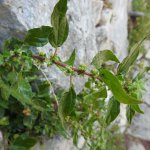
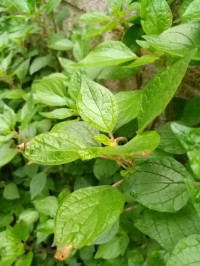
- Parietaria: includes species such as Parietaria judaica and Parietaria officinalis, herbaceous plants common in urban and rocky places.
- Soleirolia: genus that includes species used for ornamental purposes, such as Soleirolia soleirolii.
- Boehmeria: genus naturalized in Italy, less common but present especially in temperate areas.
These genera represent the best-known species in the Italian territory and are important for local ecology and biodiversity.
Etymology
The name of the family derives from the genus Urtica, a Latin term indicating nettle, a characteristic plant and symbol of the family itself. This etymology highlights the importance and recognizability of this genus within the entire family.
Sources
- Wikipedia
Species of the family
4 species catalogued
Explore
Other botanical families