Botanical species
Parietaria judaica
L.
Pellitory-Of-The-Wall
Description
Morphological description
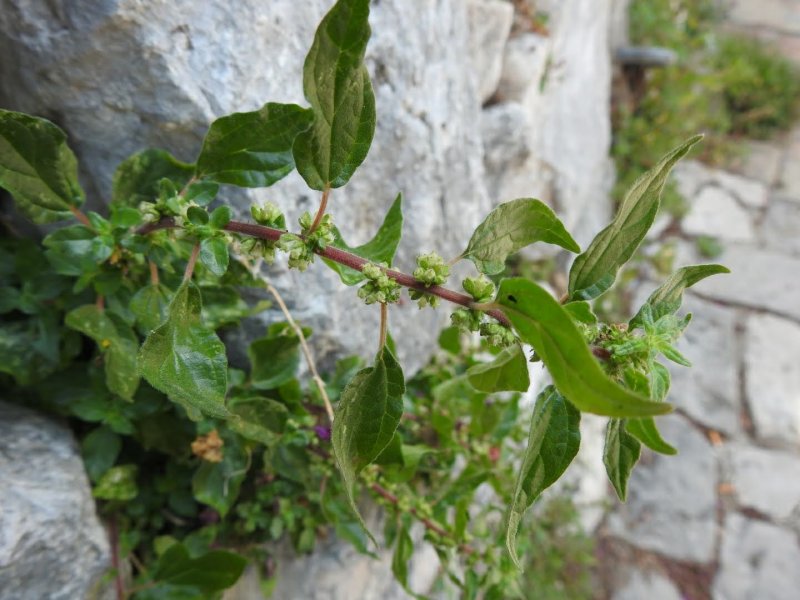
Perennial herbaceous plant generally 20 to 40 cm tall, with a prostrate habit and cylindrical stems, woody at the base and branched. The stem is often reddish and has a sparsely pubescent surface. The root system consists of a short rhizome that allows perennation and the emission of new shoots at ground level.
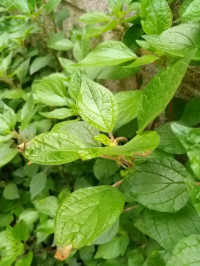
The leaves are alternate, simple, elliptic-acuminate in shape, with a smooth margin and herbaceous texture. Leaf size varies from 10-15 mm up to 30 mm, with a petiole 5-10 mm long; the upper surface is darker and the lower paler, both are hairy with non-transparent veins. The petiole is filiform and also covered with hairs.
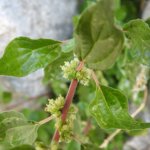
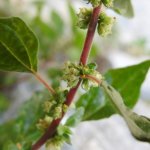
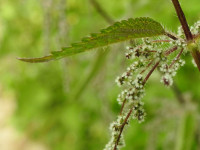
The inflorescence is short and few-flowered, consisting of flowers arranged in axillary glomerules, with a scapose habit, meaning the floral axis is elongated and often leafless. The flowers are small, 2-4 mm, apetalous and of variable color from greenish-white to purple. They are both hermaphroditic and unisexual; the hermaphroditic flowers are numerous and have fine, sometimes hooked hairs, while the female flowers are rarer and have lanceolate, acute and densely pubescent lobes. Each flower is subtended by four bracts united at the base.
The perigonium generally has a tubular shape about 2 mm long, which elongates up to 3-4 mm after flowering. There are four stamens, with an ellipsoid monocarpellary ovary and a deciduous penicillate stigma.
The fruit is an achene (dichlamydeous), simple and indehiscent, ovoid in shape, black and shiny, 1-1.3 mm long, covered by the persistent perianth. The surface is smooth and glossy.
Habitat and distribution
This species is typical of the Mediterranean basin and Macaronesia, with widespread distribution in Italy and Mediterranean regions. It grows mainly in anthropized environments, colonizing cracks in vertical walls, walls, rubble and road edges. It prefers sunny exposures but can also tolerate moister conditions provided they are rich in nitrates.
The growth altitude ranges from plains to moderate hill and mountain elevations, particularly in areas with very hot and dry climates. In Italy it is widespread, although more frequent in southern regions and the major islands, where it finds ideal conditions for its development.
The preferred substrate is calcareous or rocky, often in the presence of poor and unstable soils, typical of degraded urban and rural environments.
Flowering period
Flowering extends over a long period, from January to December, allowing continuous production of flowers and pollen throughout the year. This long flowering phase is favored by the mild Mediterranean climate, with slight geographical variations related to altitude and exposure.
Ecology and pollination
Pollination is mainly anemophilous, i.e., wind-mediated. The plant produces large amounts of pollen, which can cause allergic reactions in sensitive individuals. Although belonging to the Urticaceae family, the hairs present on the plant are not stinging.
Seed dispersal occurs through the fruits, which thanks to their light and resistant structure can be carried by wind or external agents. Perennation occurs through the rhizome, which allows the plant's survival and regeneration even in difficult conditions.
Curiosities and traditional uses
Historically, Pellitory-Of-The-Wall has been used in herbal medicine and folk medicine. The name veterina refers to ancient beliefs about its therapeutic properties, such as the ability to “break stones” and thus facilitate the expulsion of kidney and bladder stones.
The plant's juice, mixed with honey, was used to soothe coughs, relieve various pains and prevent hair loss. Moreover, like other species of the genus Parietaria, it is known for its diuretic properties, useful in treating urinary tract diseases and respiratory infections.
The plant is also considered edible and can be used in cooking, although in moderation.
Etymology
The generic name Parietaria derives from the Latin páries, paríetis, meaning “wall” or “partition”, referring to the species' typical habitat, which frequently grows on walls and rocky walls. The specific epithet judaica indicates Judea, a historical region of southern Palestine, where Linnaeus originally observed and described the plant.
The Italian common name “vetriola minore” refers to its similarity with other species of the genus, distinguishing it by size and habit.
Sources
- Acta Plantarum - Flora delle regioni italiane (scheda di Roberta Alberti)
- World Flora Online (WFO)
Characteristics
Scheda botanica
| Famiglia | Urticaceae |
|---|---|
| Fioritura | tutto l'anno |
| Forma biologica | Scapose |
| Habitat | with white flowers, edible plant, Perennial plant |
| Uso alimentare | Commestibile |
| Uso officinale | Pianta officinale |
Domande frequenti
- Quando fiorisce Pellitory-Of-The-Wall?
- Pellitory-Of-The-Wall fiorisce tutto l'anno.
- È commestibile Pellitory-Of-The-Wall?
- Pellitory-Of-The-Wall è considerata commestibile. Verifica sempre le parti eduli e la preparazione corretta prima del consumo.
- Che tipo di pianta è Pellitory-Of-The-Wall?
- Pellitory-Of-The-Wall è una Hemicryptophytes (Scapose) secondo la classificazione di Raunkiaer.
- A quale famiglia appartiene Pellitory-Of-The-Wall?
- Pellitory-Of-The-Wall appartiene alla famiglia botanica Urticaceae.
Where I found it (3 sightings)
Classification
- Kingdom
- Plantae
- Family
- Urticaceae
- Full name
- Parietaria judaica L.
- Synonyms
- Parietaria diffusa Mert. & W.D.J.Koch
- Life form
- Hemicryptophytes scapose
Similar species
Search for species with similar characteristicsFurther reading
Noticed an error in the identification? Write to me
Other species of the same family
Urticaceae
Explore
Other species of Urticaceae