Botanical species
Urtica dioica
L.
Stinging Nettle
Description
Morphological description
Perennial herbaceous plant, dioecious (with distinct male and female individuals), which can reach a height between 40 cm and 1 meter. The habit is erect, with robust stems, simple or slightly branched, angular in cross-section and grooved in the upper part. The stem has a hirsute surface, often covered with stinging hairs, which give the plant the characteristic unpleasant sensation to the touch. The root system is formed by woody and stoloniferous rhizomes, allowing rapid expansion and the formation of dense colonies.
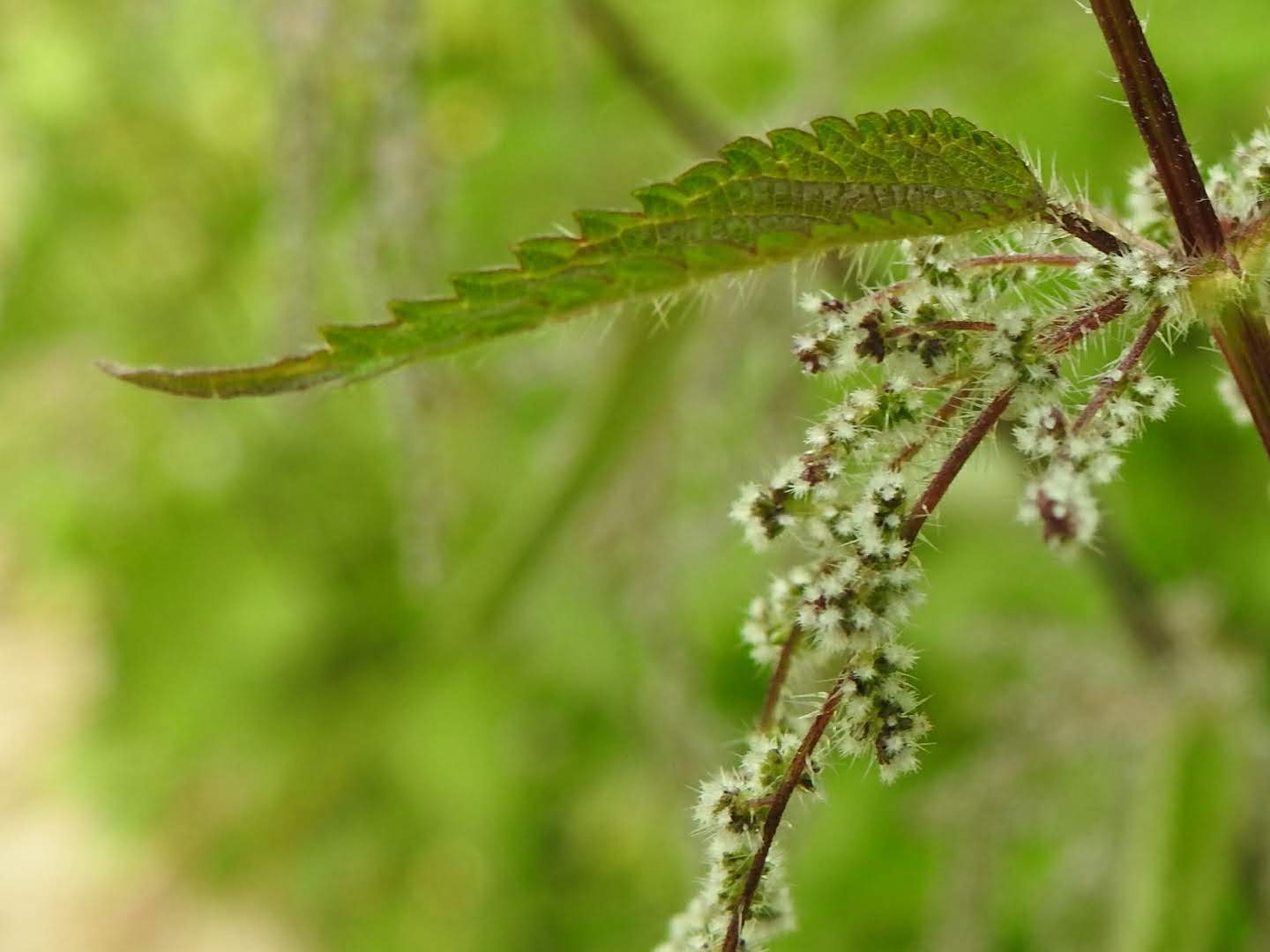
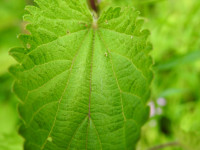
The leaves are opposite, petiolate, lanceolate or ovate-lanceolate in shape, with variable sizes generally between 5 and 13 cm in length and 2.5-6 cm in width. The base of the blade is typically cordate or slightly truncate, the margin is coarsely toothed or serrated with teeth often curved at the apex. The upper surface of the leaves is normally covered with stinging and bristly hairs, while the lower surface has a higher density of hairs, especially along the veins. The free stipules are linear-lanceolate, 2-8 mm long.
The inflorescences are paniculate racemes, axillary, 3-7 cm long, with small, minute, yellow-greenish or whitish flowers. The male flowers have four pubescent tepals and stamens with stinging hairs; the female ones have pubescent tepals with feathered and capitate stigmas. The female inflorescences tend to hang during fruiting. The fruit is an ovoid achene, slightly laterally compressed, 1-1.4 mm, wrapped by the persistent tepals of the flower, brown-grayish in color.
The plant shows considerable morphological variability, with some varieties characterized by different density and type of hairs (for example, almost glabrous plants or with simple appressed hairs). In some areas, such as Sicily, forms with prostrate stems and smaller leaves are observed, which deserve further taxonomic studies.
Habitat and distribution
It is a widely distributed species in Italy and the Mediterranean basin, also extending into the temperate regions of almost the entire globe. It prefers humid and nutrient-rich environments, such as moist woods, riverbanks, hedges, uncultivated areas, path edges, and disturbed soils. It grows from the plains up to hill and submontane elevations, generally up to about 1000 meters altitude.
Preferred soils are rich in nitrates and organic matter, often disturbed or rich in debris, with exposure from partially shaded to shaded, especially along watercourses or in forested areas. The plant adapts to a wide range of environmental conditions, often becoming invasive in some areas.
Flowering period
Flowering mainly occurs between May and November, with a summer peak that can extend into autumn. In some areas and milder climatic conditions, flowering can also extend from June to October. The duration and intensity of flowering may vary slightly depending on altitude and latitude.
Ecology and pollination
The species is dioecious, with male and female flowers on separate plants, although occasionally monoecious individuals or plants with hermaphroditic flowers appear. Pollination is mainly anemophilous (pollen transport by wind), but the intervention of pollinating insects attracted by the minute and inconspicuous inflorescences is also possible. The stinging hairs present on leaves and stem represent an effective defense against herbivory.
Seed dispersal occurs via light achenes, which can be transported by wind or animals. The stoloniferous rhizome also contributes to vegetative propagation, making the plant very expansive and sometimes invasive, especially in disturbed or nutrient-rich soils.
Curiosities and traditional uses
Stinging Nettle has been known since ancient times for its stinging properties, due to the presence of hairs containing irritating substances such as formic acid. Despite this, it has been widely used in folk medicine for its diuretic, anti-inflammatory, and remineralizing properties. The plant is rich in vitamins and minerals, particularly iron, and is also used in phytotherapy to treat rheumatic conditions, anemia, and skin problems.
In cooking, young leaves are harvested and consumed cooked, as a nutrient-rich vegetable, for soups, risottos, or omelets, after eliminating the stinging effect through cooking or drying. In some traditions, Stinging Nettle has also been used to produce strong textile fibers.
In folklore, Stinging Nettle has assumed symbolic meanings related to protection and purification, but also to pain and self-defense.
Etymology
The scientific name derives from the Latin urtica, which in turn comes from the verb urere (to burn), referring to the pungent and irritating sensation caused by the stinging hairs to the touch. "Dioecious" indicates the presence of male and female flowers on separate plants.
The Italian common name "ortica" preserves the same Latin root and recalls the typical stinging characteristic of the plant.
Sources
- Prof. S. Pignatti, "Flora d’Italia"
- Tela Botanica / H. Coste, "Flore descriptive et illustrée de la France"
- World Flora Online (WFO)
Characteristics
Scheda botanica
| Famiglia | Urticaceae |
|---|---|
| Fioritura | maggio – novembre |
| Forma biologica | Scapose |
| Habitat | spiny plant, stinging plant, Perennial plant |
| Tossicità | Tossica — non consumare |
Domande frequenti
- Quando fiorisce Stinging Nettle?
- Stinging Nettle fiorisce maggio – novembre.
- È tossica Stinging Nettle?
- Stinging Nettle è una pianta tossica o velenosa. Non consumare nessuna sua parte senza aver consultato un esperto.
- Che tipo di pianta è Stinging Nettle?
- Stinging Nettle è una Hemicryptophytes (Scapose) secondo la classificazione di Raunkiaer.
- A quale famiglia appartiene Stinging Nettle?
- Stinging Nettle appartiene alla famiglia botanica Urticaceae.
Where I found it (10 sightings)
Classification
- Kingdom
- Plantae
- Family
- Urticaceae
- Full name
- Urtica dioica L.
- Synonyms
- Urtica dioica L. subsp. pubescens (Ledeb.) Domin; Urtica dioica L. var. heterophylla Goiran; Urtica dioica L. var. microphylla Hausm.; Urtica dioica L. var. pseudo-balearica Lojac.; Urtica galeopsifolia Opiz; Urtica pubescens Ledeb.; Urtica sicula Guss.
- Life form
- Hemicryptophytes scapose
Similar species
Search for species with similar characteristicsFurther reading
Noticed an error in the identification? Write to me
Other species of the same family
Urticaceae
Explore
Other species of Urticaceae